AI. Learning Dye Transfer

give it a try. If you know the answers well enough AI chat answers will amuse, or frustrate. The answers the at hand models provide are based upon web posts and link count results which are somewhat circular. The answers provided are incomplete, sounding much like a salesman taking over the help desk during lunch. Or, good enough for an interview, but falling far short of being able to make prints in a commercial lab. But why?
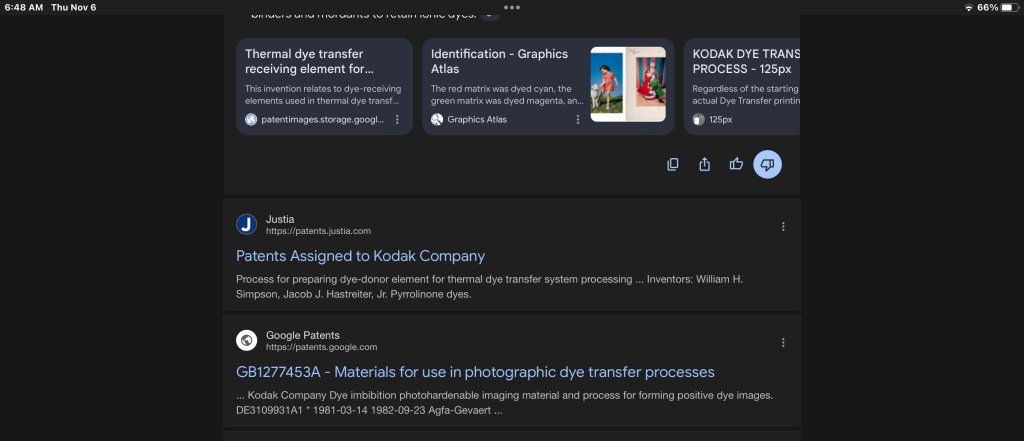
Ask google for dye transfer patents …. they fail

The models seem to have been trained using data collected from internet forums along with, at most, 4 website collections of publications from the 80s. In short, they don’t go back to origins, far enough to source matterials; worse, they don’t detail steps or stages of the process that would be recognizable to a practitioner, nor are they specific enough for the novice seriously intent on reproducing the process.

I asked general questions — most models got close enough for a high-school paper. The more specific I got, the less useful their responses.

my dye transfer chats were with these models as well as Google’s browser version. It was most dependent upon websites which meant that the more detailed my request the less accurate the response. Google’s link valuation system presents the problem of knowledge transfer remaining among those with little direct experience in the hobby fields.

As of this point [Nov 6, ’25 ] I am hesitant to post any direct results… as many of the Models say … bubble, bubble, thinking… bubble.

When asked for references used in answering me, it answered with seemingly plausible references. At least until I checked, first the patent, next two journals … I stopped with those non-existent materials. Who would check? Who, other than me, has the time as well as prior knowledge to even attempt the test, verification cycle.

The bubble is worse than financial.

Peaceful Bliss Day

hello Margaret are you still here ?

reminder it wasn’t the first bliss day missed, and it won’t be the last. Fearsome hunger fuels the inkwells, collection plates and ballot boxes of our empty passageway.

We know that people can maintain an unshakeable faith in any propositions, however absurd, when they are sustained by a community of likeminded believers. — Daniel Kahneman (1934-2024)


[The Great Disappointment in the Millerite movement was the reaction that followed Baptist preacher William Miller’s proclamation that Jesus Christ would return to the Earth by 1844, which he called the Second Advent. His study of the Daniel 8 prophecy during the Second Great Awakening led him to conclude that Daniel’s “cleansing of the sanctuary” was cleansing the world from sin when Christ would come, and he and many others prepared. When Jesus did not appear by October 22, 1844, Miller and his followers were disappointed


published in 1956, detailing a study of a small UFO religion in Chicago called the Seekers that believed in an imminent apocalypse. The authors took a particular interest in the members’ coping mechanisms after the event did not occur, focusing on the cognitive dissonance between the members’ beliefs and actual events, and the psychological consequences of these disconfirmed expectations.

‘During his lifetime, many of his adherents believed that he was the Messiah. ‘
[The concept of the Messiah is central to Judaism, representing an anticipated savior and bringer of universal peace and justice. Expected to restore Israel and gather in the Jewish diaspora, the Messiah is often linked to the Davidic lineage as foretold in the Hebrew Bible. Over centuries, beliefs about the Messiah have shaped Jewish Life.

Since Schneerson’s death in 1994, some followers of Chabad have persisted in believing in him as the messiah. Chabad messianists either believe Schneerson will be resurrected from the dead to be revealed as the messiah, or go further and profess the belief that Schneerson never died in 1994 and is waiting to be revealed as messiah. 

[“He will soon rise!” they proclaimed. Others said, “He’s not really dead. This is just a test for our physical eyes.” Some even camped out near his gravesite, waiting for his resurrection]

T’chiyat Hameitim is a core tenet of traditional Jewish theology, referring to the revival of the dead, the physical body being reunited with the soul during the Messianic Age. The Resurrection of the Dead is considered the 13th cardinal principle of Judaism. 

Does this mean that Judaism and Christianity remain the same?

and what’s this got to do with Art ; well, what does Art have to do with belief . From much to everything — 0 to 1’finity. belief guides choice . Artists are foundational; here before counting..ANd, artists don’t kill other artists; don’t round them into camps; don’t make claim and lay waste to each other. artists don’t make barbed wire 

At least not yet.

The chosen, accountants, automated their job . now, the chosen, programmers automate their job . The task of AI isn’t imagination it’s duplication, regurgitation and AI can only eat the digitized .

Certitude is not the test of certainty. — Oliver Wendell Holmes, Jr. (1841-1935)