every kitchen of an accomplished cook has a long running pot of something. That is called the soup.
The lab world evolved addressing more problems of production, not just the obvious one. Making food to taste meant knowing the taste. This is learned by trial after trial. Commercial kitchens make more meals, and better meals than most home cooks.
Terms from the times:
Brownprint — what the Kodalith paper made. Meant as guide and softproof.
Early scanners: RCA CombiScanner. PDI Scanner. Fairchild Scan-A-Color. Crossfield Scanatron. These were available in the mid 70s.
But revolutions never happen once. The 70s were a revision of problems, not the full solution. Photography had to be replaced. The scanner is just a technical aid to continuing a past. A resuscitator.
Big differences between the professional cook and the home cooker. Professionals don’t spend time gossiping about the difficulties; rather, they talk about the possibilities.
Knowledge stays in the fog of the past. Terminology that changes isn’t written in dictionaries of the future. Since those who use the term have left the field, those who were never in the field, those who weren’t trained or apprenticed, the story of original meaning, that of direct relationship, those people no longer enforce the meaning.
A crossover was a place, a part in a machine. Just as film machines at a place where the racks could be pulled out or pushed back into the line for additional processing. Pulling or processing from the soup.
Upon the diminution of film as primary image former, commercial labs ceased. Small labs can survive in small markets, erratic markets; dead cat bounces feed a starvation diet.
What (who) remains: people who could have worked in the big time but chose to take a hobby land approach. They learned from the magazines… those who don’t understand the process, those who look for why it won’t work; like a poorly trained law-clerk.
These people hear a word, and cling to the new found term, in hunger for a position of knowledge among others in the darkening room. They apply it widely. To almost every approximation, the word can be fit, it will be chived into use.
Kodak filters for flashing
Filter
Color
Purpose
47 or 47B
blue
reduce yellow density in print
44A
cyan
reduce red density
58
green
reduce magenta density
32
magenta
reduce green density
25 or 29
red
reduce cyan density
32
yellow
reduce blue density in print
effect of color flashing
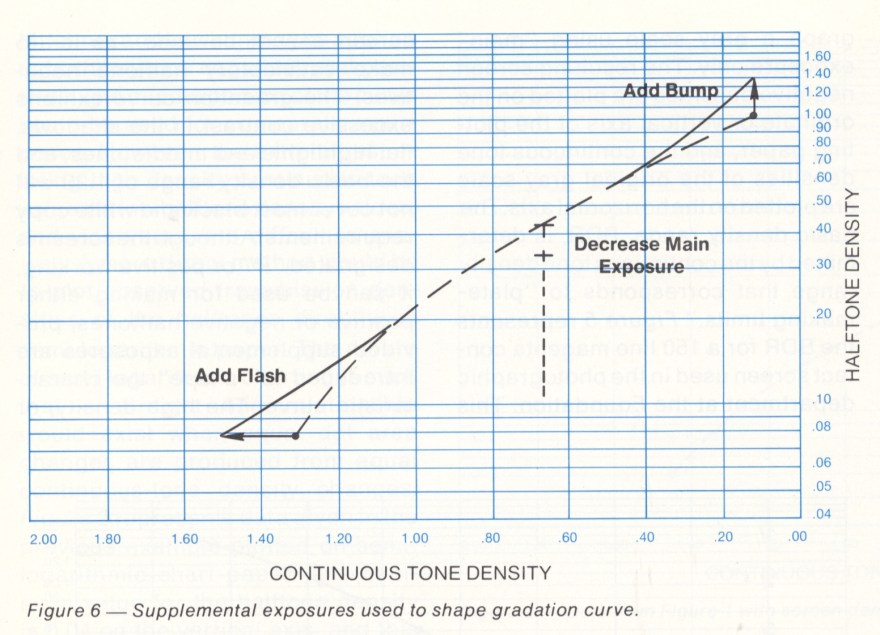
Darkroom lab exposure have 3 stages of exposure possible. Think of them as being in relation to sequence of exposure to the unprocessed emulsion. An exposure before the image exposure, the image forming exposure, and the last being after the image has been exposed. These exposures combined are used to shape the curve shape of the finished image. This method was a key skill in pre-press labs. It was also used by commercial dye-transfer labs to a lesser degree, mainly because few labs had staff skilled in both commercial processes. Industry divided the knowledge into market segments, not the schools.
bump [HL] exposure is short exposure without mask or screen
flash [S] exposure is short exposure prior to copy, mask, or screen.. also a Raw, or Blank exposure
main exposure controls location of midpoint as well as mid-tone scale. Developing is used to provide range of these scales.
In practice, this required multiple (2, or 3) light sources. One was the enlarger, the other(s) were lamps, likely modified to hold filters. In the typical shop, with such a setup, we routinely altered the crossover points of a characteristic curve.
It wasn’t a bad thing, it was routine, controlled, essential…



You must be logged in to post a comment.