bookshelf: Critical Notes

books I’ve taken from the shelf many times. Fewer times these days, this century. We’ve much more to read; work of equal depth as these early ones — these are things to read so that you’ve a foundation to react to this century’s writings.

They fear that writing, thinking will clarify their work, making it less creative. That they are also the ones who talk for years about techniques they have never done; they have a bucket list that could fill a pool. Hating art school goes along– too expensive; I already know how to use a camera.


By Non-photographers… does that make them useless, irrelevant — wrong?

  • Camera Lucida / Roland Barthes ::{1980] the “spectrum” He moves from the objective to the subjective. he book develops the twin concepts of studium and punctum: studium denoting the cultural, linguistic, and political interpretation of a photograph, punctum denoting the wounding, personally touching detail which establishes a direct relationship with the object or person within it.
  • On Photography / Susan Sontag. essays that appeared in the New York Review of Books between 1973 and 1977. [1977] establish within people a “chronic voyeuristic relation to the world.” 1998 appraisal of the work, Michael Starenko, wrote in Afterimage that “On Photography has become so deeply absorbed into this discourse that Sontag’s claims about photography, as well as her mode of argument, have become part of the rhetorical ‘tool kit’ that photography theorists and critics carry around in their heads.”

By photographers.. are these more useful. Has writing ruined their photography. Why didn’t they just “let their photographs do the talking”

Minor White … reviewing
  • Photographers on Photography, Nathan Lyons,[Abbott, Adams, Bruguiere, Bullock, Callahan, Coburn, Demachy, Emerson, Frank, Lange, Moholy-Nagy, Man Ray, Robinson, Siegel, siskind, Henry Smith, Eugene Smith, Steichen, Stieglitz, Strand, Weston, White]
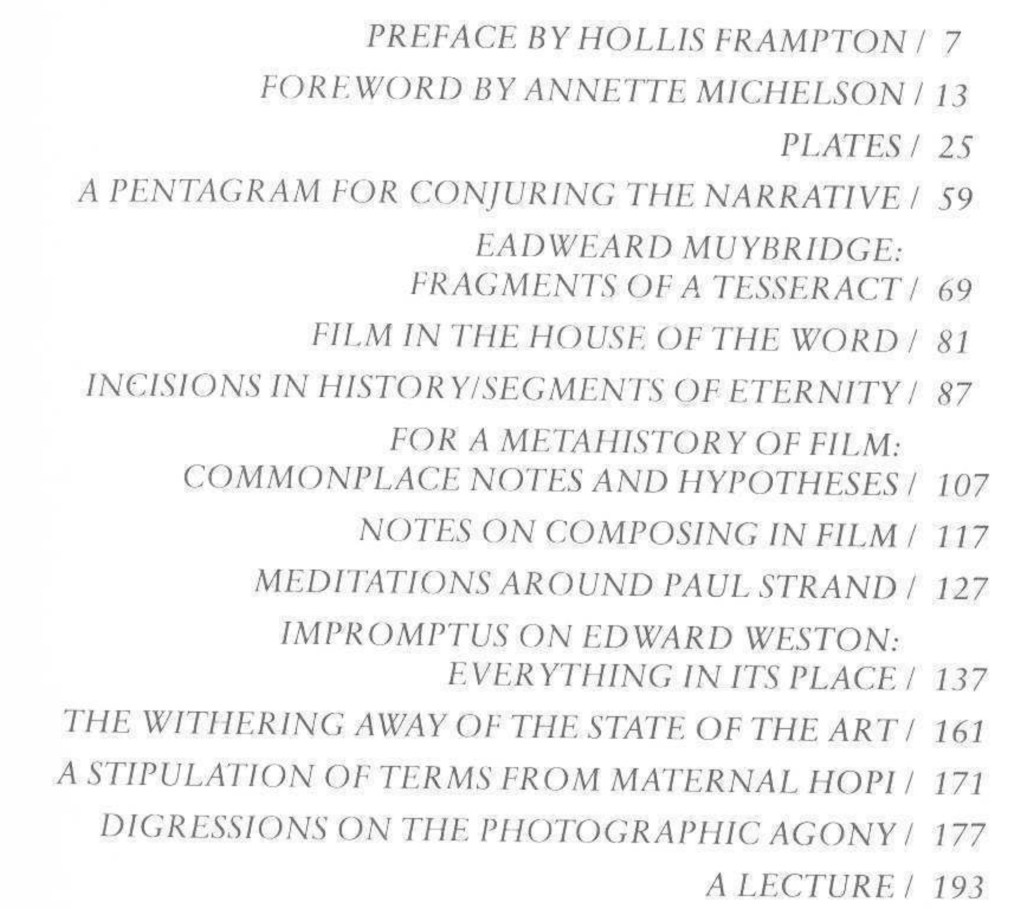
  • Circles of Confusion, Hollis Frampton. 1983
  • The Photographer’s Eye, John Szarkowski,1966. The Thing Itself, The Detail, The Frame, Time, and Vantage Point
    “This book is an investigation of what photographs look like, and of why they look that way. It is concerned with photographic style and with photographic tradition: with the sense of possibilities that a photographer today takes to his work.”
  • Looking at The Photographs / John Szarkowski, 1973. 100 Pictures from the Collection. [features Linda C, I was her first TA at SFAI. thanks Margery]

Words can’t take away from a worthwhile image anymore than they can bolster a worthless one. Fearing words is a crutch of someone unable to think. It is certainly not a requirement that a visualist also be an author, or philosopher. It is just unlikely that they are also unable to engage the history without using engaging their mind.

… an endless topic..

Guides to Other Land

as we divide, we find ourselves in groups gathered behind different dead. This can be illustrated with tales of two deaths – who notices, how, why.

Some deaths are noticed widely – even by those who did not know the person. Who you notice in death, who makes an absence also made a presence in your life; made a contribution to you even though they may not have known you, acknowledged you while they lived. These people are likely your guides – your markers.

We can know a group by noting who they notice even more than what they talk about. In major matters of life the ends of are the points observed and commemorated. Deaths are noted with encomiums – some sincere, some superstitiously just noted with RIP.

Simultaneous “worlds” of photography operate with relative autonomy. Sociologists and communications researchers studying photography have revealed distinctive spheres of activity in which work routines, photographic styles and evaluative standards differ sharply (Becker 1982; Chalfen 1980; Christopherson 1974a and 1974b; Musello 1980; Phillips 1982; Rosenblum 1978; Schwartz 1983)

Robert Frank  (November 9, 1924 – September 9, 2019) 

On the day Robert Frank died, much of the artworld was publishing obits, showing photos of gatherings at his New York studio. As social networks sprouted tributes ranging from selfies to full scale ZZZ the other world talked of lens standards and standardized images.

Film Forum topics 9.9.2019

Bruce Barlow (June 9, 2019)

They get as far as a Workshop. Characteristically they don’t notice the death of their other online counterparts.

The artworld notices one another — the Snobby Hobby notices the price of cameras.

why did the forum Crossover

an overnight. Not every error is the same error; not every color error is a crossover. Most aren’t.

separations. telling theory from experience. the cowboy from the hat

pigment diameters: a pigment isn’t a colorant of a fixed size. It doesn’t have to “fail to fit thru those tiny nozzles” in a jet printer to be a pigment. That test is a failure to thrive in a learning world.

[the green curve on the right is crossing over the blue curve] If it could be shifted to the right…

Structural pigments don’t have color.

A dye is a colorant which is molecularly dispersed or solvated by a carrier. The carrier can be a liquid or a solid at room temperature. A commonly used carrier is water or a mixture of water and organic co-solvents. Each individual dye molecule is surrounded by molecules of the carrier. In dye-based inks, no particles are observable under the microscope.

Pigments are colored, black, white or fluorescent particulate organic or inorganic solids which usually are insoluble in, and essentially physically and chemically unaffected by, the vehicle or substrate in which they are incorporated. They alter appearance by selective absorption and/or by scattering of light. Pigments are usually dispersed in vehicles or substrates for application, as for instance in the manufacture or inks, paints, plastics or other polymeric materials. Pigments retain a crystal or particulate structure throughout the coloration process.” –CPMA – Color Pigment Manufacturers Association, Inc.

not a crossover. most of the green horns would think it was. this gif was made from two separate, seemingly balanced prints. at least the grey steps were correct.

The problem with pigment, carbon printers’ results are: Undercolor. undercolor — CMY have degraded, overlapped out of balance. UCR mask reduces these colors so that the K will be image content. Exposure controls amount removed. Soup the mask to a contrast that reduces in the shadow of the separation negatives.

mask is option in best match colorant sets.

the essential is matrix, dye, blank

masking is an aid to holding the Chrome for the paper

he was good at transferring information without killing imagination