Vactrol: Beseler Colorhead

being a technical talk that carries information as it raises questions about who you ask; how much attention they pay, even to themself. They have a solution, but they don’t recall it; they don’t expand upon the sources given them by simply using google. Or, they don’t go to the specialist boards, where the problem is small, the answer easy, including the “diy, make one yourself” complete with schematic and parts list.

A vactrol is an electronic component that was used in equipment designed when discrete was a word for separate components on circuit boards. That was during the time darkrooms were springing up across suburbs as well as small studios around the country.

Vactrol was a trademark of Vactec (1960s) for their analog optoisolators. These are a light source (neon lamp) directed at a LDR(light dependent resistor) sealed inside a ‘can’ — The resistor (LDR) changes values as the light source changes intensity. The neon bulb ones have been superseded by LED versions for decades.

“the slow reaction time, and the fact that a resistor is easy to integrate into analog circuitry, makes the vactrol a nice control device for analog modular stuff.”

Beseler Dichro 45 no light” OR “delay in timer-lamp on”

Is the problem heard on darkroom question boards. Two models for color printing: The Computerized, and the S. The vactrols were used to isolate the voltages and signal paths in the colorhead electronics. The Dichro (computerized) is a ‘closed loop’ system intended to maintain continuous color readout; even having memory modules to store settings for different emulsions or, ‘color gradings.’ More than a neutral, or flesh reading.

Looking at the board you will see two ‘silver cans’ — these are the likely problem. They should be labeled: VACTROL VTL 9B8. There are datasheets on the specialist boards for these items. They were superseded, in most applications, by VTL-5C3.
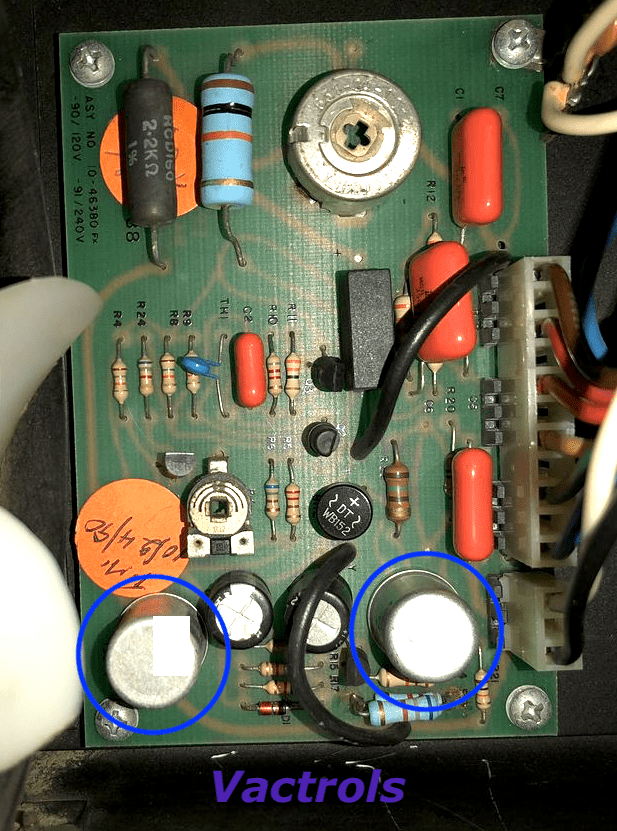
circuit board

The replacement is an upgrade; it is longer lasting than the original vactrol; in fact, much of the board can/should be upgraded with more recent components. Capacitors and connectors used in last century’s boards were rarely the best grade available. Upgrade using the VTL-5C3.

Reference Notes:

Beseler 45 Heads: Point-Light head $915; Dichro 45 $1,375; Dichro 45S $825; Condenser $1,042; Dichro (computerized) $2,175 [original prices]
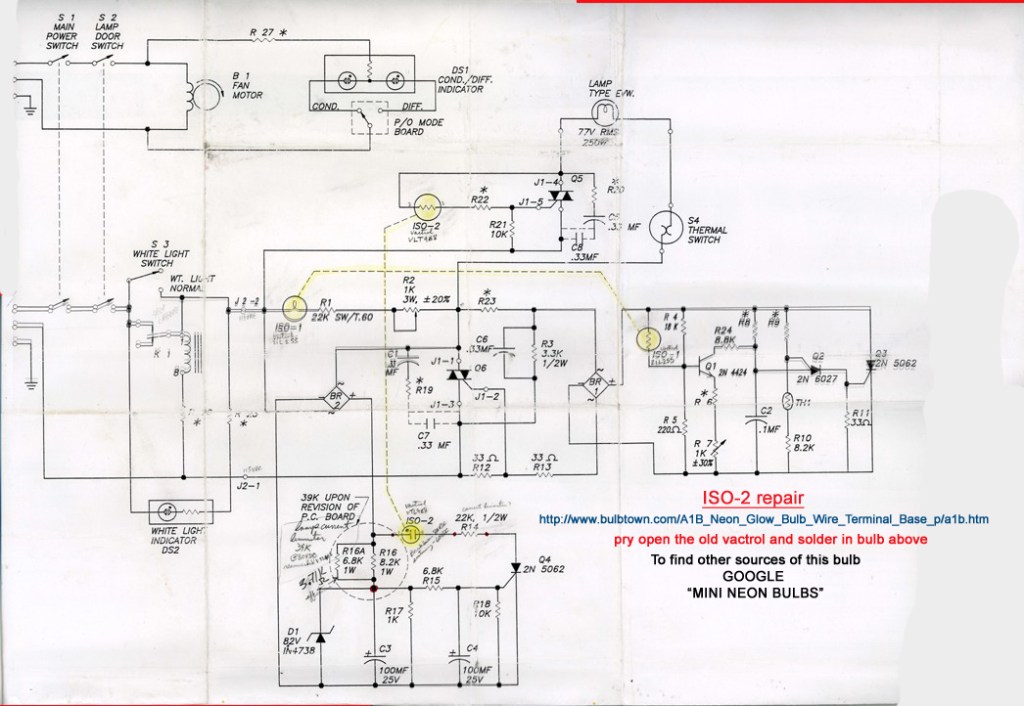
Beseler Colorhead Schematic [partial]

VACTROL VTL 9B8

Resistive opto-isolator – Wikipedia

Decoder Ring:

•Two-digit number — the max size of the negative it can accept (e.g. 23 is 2cm x 3cm, 66 is 6cm x 6cm, 45 is 4×5 inches, etc.) 
•M — electric motor to raise and lower the lamphouse
•C — Beseler colorhead (filter drawer type)
•R — Resistrol unit (variable voltage regulator)
•X — Rear support truss (extra reinforcement)
•AF — Automatic focus
•B — Beslite (flourescent cold-light head)
•AG — Beseler-Agra colorhead (continuously variable filter type)

Digital Is Way Easier

digital is easier. it is the dominant form of taking, and making.
people have an absurdly strong desire to do things the easiest way. ever wonder, really, how hard making pasta sauce is?
how about salad dressing; or a sandwich, yet daily billions are spent on some fast food, which isn’t fast, and is barely food, not because it is fast, but because it seems easy.
digital printing is far easier than darkroom printing. easier, and faster, meaning that for some very small set, they can make a print that is better than a very skilled darkroom printer. That probably isn’t you, in either case.

Links: BW Masking. film

A mask is a piece of film used to modify another piece of film. Simple enough. Masking is the process of making these masks. From the 40’s until the 90’s, masking suggested that you were doing color work; some type of assembly, or photomechanical process. Much of the literature was written with those commercial goals in mind. They taught the method of achieving reprographic standard.

The first methods of aligning, of registering the mask-set, relied upon steam and glycerin. Next step involved cut-n-butt, the optical alignment of the films. Lithographers introduced button registration in the 30’s, Technicolor introduced pinset registration.

In the 60’s the enlarger makers, Omega, Durst, etc. introduced “color separation enlargers” with pinsets. Condit( & Bregman) came on the scene after them. It seems nobody enforced the patents.

After the decline, actually the drop, of dye-transfer BW (monochrome) separation took root. Contrast reduction from the Ciba/R world was enlisted; however, much of the equipment that had been in the lab was being trashed during the early 90s.

Along came some avid believers. the market was small enough that the workshop world could become a market for a small scale business.

Contrast Reduction Masking —

LINKS

— Lynn Radeka https://www.radekaphotography.com/

https://www.freestylephoto.com/contrast-masking-the-traditional-print

EZ Note:

  • You can expose with either clear glass, a diffusing glass, or both. You can even put a thin glass between the two pieces of film to further decrease sharpness.
  • A good masking film has no AH layer or a minimum AH layer, and has a good quantity of acutance dyes in the emulsion itself. Pan Masking film was made just for this purpose and could be exposed either through the base or emulsion side.
  • Both highlight and contrast masks are similar, they just address a different part of the tone scale, if I read what you are saying right. And you can make one either sharp or unsharp depending on what you are trying to achieve. You can even combine several results into one mask, or you can use several masks together in registration. Lith masks are also nice to try, giving quite nice special effects.
  • In color, you can make separation masks for color correction that can also be unsharp if desired. They can also reduce contrast. Therefore, by this method a transparency can be printed on Ilfochrome and yield results equal to the best color negatives with the proviso that you always lose some tone scale in pos-pos printing due to the two toes and two shoulders of the materials you are dealing with.
  • Just make sure you keep everything in register with each other, so you don’t get really odd results.
  • BTW, a nice unsharp mask can be achieved by developing in Dektol 1:3 for 3 mins or by inspection to get a just visible image. Underexpose and develop for up to 3 mins (just about the right time for that developer) and you will have a very nice B&W unsharp mask.
  • Ron Mowrey