
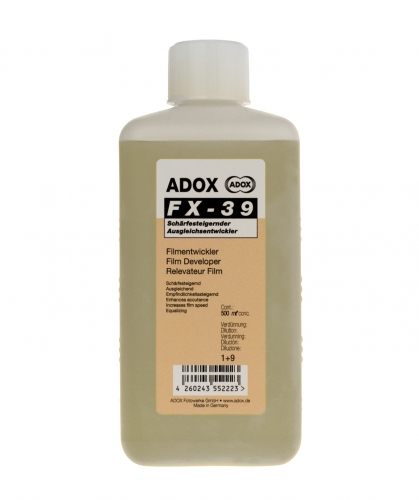
Adox has announced the return of FX39. [ old news]
The formula was originated by Geoffrey Crawley. FX39 is a one shot developer designed to be used at high dilutions for Delta and T-grain films. It was formulated for sale by Paterson, but they dropped it.
“FX-39 is based on Willi Beutler´s formula for Neofin Red, and further developed by Geoffrey Crawley. Makes very good use of the film’s full ISO-rating. ” [adox.de (11/’23) ]
“If grain is too fine, light scatter in the negative increases when a negative is enlarged, reducing edge contrast.” — Crawley
39 Is Not 37
The formula for FX39 is proprietary, but Geoffrey Crawley published a close cousin, FX37.
FX 37 fully exploits Phenidone’s speed enhancing properties. For most films, true speed is a half to two-thirds of a stop more than the manufacturer’s ISO.
STOCK SOLUTION
| Chemical | Amount | Units |
|---|---|---|
| Distilled Water | 750 | ml |
| Sodium Sulfite | 69 | g |
| Hydroquinone | 5 | g |
| Sodium Carbonate (anhy) | 5 | g |
| Phenidone | 0.5 | g |
| Borax (Sodium Borate) | 2.5 | g |
| Potassium Bromide | 0.5 | g |
| Benzotriazole , 1% Solution | 5 | ml |
| Distilled water to make | 1000 | ml |
USAGE
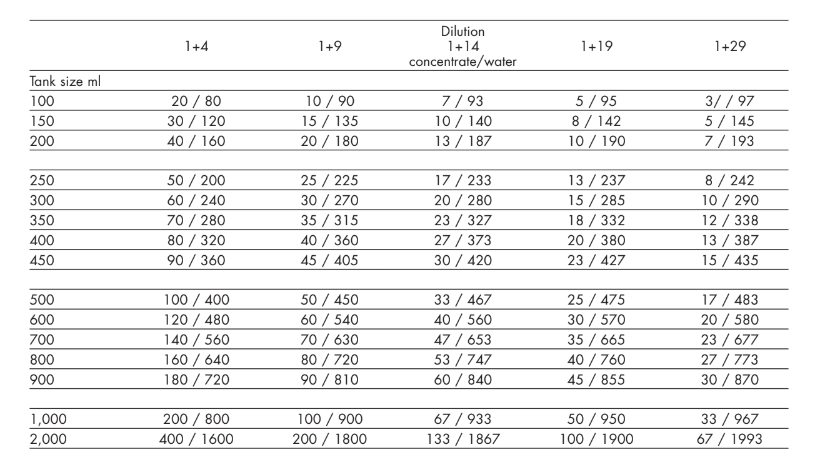
Dilute 1:3. Dilute 1:5 for longer developing times and increased film speed.
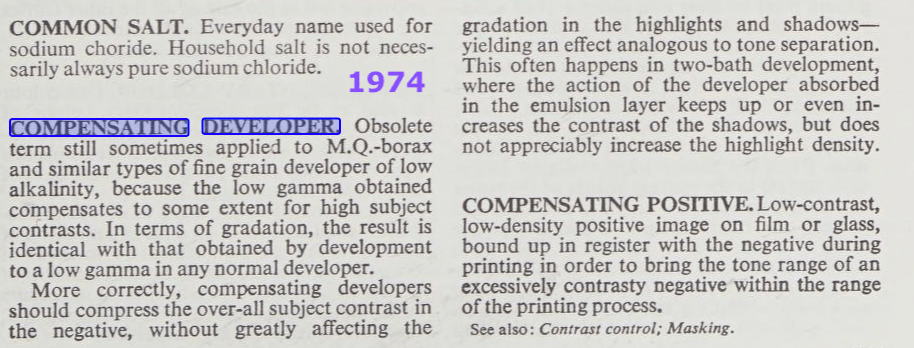
Notes on acutance and compensating developers. The exposure latitude of current emulsion permit such wide tone scale that there is room for considerable variation (errors) of exposure. Exposure can be used to move the subject tones up or down. Compensating developers were well suited to earlier emulsions with less latitude. Similarly, acutance developers came into wide, almost exclusive use with earlier roll-film emulsions.
“A high definition developer enhances chemically the edge effect between areas of adjacent tone, thus giving a visual sensation of higher definition. —Jeremy Haworth
Acutance is the objective correlate of sharpness. Harold Harvey advised tha PPD developers “Despite their fineness of grain, the images had extremely poor resolving power.” Beutler has written that developers high in a silver halide solvent results in unsharp negatives with loss of fine shadow detail near the emulsion surface. Keep the level of sodium sulfite at a level to act as a developer preservative. Grain :: sharpness can be modulated by varying the sodium sulphite amounts.
Double-coated emulsions have greater latitude; they may also provide greater gamma range as they provide longer straight line of HD curve. Thicker emulsions have more scatter — the gelatin is more turbid. These are why ‘thin-emulsion’ became popular during the influx of 35mm users after 1950. The search for greater acutance along with more compensation of range of exposures on a roll of film encouraged the search for improved developers.
With the invention of tab-grain (TMAX, Delta) films, the need for acutance developers has subsided. With Kodak’s TAMX films, they devised newer developers; Tmax RS and Xtol.
additional information: On D76 [use divided D-76, or 1:3 ]
===coming: notes on FX. on “scatter.” on acutance control.





You must be logged in to post a comment.