The Paper is Key

Ink, metal, chalk, or dye on paper, it is the paper that holds the “stuff of” and it also is the source of the light.

Albumin Printing: https://www.bostick-sullivan.com/product-category/alternative-process-kits/albumen-printing-process/

Or, albumin paper: https://analoginside.com/en/product/20-papeles-albuminados-85×11-216x277cm/

Unsensitized photo-paper: https://www.fotoimpex.com/brands/adox-art-baryta-241×305-cm-95×12-inch-50-sheets.html

Reflection requires smooth surface — smoother is more reflective. This provides higher “saturation” — the Dmax. The topmost covering produces the first and last light scatter. In photography of the Silver Gelatin type, this is Gelatin. Albumin has also been used. Many colloids have been tried in search of the perfect holder; that stuff with perfect properties — lasts, passes liquids, blocks gasses… No perfect single thing has been found — we live with a suited to purpose answer.

The ‘goo’ adds color– albumin is different color than gelatin. They age differently. As matter of cost,the albumen silver print uses more silver than the silver gelatin print

Make it smoother; get higher density. Gelatin seems our easy, cheap solution. That is what we have used at industrial scale since the 1930s. Keep the emulsion thin and smooth to achieve higher density.
The secret to Dye Transfer’s intense color isn’t due to the matrix nor the dyes but to the paper, one of the most protected secret of the process. That was the item causing Kodak to stumble in the 80s. The process of the mill was little understood by much of the Kodak elite.

Additional to coating is HOW you coat; the tool, coater, as well — how many coatings. Making the emulsion means controlling crystal size, dispersion and “layer” —
A Simple Question

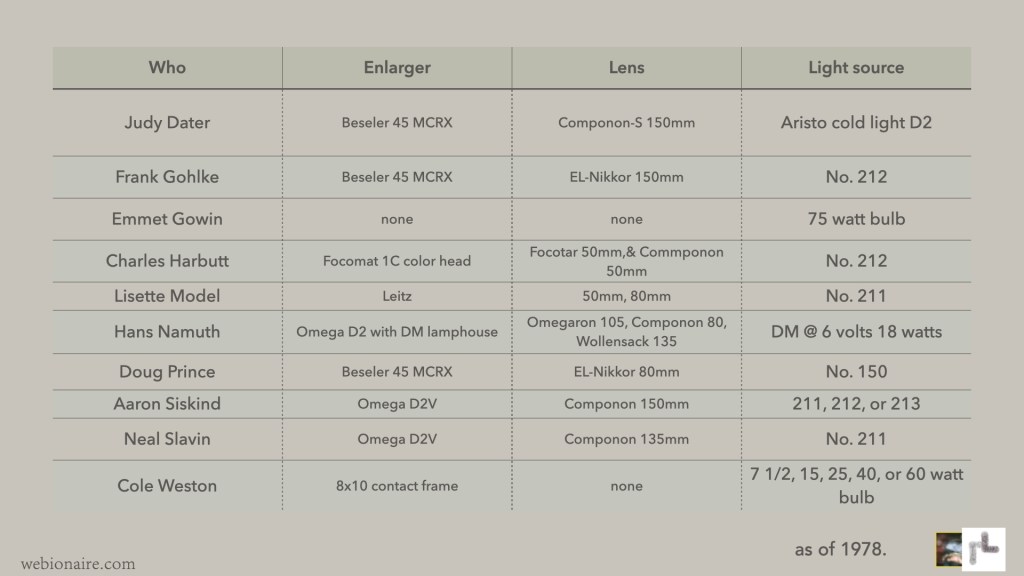
One simple question, a shopping one. Which enlarger should I buy?

What have other established photographers used?

Links [2024]

simple update

links: http://www.jollinger.com/photo/enlargers/

—-> http://store.khbphotografix.com/home.php

— >https://glennview.com/nav.htm

>>Who made the best/first/… maybe check the patent database;;

patents: darkroom enlargers

My first enlarger was a Kodak. It was equipped with Ektar lenses. My selection was easy because it was the enlarger mentioned in a dye-transfer guide. And, I found a used one at a local camera store (DC). Next, came a Durst, then and Omega D2. At places I worked, were Fotars, Agfas, Dursts, Omegas and an occasional Leitz. Each had something worthwhile, while each had something missing. In a professional custom lab, there is no reason to keep testing enlargers: those that work well become the central tool. If it doesn’t meet all needs, modify it. In my present darkroom, I have several Omega and Beseler enlargers. One Omega has a Durst carrier system added. With point light, several types of condensers, and diffusion lampheads; I can print using additive, subtractive, split filter — any which way I want.

There was a time that photopaper was slow,varied by batch. It didn’t print the same month to month– reprints were risky. Additional consideration in the best printing labs, the enlargers had to print the same color, the same contrast across a divided order. That is something the home brew doesn’t encounter. Home cooks never have to make the same thing 50 times a night. Professionals do.

Commercial chefs have many knives, can cook on many fires, are expected to produce peak performance order after order.

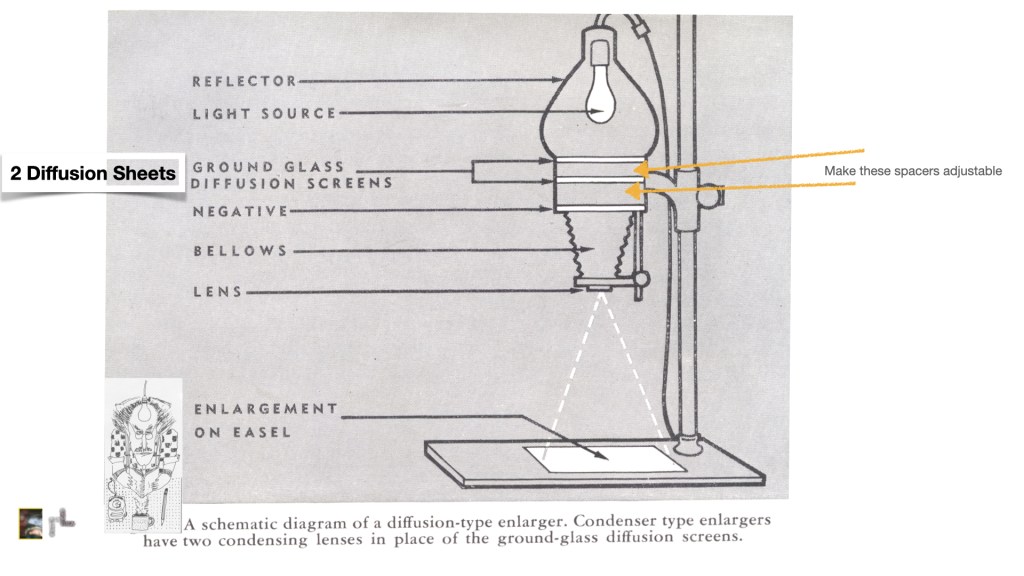
The light, the lens, the space are primary tools — choose those you will use. An enlarger is a holder, a jig for the light , lens, and film stage.

Deciding the type of LampHead affects the contrast range of the negatives you make:

condenser is an optical lens that renders a divergent light beam from a point light source into a parallel or converging beam to illuminate an object