techday: masking 1964

My first dye was made in 1960. It was on Pan Matrix from a color negative. Probably of my dogs. All these are lost to landfill on a farmside hill in Ohio.

A mask is a cover; it holds back light. At first, it was done fully by hand. Masking and retouching have always seemed like two parts of the same concept to me. Dodging is masking that disappears. Retouching a negative holds back something, which is what a mask does. I learned negative retouching from a Paul Outerbridge book. With an endless need for these skills, automatic masking methods found researchers. The “exposure method” of mask making took hold. That is likely the only method you consider.

The first films are long gone. No lab I ever knew kept originals; the client always wanted them returned. Photographers had files of film originals, but they didn’t get the seps; none of the intermediates were maintained more than a year. Perhaps government agencies could manage the volume of film use, but not the commercial, custom labs. Our volumes were too high. We could barely keep supplies in store. What I do have are notebooks; some quite full, and likely complete. Film, processing, curves, all these are what I call upon as reminder of what things were like.

poor Milpool… don’t take his word.
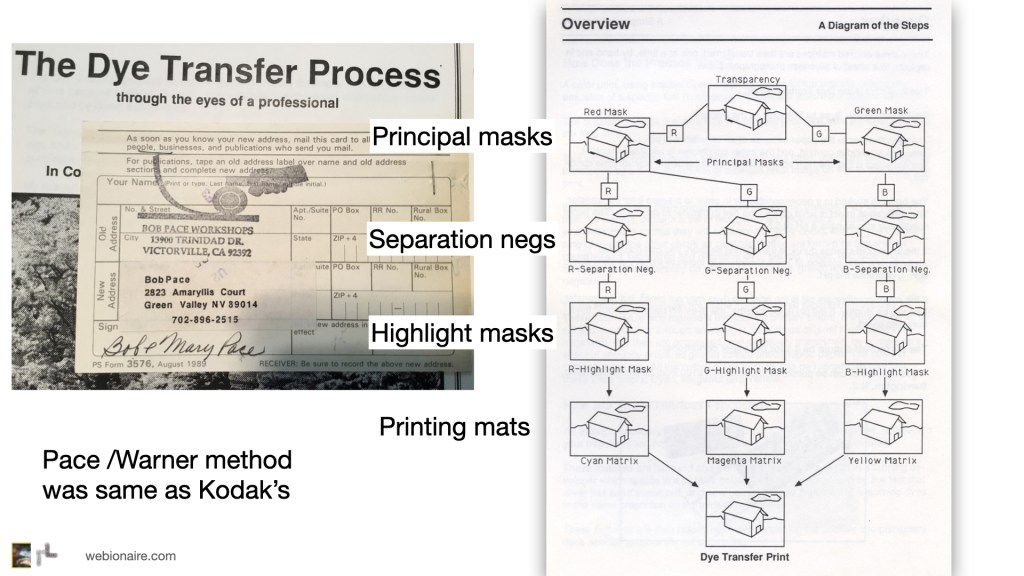
You can count the sheets of film. 2 principal masks — shortened version was a single mask using a magenta filter. I accidentally discovered, using a blank Color Negative ‘base’ acted as a correction mask. I misunderstood readings on what a color negative ‘orange’ mask achieved, thinking it solved problems for all film — believing it a universal filter, I used it on my early Transparency printing. I began making dyes with the Pan Matrix method. I shot color negative, then made mats with PM. These were my early, teenage years. Explaining my shortcut to an accomplished printer, he patiently explained my error, then suggested I substitute a Magenta Mask, as he handed me a Wratten filter, and pamphlet on the procedure.

There were always good people. Maybe because they made a living doing the work. They had little fear of being knocked from their hobby horse.
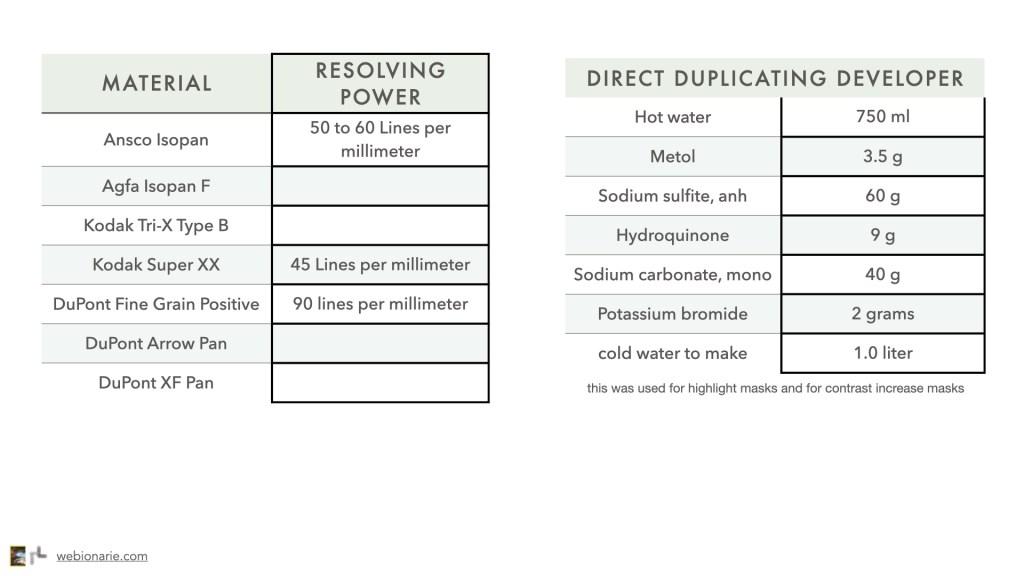
Super-XX was used by generalists, not by specialists. My initial films were many, including Super-XX. Even early in my transparency sep skill, I was disappointed with it. Isopan was superior, as was XF Pan. An early reference took me to Tri-X Type B, a very good separation film; it was also used by Eliot Porter, although he was a Super-XX user. After finding Kodak Separation Film types 1 & 2, my separation methods matured.

With color negatives of the late 50s, early 60s, contrast and exposure latitude was poor; matching the Matrices was challenging, requiring manipulation of dyes and matrix developer, even beyond what the instruction sheets told. And, after a few years, since I was printing for others, I had masked the negatives. Often for contrast increase, which meant using direct-dupe material. That could also be used for making distinct tone separation masks– all these things, along with having figured out ‘color coupled’ masking, meant I was getting work from labs. None of them realizing they were working with a teen skipping school.
backfill: Scan C-41

the only way to print is with a stopover to the screen. digital is the “new” analog. (it has been since the time of Scitex; the time when removing blemishes was called: Scitexing). One constant over time is that those people less capable of retouching, deride it in all its forms: brush, pencil, or mouse.

Scanning brought knowledge and doubt. Some have knowledge, some know-how, many more have doubt. The transition to ready scanning methods took more than 60 years to make. Scanners are part of the age of transition from chemical to computer; machine space to math scape.

Is there magic in the sauce? Maybe knowledge is held by some, being shared in the darknet (of books, journals, patents and conference lectures)

conversion equation
3 software interpretations

Glossary

Raised by my reading (about) Richard Benson, reminder of many other printer/printmakers, some having influence, such as Dan Margulis, some not. Dan Margulis was an early Photoshop advocate and user of LAB.

  • Gamut. the range of colors that can be produced by a process.
  • GCR gray component replacement, using black to some extent rather than cyan, magenta, and yellow in combination
  • Metamerism. visual phenomenon that two colors may appear to be the same under certain lighting conditions but different under others; two colors exhibiting this are called a metameric pair.
  • UCA undercolor addition. adding cyan, magenta, and yellow to areas that are predominantly black, to a achieve richer, darker color
  • UCR GCR that is confined to shadow areas
  • YCC Kodak’s proprietary colorspace much like LAB.

In the begin– [T, skoffs:  I’m highly skeptical about what ‘people’ say on forums about scanning software mimicking RA4. The reason for this is that I’ve never come across any hints that these people had any inside information on the color algorithms and for the most part seemed to make an educated guess, only. Sometimes, that is good enough, but especially in this case, I don’t think it helps any.

— \\in fairness, krk is responding. as naysay to:One comment, by a couple of users on the facebook Coolscan community – really caught my attention: these people mentioned that the tool was engineered to produce a result that closely matches the colour response of C41 film onto RA4 paper – as most film for the pa..

Certainly, it may seem to those not a member of the change-over, the time of Scitex and others, that no one could have inside information about the algorithms, ie, the science being used by Kodak, Fuji etc. Luckily, color science is a widely published field — both the densitometric and the colorimetric theory is available in text and articles distributed at conferences. Nikon scanners as well as Hasselblad ones implemented modes introduced by firms such as Scitex along with Kodak and Fuji.

Sensitometric Curve sources: profiles from PhotoCD[Kodak]

[April 2, 2021: VueScan first started supporting different film types about 20 years. We originally got film profiles from the PhotoCD database. These film profiles contain ‘sensitometric curves’ for different film types, and they don’t vary much in film types in use in the past 15 years or so.]

Negafix claims similar source for their film-types.

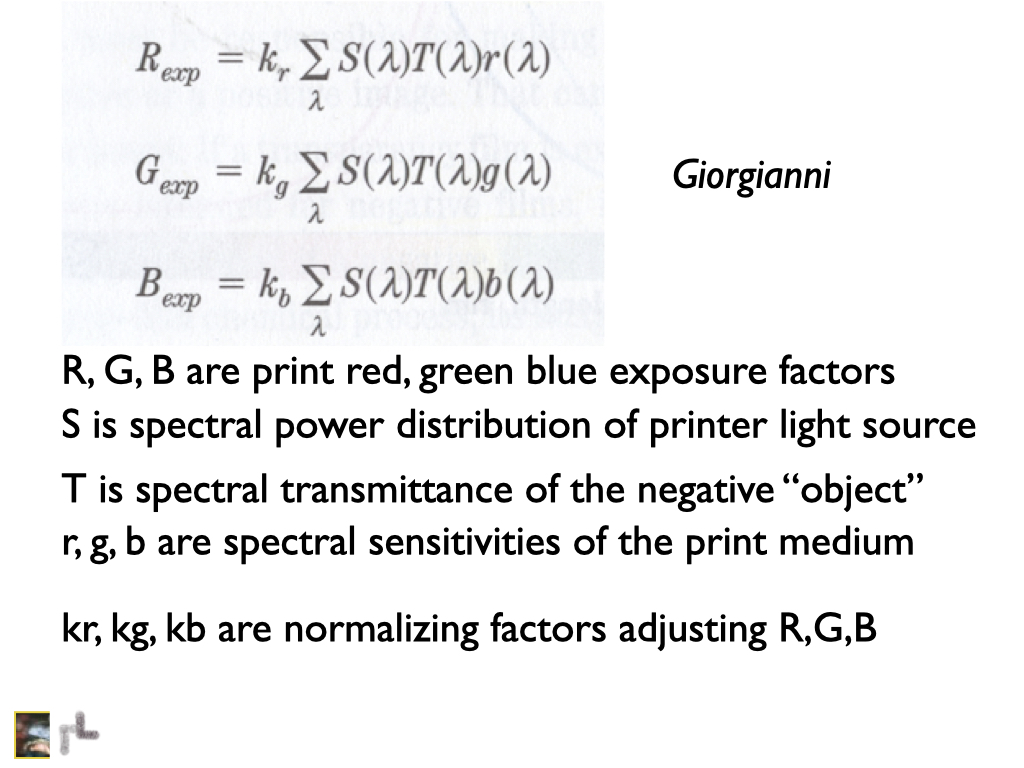
[from the Kodak designers, “… each photographic negative is designed to be optically printed onto one or more specific print films or papers, using specific printer light sources. That fact provides the key to making meaningful measurments of color negative images.” — Giorgianni and Madden.

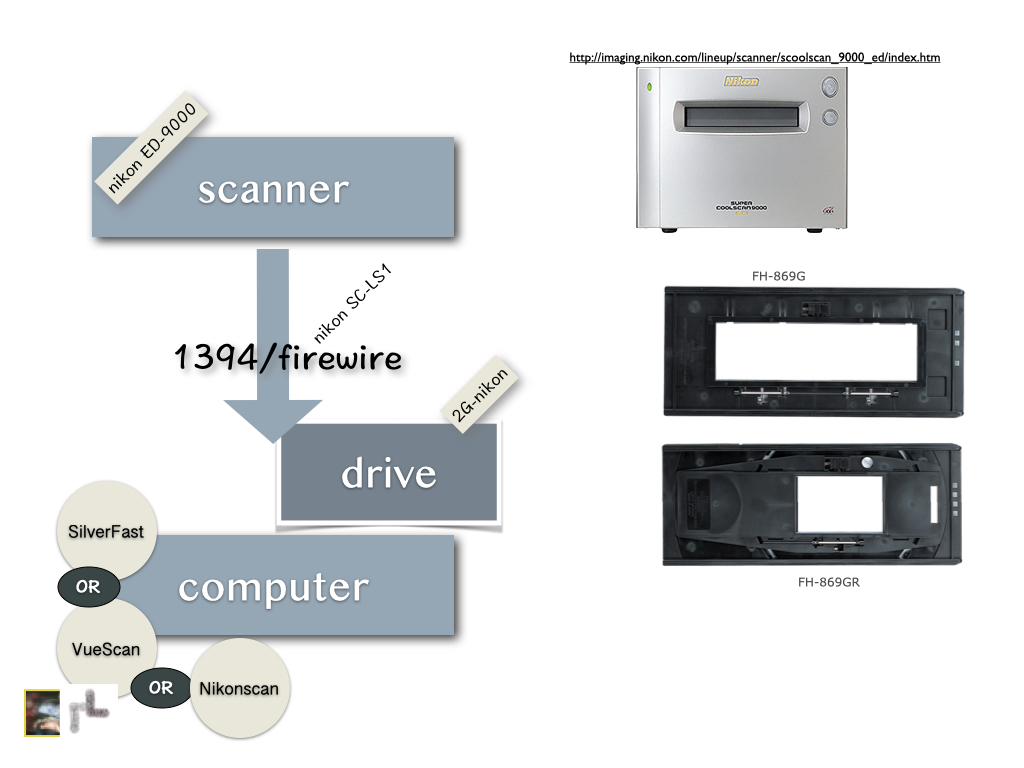
What do I do?: I use Nikonscan with a Nikon Scanner. I scan to a NEF format file. My use of Vuescan is for making PDFs with an Epson scanner. Hasselblad has a native camera file format which I request when someone scans with a Flex*.

“[157] since negatives are not meant to be viewed directly, it would not seem logical to also measure them using methods based on the response of a human observer” [meaning standard colorimetric measurements] [160] The neutral and color characteristics of color negative films are designed in terms of computed printing densities; therefore, printing desnities are the most meaningful desntiy measurements tat can be made from color negative films.


Nikon film scanners were manufactured from 1988 to 2004. Nikon Scan is Nikon’s own proprietary software for film scanners but it only supported computer operating systems up until scanner development stopped.

  • most recent to oldest >–>
  • Super COOLSCAN LS-9000 ED
  • Super COOLSCAN LS-8000 ED
  • Super COOLSCAN LS-5000 ED
  • Super COOLSCAN LS-4000 ED
  • COOLSCAN V LS-50 ED
  • COOLSCAN IV LS-40 ED
  • Super COOLSCAN LS-2000
  • COOLSCAN III LS-30
  • COOLSCAN II LS-20
  • Super COOLSCAN LS-1000
  • LS-4500
  • SCANTOUCH AX210
  • SCANTOUCH AX110

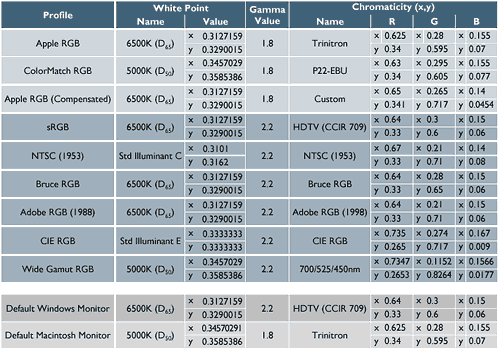
” Nikon Scan 3 and the Coolscan IV provide a choice of a wide range of color spaces, and screen gamma settings of 1.8 and 2.2 (the default gammas for Windows and Macintosh monitors, respectively). With the color management option enabled, Nikon Scan also supports the full ICC-standard workflow: The software chooses an input profile based on the scanner model it detects, uses the one of the offered color spaces as the “edit” profile, and allows you to specify a monitor profile for accurate screen display. (You’d develop your own monitor profile using any of a number of available profiling applications.) The chart below (courtesy Nikon USA Inc) shows the colorimetric parameters for the standard edit color spaces offered.”

Amateur Quest.ions

The outpost of the bachelor herd. Those old timers who didn’t do the stuff they will be asked about; they’ve become the experts.

  • they ask shopping questions. They use the forum as if it were a sales counter on Saturday, the day the weekend warriors get to pretend they do THIS for real.
  • the same group rejects, out of ignorance and arrogance, the question of a newcomer. New in the process, not in imagination– at least imagination prompted by broader reference imagery than the Snobby Hobby.

Stages of the meaning of amateur: what do they provide us? How can the task of understanding be accelerated? Follow a thread, re-constructed for revelation of the question-response cycle of early participants in an online community of practice.

One person. the OP, is a professional lab printer with many years of experience. As he ventures further away from the longtime standard darkroom print, he seeks out answers from the unknown members of a forum. [this took place in 2016 (over 2 days) ] The general topic filters doesn’t seem to be retained; it becomes a topic in which expertise dissolves — it doesn’t stay with the group, no matter how many times it is repeated — the group mind has no memory. They don’t learn.

Oddly, the professional lacks the knowledge, therefore, must ask a group of unknowns. He, likely, assumes they have more experience than they do– he is, even more likely, hoping they have more experience than he does.

Why would he assume that they know how to make studio photographs with filters that will be solarized? None of them exhibits solarized work. Few of them show anything other than landscapes; typical outdoor scenics of the great west.

Effect of filter. Effect of solarization.

Effect of lacking foundation skills to be a professional: will rely upon those of lesser skills. Probably meaning you haven’t become an independent, valuable provider to those with ability to pay well. Your chances of survival go down if the skill in your market rises. As widespread darkroom skill declines, you get to survive. Luckily, that is the course of the century. The lights are being turned off.

// success is timed. Multiply your costs factor. A well defined question provides pathway to correct, useable answer. They are right about one thing: a book is better than them.

Wratten 12 (Y)
Wratten 11
Wratten 44 (cyan)
Wratten 25 (red)
contrast with BW film is relative to other colors.

Light source matters, as does color sensitivity of the BW film.


along similar lines, at least in the same quadrant of that (above) 2 year old note: we get another request for information from the same professional.

an adage pops up: you can lead a horse to water…

The person who can’t find information on their own, isn’t the person who will use the information well. Locating a vendor is an elementary part of running a business. Asking the hobby world makes you a hobbyist — and a foolish one, in this case.


Reliance upon a small group makes you either on the advance or the decline. The hobby forums are not the leading edge of chemical photography.

The conversation is complete. My observation: the newcomer should leave, so should the old timers.

Advise, constant, recurring: don’t ask the forums. In old ‘cology it was said: “don’t give away your eyes.”

You will learn more about your work by doing it. Don’t ask them, they really never did succeed. The Fromm’s and Friends are only noticed because they hang out in a space someone else provided. The tour bus drops you off where they can park, not where you need be.