Equipment does matter! — sometimes it does; sometimes it doesn’t. For most people, even photographers, photographic equipment gets in their way, Even if their way is the standardized imagery of the Kodakery.
Equipment Poor
is the phrase once used as epithet about those professionals who bought more equipment than they ever used; buying so much they rotated credit cards. They were made poor by their falling for the pitch of the Camera Monthlies sold at the camera counter. Salesmen could be relied upon to inform their customers about improvements to their vision that lay in their future — oh, and we have layaway.
Lollipops also fell into the trap of buying for something sometime in the future. These people were the ones caught off-guard when the tide changed.
Lollipops were the single person lab barely able to support themself. They may have had aspirations of becoming a mom-n-pop. Lollipops eventually realize they’re just a hobbyist on the brink of becoming a hobo. For most, the only professional thing they did was get a re-sale license
— ANSWERING every question the same. applying one answer for every situation. see it in one case, not the other. variable in the Sinar, not in the souping. BL mode. Cost of souping, not knowing that the person used the burst system to save more than direct cost, and that in that approach they hired an assistant, gaining even more work relief: they could answer phones and other small tasks. [ link site ]
two pathways taken. The first is more popular than the second. Note the view counts.
One sells — they are trying to make a living off of the adventure of photography
the other is the much harder, less certain way. Sometimes it works.
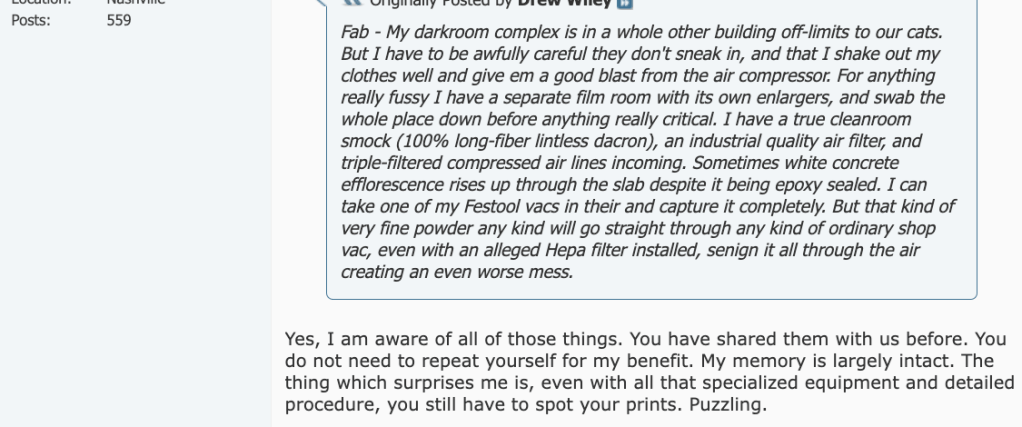
\\\ dust on neg during exposure: of the camera film, or of the print. A speck of dust on the film during exposure becomes an unexposed area of film: it is clear, usually base clear. It will print black, so can’t be spot-toned out. While dust on the negative during printing blocks, dodges light from the paper, making a lighter spot. These are the most common dust problems. Dust on the negative can be seen using a “raking” side light. I use a small led penlight to see them, then using a small 000 synthetic brush, lightly touch them. They cling to the brush tip and are removed. I don’t use a clean-room, instead I clean the darkroom. The procedure used for making masks and seps is different. For a different time.
beware: the expert that can’t tell a black spot from a white spot.
A cleanroom is just another claim of authority. Like a superior knowledge of venting air: designing and building a superior vent-hood. One designed for removing fumes during mixing of sophisticated chemistry. Even so, the braggart must refrain from processing for a few COVID years for fear of irritating his lungs. And before then, he rolled his processing drum outdoors to save him from the RA-4 fumes. This complicated way of working is used as part of the elaborate reason for such low output. His dog is always eating his homework.
clean the negative with Film Cleaner or alcohol
1-3 mins
make a proof print
pre-moisten the emulsion side with diluted Photo-Flo
1 min
reduce necessary areas with chemical reducer
1-3 mins
wash negative with running water
10 mins
dry negative in dust-free area
15-20 mins
etch necessary small areas
treat etched areas with Kodak Abrasive Reducer
1 min
Add red or neutral dye to the base side of the negative
dry negative in dust-free area
15-20 min
add Kodak Retouching Fluid to the emulsion side of the negative; buff until dry and smooth
1 min
Add pencil retouching
Use stylus on base side to remove pinholes.
Protect retouched negative in an acetate sleeve.
after Vilia Reed. [p29]
Hammond: “Today many portraits are made on small films and the prints are made by projection and therefore somewhat different methods of retouching have to be used. Chemical reduction on negatives now is often used instead of etching with a knife, and enlarged negatives are often made from the small original negatives. (1941)
Cass: p81. four types of scratches on negatives
very fine. apply retouching fluid to base and emulsion
definite scratch; like hair or dust line. Can be abraded.
large scratch. gouge on emulsion. this can be opaqued on the base of the negative
ong vertical or horizontal scratch caused by processing or camera.. on base of negative and appears white on the print.use soft eraser, gently erase down the line on the base side. this diffuses the scratch. clean the grit with toothpick skewer, then apply retouching fluid. color scratches are finished on print.
References
Hammond, The Art of Retouching and Improving Negatives and Prints, 1948
” I know … was with …. learned how from …. Winogrand”
He taught me how to inspection develop 8 rolls at a time in an open sheet film tank and I have seen his negatives. Very full toned. Unfortunately it appears that whoever developed his remaining rolls posthumously didn’t know that the development times needed to be reduced between 30-50 percent depending on the conditions he was photographing in. Expose for the shadows, develop for the highlights.”
Develop by Inspection:
which of the negatives on the roll is being considered the prime, ie, main negative being inspected. Is it in the middle of the roll, leader, or trailing frame?
if you photograph in Texas a lot, then your pictures are going to look a lot like Texas. — Winogrand
“If students were taking Garry’s class to learn photographic techniques and methods, they were sorely disappointed. Garry didn’t teach much technique. That was left to the PJ side of the photography world or to his “TAs”. You have a lifetime to learn technique, he seemed to be saying, but I can teach you what is more important than technique, how to see; learn that and all you have to do afterwards is press the shutter.” — Garza (74-76)
https://sites.utexas.edu/photo_utaustin/history/Garry Winogrand was the next leader of the photography program, from 1973–78. Winogrand was an equally acclaimed, though fundamentally different type of photographer. Along with his European counterparts such as Henri Cartier–Bresson and Robert Cappa, Winogrand captured pressing social issues and anxieties of his time. However, unlike Cartier–Bresson, Winogrand wasn’t looking for a decisive moment. No moment is most important, he said. Any moment can be something. Winogrand’s critiques in class often involved cut-throat edits and critical, obtuse comments while students sat in a room filled with cigarette smoke, drinking copious amounts of coffee.
First encounters are, like cameras, all about the surface of things; getting beyond means taking yourself further. Become the artist you say you are.




You must be logged in to post a comment.