In Frank’s West

Cover to uncover… picture making method. Meaning within the frame. Understanding what comes from beyond the frame.

US 91, Leaving Blackfoot Idaho shows two young men picked up by the photographer. Though the men seem intently focussed on the road, the car windows are blank. A text by the English philosopher and statesman Francis Bacon is in the visor; this Frank had copied down when he visited Dorothea Lange before he set off on his journey to find the heart of America.
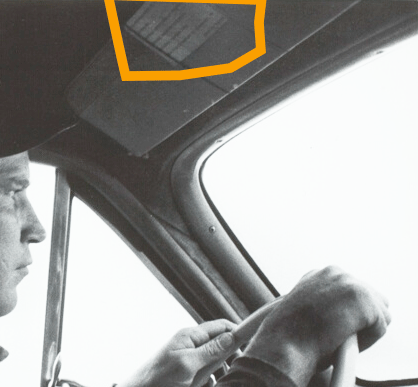
one aspect of “reading” for understanding is in your covering items contained within the frame… What is lost

in this instance, it is very difficult to understand the text — it cannot be read .. it is mere squiggle. What would it be?

We have to leave the frame for the content..

That text reads: ‘The contemplation of things as they are/without error or confusion/without substitution or imposture/is in itself a nobler thing/than a whole harvest of invention.’

https://www.artic.edu/artworks/87174/u-s-91-leaving-blackfoot-idaho

For the second half of Dorothea Lange’s life, that quotation from the English philosopher Francis Bacon occupied space within her day. She pinned a printout of those words on her darkroom door in 1933. It remained there until she died, at 70, in 1965 — three months before her first retrospective opened at the Museum of Modern Art in New York .

Referenced in publications

proof sheet: https://www.nga.gov/collection/art-object-page.78965.html
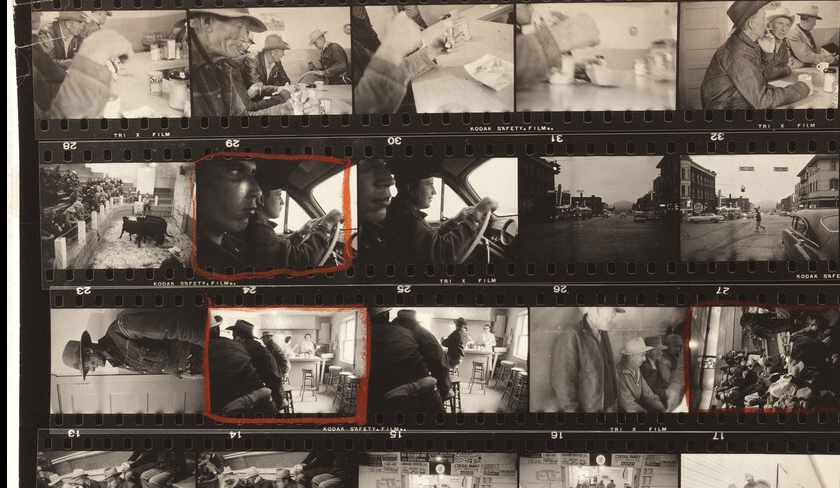
2 possible frames … chose the one without the space between the figures.

same configuration choice in next row of grouped figures.. make the group of one blob.. cluster into single tone pack

Robert Frank’s book, The Americans, is divided into 4 sections. Flags mark the divisions of the book.

  • Flag blowing.. Parade, 1955.. two people “looking” out of windows (First Chapter)
  • Flag hanging over stripe shirt, and… Fourth of July, Jay, New York.
  • Flag as shade… Backyard, Venice West, California.. just two pages after Bar, Detroit.
  • Tuba player… 1956, Political Rally, Chicago (Fourth Chapter)

Robert Frank (b. 1924) traveled across the United States to photograph, as he wrote, “the kind of civilization born here and spreading elsewhere.” During his nine-month journey, he took 767 rolls of film (more than 27,000 images) and made more than 1,000 work prints. He then spent a year editing, selecting, and sequencing the photographs, linking them thematically, conceptually, formally, emotionally, and linguistically. https://www.sfmoma.org/press/release/sfmoma-presents-looking-in-robert-franks-the-amer/

Secret Dye Transfer School

This is an expanded version of { Everyone loves a secret…. } with questions.
Avoid tidepools of inactivity; don’t get caught in their stagnation.

THE SECRET IS: TRY. NO SCHOOL TEACHES COURAGE.

The secret case of Eggs. You cook eggs at home, getting very good over the first dozen. A chef trained at CIA will cook that dozen eggs several ways in their first morning. The secret is variation — faster feedback between effort and result.

How to poach an egg… or, how I poach an egg… based upon its size, use of poach … cooking is easy, but it is a manual skill. The analogy should be obvious. I would never spend time trying to teach someone how to cook, if they are afraid of making mistakes. The arrogant amateur is deadly in a commercial lab.

Commercial labs had more information, more experience than Kodak about the the use of dye transfer materials. We even told them about ways of correcting the magenta dye (restrainer). Labs experimented more frequently. The bigger the lab, the more varied the requests. Full shift labs had more types of products. Only small labs specialized in dyes . No one kept secrets from anyone else. okay, we tried to keep client lists hidden. At least we didn’t publish them.

Big labs probably came to dye transfer after it became a mature, consistent product. Mixed dyes was the first success. Type C’s, Printons, dupes, etc … these products provided the profit for dye transfer to be a service. Dyes were, for the most part, a glory part. Those in “pickle alley” specialized in dyes almost to the product type; their photographer clients did, so they did.

Kodak made different papers …one retouchers and illustrators preferred, another popular in portrait studios, and the common one, Type F.

Would you take a class to learn dye transfer printing? Would it take you nearly 20 years to make your first print? If it did, whose problem is that? Suppose you bought the supplies, the books, equipped a lab; all that, yet you never used a box of the material. What secret kept you from trying to print?

In my experience, I have never known anyone to succeed without ernest initial effort. With dye transfer, the printers who make their third print within the first week of effort get the furthest. These are the printers that are solving new, more complex problems for most of their thousand image career.

Frequently, timid people never acquire the skills they think they should. AFter all, they are literate; they collect information, data sheets, magazine articles. Every article they read tells them of the difficulties, as the author promises great reward. What a view from the heights.

https://www.photrio.com/forum/search/754152/

Prints? Uncovered conspiracy?

IB Photochemistry — from Aug, 2007 to Feb, 2025 – a very long journey getting to a point of.. what… what does he have? A manual from a small Northern California lab. This manual reveals: the answers are on their wall placards, not in this document. [ may be Garelick, or Teoli]

someone spending time uncovering a conspiracy… of their invention?

Lack of knowledge doesn’t mean someone is hiding it from you. Lack of experience is your failure.

How many prints do you think he has made?

Kodak had a training facility in Rochester. It served their marketing group’s learning needs . The dye transfer commercial labs didn’t learn from that facility. In-house, industrial labs like GE, or GM, etc went there. Labs with many dye transfer employees wouldn’t go — the information would have been geared to too low level. MEC was opened in 1972. What did all those labs, the largest of which began before 1960, do for learning before ’72?

Multiiple shift, commercial dye labs, had wider range of experience than Kodak. We saw many problems, having to solve them with elegant, complete answers — usually at a small profit. We optimised by experience. Knew more by doing more.

big labs had a head start. They had employees who had learned in the forties … were running sections in the 50s. The process experience transcended single-vendor, single product type.

Theory was studied in service to experience.

  • Try it..
  • if it doesn’t work, explain
  • write it up…
  • stick it on the wall

Kodak Lab Days.

Kodak changed over the decades of my contact with them. In the 60s, they seemed very accessible. By the 80s there seemed less knowledge, but with more datasheets. Instead of information, they provided brochures… many handouts.

Frank M. –[ someday, more..]

Kodak’s final days … from letter sent to labs in their marketing mailings list.

We also received such things as:

  • CIS Current Information Summaries
  • and my favorites: From the desk of — the best were from Jeannette, Frank, Louis, Bob S., “girl group”

this day in 1898, the U.S. Supreme Court, in United States v. Wong Kim Ark, ruled 6-2 that Wong, who was born in the United States to Chinese immigrants, was an American citizen. It was the first Supreme Court decision to rule on the citizenship status of a child born in the U.S. to noncitizen parents.

To the Wileys-and-Garelicks: please, get the dates correct; woth that achieved, your data may make sense.

Possible set of dates: 1936 – 1957 [ much foundation; most of the theory] 1957-1977[ the changing nature of Kodak along with the nature oc the commercial color lab] . Next, the dates become, in my file folders: 1981, 1986, 1988, 1991, 1996.