lab. 12/18 Fujifilm

What Fujifilm knows. Two interesting patents about color print/ display materials. Also contain light sources used during testing of the new material.

People. Patents. Products. Find the people behind the knowledge and you will learn what the product solves. Meindert Slagt has few patents. This one lists several people with multiple patents. Jun Matsumoto came about in reviewing other patents of the holders. He is a key researcher for Fujifilm. Finding the addresses of each of these researchers locates their research building.
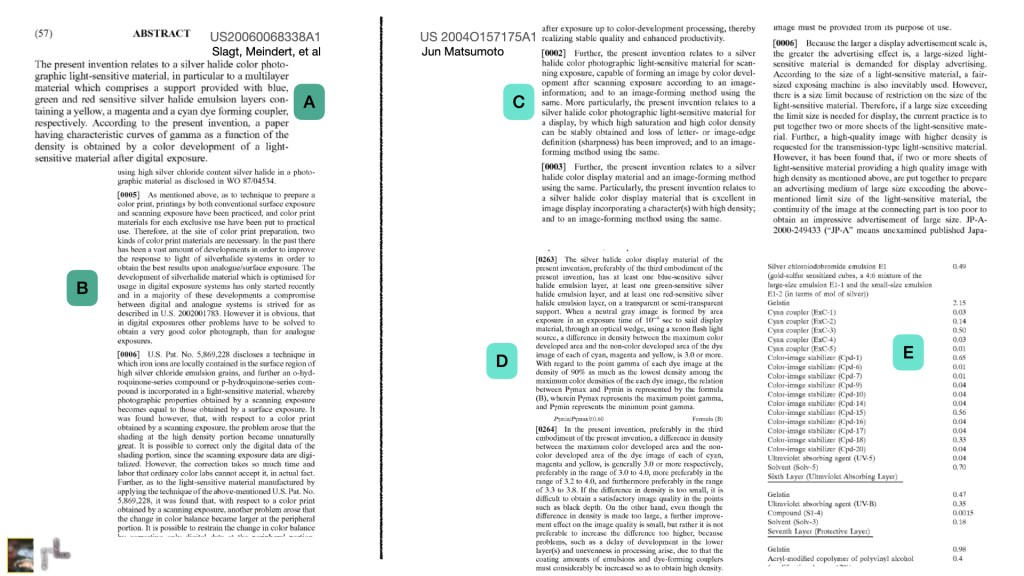
The need to provide a different print material, one designed to solve the problems of prior silver/color printing in being used in a digital /scan printing system.

  • A: “light-sensitive material after digital exposure.”
  • B: “it is obvious, that in digital exposures other problems have to be solved to obtain a very good color photograph.”
  • C: “a high-quality image with higher desnity is requested for the transmission-type light-sensitive material.”
  • D: “if the difference in density is too small, it is difficult to obtain satisfactory image quality in the points such as black depth…” difference too higher, problems such as delay of development in lower layer(s)…
  • E: a snippet describing a single layer (the Fifth) of the display material. This is the Red-Sensitive layer. Notice that there are 5 Cyan couplers indicate, and eleven “color-image stabilizers.” Describing all the chemistry would take months.

>> https://patents.google.com/patent/US20060068338A1/en ” as to technique to prepare a color print, printings by both conventional surface exposure and scanning exposure have been practiced, and color print materials for each exclusive use have been put to practical use. Therefore, at the site of color print preparation, two kinds of color print materials are necessary. In the past there has been a vast amount of developments in order to improve the response to light of silver halide systems in order to obtain the best results upon analogue/surface exposure. ” Inventor Meindert Slagt Akira Kase Peter Franciscus Van Asten Yasuo Iwasa

>> https://patents.google.com/patent/US20040157175A1/en “As a method to expose a light-sensitive material according to digitized image information, an image-forming method in which scanning exposure is carried out using a light source of high light intensity such as a laser or LED, has been rapidly gaining popularity. Resulting from the recent popularization of laser printers and digital prints, the above-said image-forming method has been common. Accordingly, there has been a continual need for a light-sensitive material having characteristics suitable for laser exposure and digital exposure. As print for a display advertisement, higher image density is requested, because a vivid image must be provided from its purpose of use.” Jun Matsumoto Shinichi Nakahira Hidekazu Sakai

—- plus, updated posts: this on portra

Photo Gossip

Why don’t they know. What is it they don’t know.

The main component of the amateur’s knowledge is the craft. They spend time and money in the buying of things to make pictures. Their conversations are about the modes and methods of making a photograph. They seek rules. They arm themselves with instruments and instruction material. These are their first steps; in most cases these are the only steps they will make. They will do the same week a thousand times over, having never learned the next thing.


Eliot Porter gets a thousand dollars, yet we are told that “my own brother” got $4,000 for a one time use. This at a time when the BEA reported median per capita was less than $4k in 1965. brother Wiley must have been doing well.

Analog Bullies

[My own brother got over $4,000 for one-time rights to publish a particular 4X5 image or another, which was a helluva lot of money back in the mid-60’s] Wayne J. Wiley 1940-1995 [55]– 1965 Wayne would have been 25.

what was the bragger doing during those years? had a job selling paint etc.  did he have a 4×5 then? he has said his first camera was 6×7, for many years—

over 10,000 miles backpacking with a sinar (norma) … we can assume it was 4×5. tst this — how many hours are needed to walk 10,000 miles. assume you are military advanced patrol conditioned — typically males between the age of 20 and 40; they can travel, with load, through uncut, rough, hilly terrain, at around 1 to 3 miles per hour. Figure how you would fit those thousands of hours into your spare time, vacations, weekends during your time with a 4×5. The rationale for making these claims: to counter someone suggesting the novice should buy a wooden field camera instead of a metal one.

Did you figure in the stop time to make pictures: “up to 4 hours” waiting for the “light,” “the wind,” the “clouds to…” Or, how about the known case: travel time to the mountain. “I don’t just drive to..” In that 8 days, he was on the mountain maybe 3 days. Did he climb, walk in the night? Doubtful. On the one trip we can extrapolate from, he walked about 18 hours in a week. Then, not again for a couple years.

Of course there are the tourist paths around the Bay. Maybe that is where he does all this alpine climbing under heavy load.

AND I have insider knowledge. I saw him exhaust himself carrying some 20×24 prints no more than 15 steps across a sidewalk and hotel lobby. Worn pant legs dragging on the floor.

the range of knowledge.. experience he didn’t have, provides the examples he calls up… like a child’s early learning about the size of the world, his numbers are wrong. in an attempt to convince you of his great experience based knowledge of the topic, he gives examples out of probable proportion, moreover, he can’t site references for the proclamations.

why are his estimates so wrong? maybe just bad memory of a 70 something. i think it more likely he has false memory: he wants it to be true. in his need to claim your attention, along with subtle denigration of opponents, he lays claim to big knowledge. And like pubescent teens making claims in the locker, it is beyond their experience. he isn’t close to the world; his numbers are false glories. 

they talk about chromes in studios; of doing things they never did. naively, you will repeat the story. warriors at the bowling alley, just telling lies for beers.

Chromes in studios could be evaluated by the client, the art director, the photographer during the shoot. The lab could push or pull in small increments. The studio experience is what drove the use of chromes and Polaroids. A big orange blob can’t be evaluated on a light box. Of course, we could have made densitometer readings and announced them to the client. What would that have done? What type of experience would that be? Even a paint store salesman should understand that.

The Whys

  • to overpower you. gain control of a conversation using facts from a past they didn’t have. they tell the story, even someone else’s to impress you with something that would have impressed them.
  • reclamation of a past they failed to realize. rather than tell you what they did, they make great examples of themselves. Indeed.
  • Photo Macho: they conquer mountains and women. In end of years, they turn to you.

Even the worst of us, can serve as a horrible example to the rest of us