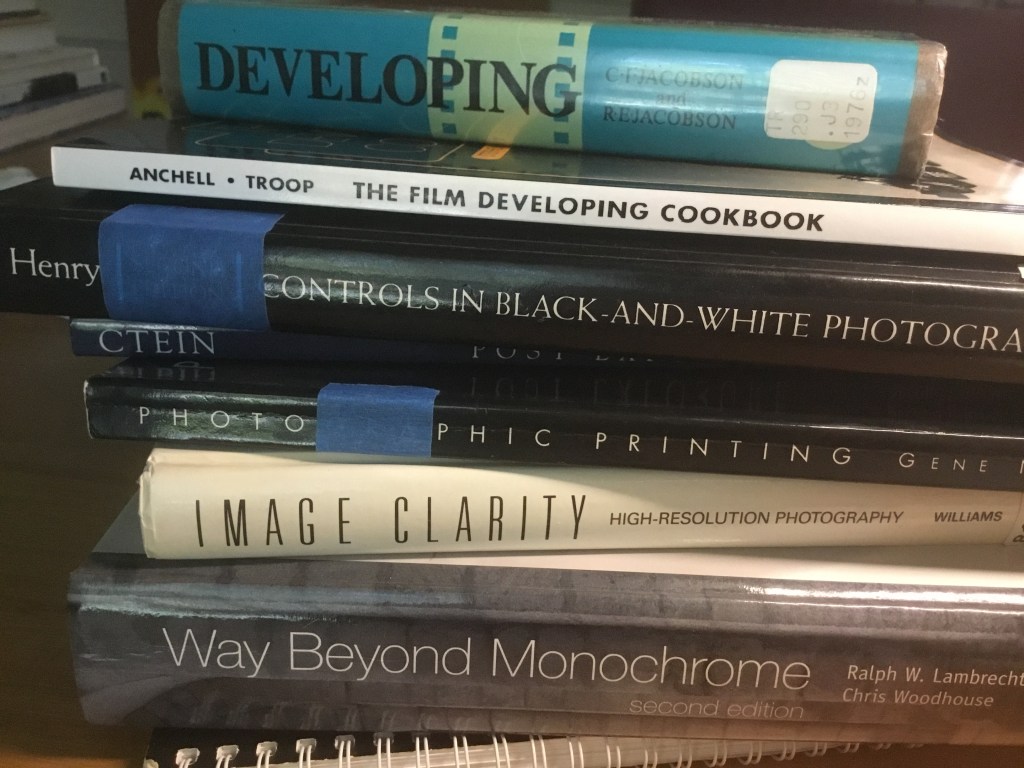
bookshelf: Critical Notes

books I’ve taken from the shelf many times. Fewer times these days, this century. We’ve much more to read; work of equal depth as these early ones — these are things to read so that you’ve a foundation to react to this century’s writings.
They fear that writing, thinking will clarify their work, making it less creative. That they are also the ones who talk for years about techniques they have never done; they have a bucket list that could fill a pool. Hating art school goes along– too expensive; I already know how to use a camera.


By Non-photographers… does that make them useless, irrelevant — wrong?

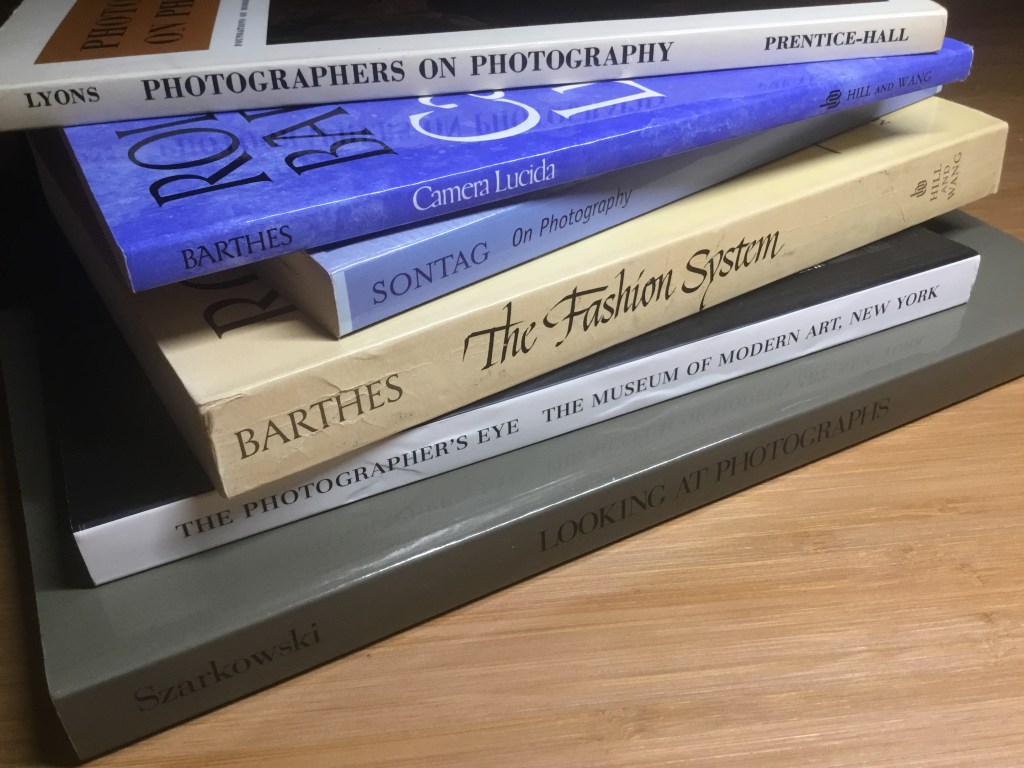
  • Camera Lucida / Roland Barthes ::{1980] the “spectrum” He moves from the objective to the subjective. he book develops the twin concepts of studium and punctum: studium denoting the cultural, linguistic, and political interpretation of a photograph, punctum denoting the wounding, personally touching detail which establishes a direct relationship with the object or person within it.
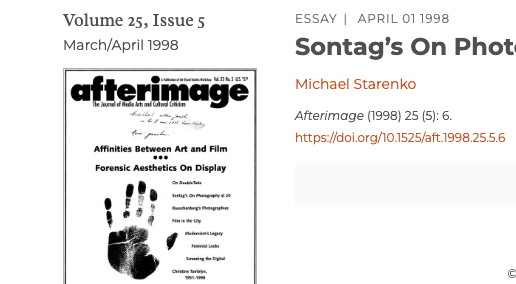
  • On Photography / Susan Sontag. essays that appeared in the New York Review of Books between 1973 and 1977. [1977] establish within people a “chronic voyeuristic relation to the world.” 1998 appraisal of the work, Michael Starenko, wrote in Afterimage that “On Photography has become so deeply absorbed into this discourse that Sontag’s claims about photography, as well as her mode of argument, have become part of the rhetorical ‘tool kit’ that photography theorists and critics carry around in their heads.”

By photographers.. are these more useful. Has writing ruined their photography. Why didn’t they just “let their photographs do the talking”

Minor White … reviewing
  • Photographers on Photography, Nathan Lyons,[Abbott, Adams, Bruguiere, Bullock, Callahan, Coburn, Demachy, Emerson, Frank, Lange, Moholy-Nagy, Man Ray, Robinson, Siegel, siskind, Henry Smith, Eugene Smith, Steichen, Stieglitz, Strand, Weston, White]
  • Circles of Confusion, Hollis Frampton. 1983
  • The Photographer’s Eye, John Szarkowski,1966. The Thing Itself, The Detail, The Frame, Time, and Vantage Point
    “This book is an investigation of what photographs look like, and of why they look that way. It is concerned with photographic style and with photographic tradition: with the sense of possibilities that a photographer today takes to his work.”
  • Looking at The Photographs / John Szarkowski, 1973. 100 Pictures from the Collection. [features Linda C, I was her first TA at SFAI. thanks Margery]
Words can’t take away from a worthwhile image anymore than they can bolster a worthless one. Fearing words is a crutch of someone unable to think. It is certainly not a requirement that a visualist also be an author, or philosopher. It is just unlikely that they are also unable to engage the history without using engaging their mind.

… an endless topic..

Standard Developing

agitation among the frogs about developers. since photography is something we do in the dark, maybe we can improve our work by knowing more of the secret. craft sometimes hides the meaning. the means get in the way. the camera blocks your view of the world.

The mechanisms of developing film (and paper) have been studied more than a century. The researchers provided products and procedures that employed hundreds of thousands over the 20th century. Some of that foundation work lead to our current digital imaging systems. Strange enough, even to enhanced solar cells and window coverings. So, it would seem a good place to look for a journey through the chemical photolab would be the manufacturers’ instructions and references. The things they read and wrote. It isn’t what most do. The information seems too curt, or too complex, so what happens is a large industry of writers, workshops and guide books flourish. Much of that has moved to youtube, and online chat forums — advice is given, repeated, overheard, rephrased — turning into accepted practice. They want to be influencers; they want to be remembered, so, they gossip. Repeat what others may have meant. It can’t hurt, can it.

A phrase I used in my teaching days: Read the directions twice; try them at least once before asking someone what they do.

Box Speed. Box Developer — that’s another. Every emulsion is tested. The chemists use developer during design and development of the film. Also, every chemist agitates the film in the developer. So, over the years they learned from the large users of their products what features would prove most useful.

There are many effects, some say defects, that are a result of developer composition and agitation. One film is not all film.

Names

Mackie line, Eberhard effect, Kostinsky effect. [347]

“Development in a vertical tank without agitation, or with grossly inadequate agitation, may produce streaks.”

[342] “Forcing development with concnetrated metol-hydroquingoe, metol-chlorohydroquinone, or catechol developers results in somewhat higher effective emulsion speeds but only when the fog values become fairly considerable.”

[459]

“Active developer diffusing from areas of low to high exposure will cause increased development of the boudndary of the image, producing increase contour desnity but also increasing teh size of the silver grains in the enhanced edge density … conventional fine-grain developers , such as Kodak Developer D-767, are diluted with water to form the dilute developing solution that gives increase image edge effects…”

The emulsion is three dimensional — more like a sponge than a ‘film.’ The further from the center is the edge, that is, the bigger the film, the greater the possible difference with agitation. Color processing requires known diffusion rates of the residue of developing — change that and you change the resultant hue-set. Not a cross-over, once again: not a cross-over. A hue shift isn’t a shift in gamma ratios.

References:

  • E. R. Bullock.
  • J. Rzymkowski.