
Those abbreviations were short for something. Abbreviations, mnemonic notations meant something, more to some than to others. I don’t know that they have much carryover into this century, probably not for the future decades– the age of emitters.
Filters aren’t masks. Filters block light; colored filters block some light and pass other light from the beam — the light path. So, what color does a filter pass? What color do you see? That is the color it passes.
filter nomenclature such as CC 10Y means “color correction .10 units of yellow.” CP meant color printing filter. CPs went between light and lens, CCs could go in focus path, not only in light path.
10 is a low value, not the lowest, but a low common use amount. Filters came in simple (primary) and compound (secondary) colors. In the land of dichroic, meaning color heads, there are 3 dials — for the secondary (subtractive primaries) of yellow, magenta, and cyan. That number is a reference to the amount of light absorbed. The higher the value, the more light is absorbed. the 10s are third stop changes. A 30 filter absorbs half its complimentary color by one stop (halves the amount).
[ CC values are calculated log d x 100: 10cc is 0.1 log d or 1/3 stop. 15CC is a half stop. 30CC is a full stop]
| Filter | Approx Peak Transmission | |
| 05 (CC05Y) | 89% | 0.05 |
| 10 | 79% | 0.10 |
| 20 | 63% | 0.20 |
| 30 | 50% | 0.30 |
| 40 | 40% | 0.40 |
| 50 | 32% | 0.50 |
Printing color negatives (those orange pieces of film) use the (m)agenta and (y)ellow filters. The cyan filter entered the pack if printing “reversal” direct positives (type Rs, cibas, or dupe films)
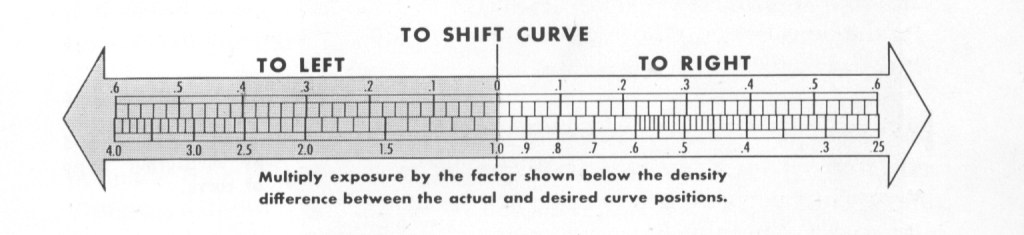
- filter density affects exposure (gels).
- the amount of correction isn’t the same for each color. 10cc yellow only needs 2% more exposure. 10cc magenta needs almost 10%
- color emulsions have multiple layers of ‘tuned’ sensitivities — they are subject to reciprocity failures — exposure times from 5 to 40 seconds are best.
- the “digital C” papers are best exposed less than 15 seconds.

voltage stabilizers (regulators) were standard lab equipment — as enlargers became more sophisticated, their power supplies contained the regulated voltage.
voltage fluctuations caused color balance changes; also shortened bulb life.
I continue to use UV and IR filters in light path, and a regulators.
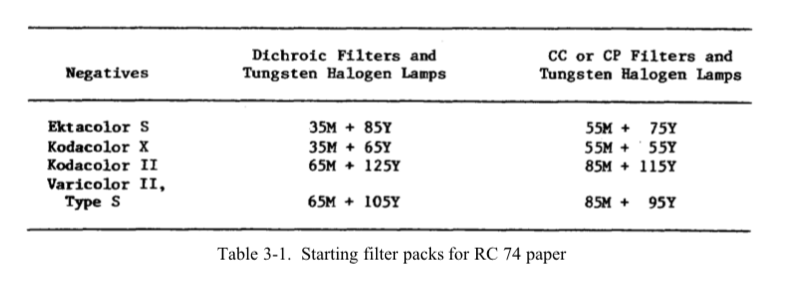


If the borders are not ‘white’ then you have stain or fog.
–Cyan probably is chemical stain; yellow is age fog. Tape is the diagnostic tool — waterproof surgical tape. Think about it.
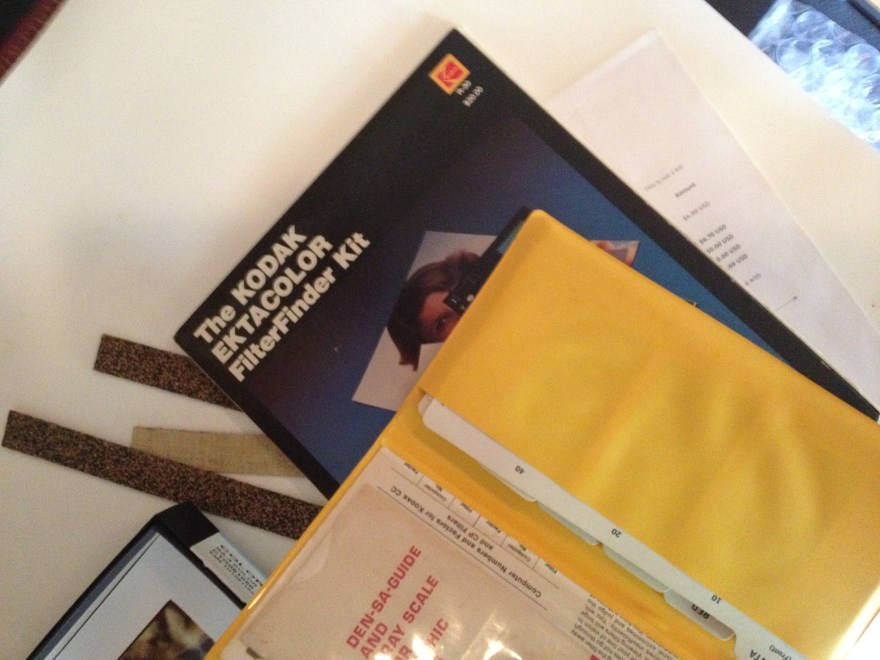
More [Kodak]:
- Kodak Ektacolor Filter finder Kit, R-30
- Kodak Color Print Viewing Filter Kit, R-25
- Retouching Color Negatives, E-71
- Color Photographic Processing
- How to process color prints in tubes
- How to process color negatives using process C-41
- Finishing Prints on Kodak Water-Resistant Papers, E-67
- Printing Color Negatives, E-66
Type R = Reversal notes

patents about reversal processes. emulsions and chemistry. covering several foundation concepts including Solarization.

You must be logged in to post a comment.