Chemistry is frightening. Film takes a long time, a lot of chemistry and it is done in sealed rooms.
No wonder that it is a reminder of the past. No wonder that it is becoming a thing of the past.
Right now it is probably easier to find out how to setup a meth-lab than it is to setup and run a film lab.
Oh the joys of capitalism.– Skeed Remarx –“Breaking Wind”
Robert Adams Lewis Baltz Owen Barfield Thomas Barrow Susan Compton Carl Chiarenza Dennis Grady Andy Grundberg Hollis Frampton James Hugunin Eugenia Janis William Jenkins James Kaufmann Rosalind Krauss Daniel Lindley Nathan Lyons Sanford Schwartz Ingrid Sischy Joel Snyder John Szarkowski
wavelengths of RGB that most color photographic papers respond to best are the wavelengths that are passed by Kodak Wratten filters
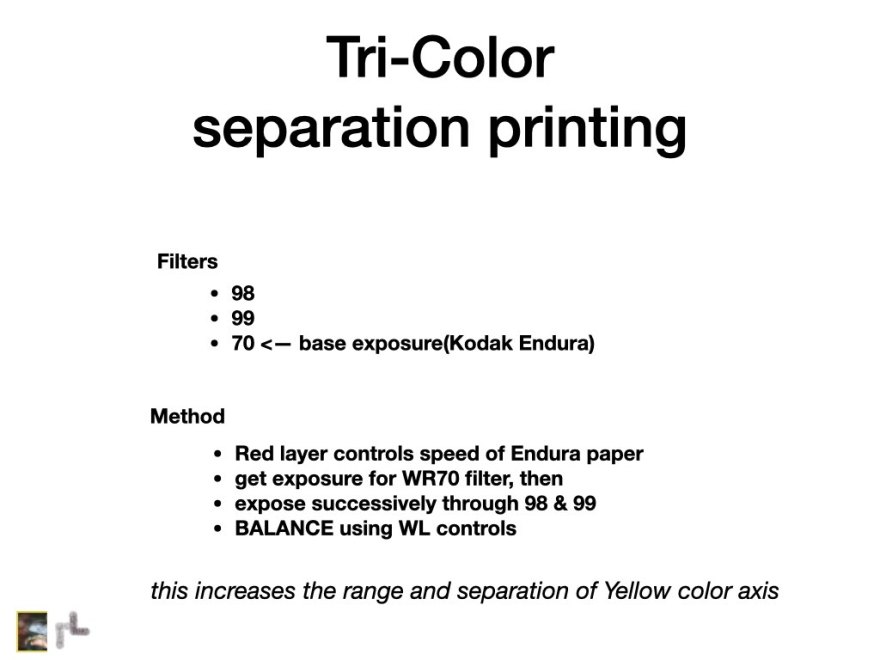
Tricolor Separation Printing
The original color printers, as well as the recommended printing method for Type “C” papers, used the additive filters. Three exposures were made using WR98,WR99 and WR70 (alternatively 29) filters. Kodak and Fuji have since improved color separation between the Type C (RA4) color layers. Additive printing was essential to take out the ‘pumpkin’ yellows. The tricolor method kept the yellows clearer.
use the WR70 as the base exposure. The Red layer of the paper is the speed determining layer.
The Reproduction of Color, Hunt 5th Ed. p.177-192.
The Color Gamut Obtainable by the Combination of Subtractive Color Dyes. Optimum Absorption Bands as Defined by NonlinearOptimizationTechnique, J.ImagingScience, 30,9–12; by N. Ohta.
Brightness and Hue of Present Day Dyes in Relation to Colour Photography, by ME Clarkson and T. Vickerstaf, PhotoJ.88b,26(1948).


You must be logged in to post a comment.