A Book to Have Written

We have books, on shelves and within.

Everyone who thinks does some writing, some part of writing. Everyone who has taught has written or talked enough to have written. Maybe speech to text could have done the job better.

I don’t teach; didn’t teach for long enough to become a teacher. I do talk to myself or dogs when they are around.

Because I read and pick what to read by following authors, there are a continual stream of books — small, big — deep, less so. An author/curator of currency mentioned a book, so I picked up a copy. And considering the time difference, the different decades of perspective and history, this book seems familiar. An easy going first year book of ideas, with enough annotation to keep the student moving.

It makes me feel as though I could have, or should have written it.

i wrote about process and specific photographs. That was an age that saw great separation between theory and application. I’m glad that gap has been crossed.

Photography; the Key Concepts. David Bate

His key concepts include reference material as well as interpretations. It is an example of a fine text supplement to studio principle course.

Bare’s book has a beginning middle and end — The other text depicted is a compilation “The Education of a Photographer” Charles Traub.. Classic writings — and available as an eBook.

A small sample of the Bate’s he refactors Fired’s “Why Photography Matters as Art as Never Before into:

GenreArtist
“History” PaintingJeff Wall, Thomas Struth, Andreas Gursky, Thoms Ruff
LandscapeAndreas Gursky, Hiroshi Sugimoto, Thomas Ruff, Bernd & Hilla Becher, Thomas Demand
Luc Delahaye, Stephen Shore, Candida Hofer, Jean-Marc Bustamante
PortraitureThomas Struth, Thomas Ruff, Beat Streuli, Philip-Lorca diCorsa, Cindy Sherman, Rineke Dijkstra,
Luc Delahaye, Hiroshi Sugimoto
Still LifeThomas Demand, Wolfgang Tillmns, Jeff Wall
Academy Painters Photographers

Asking Directions in a Stalled Car

asking directions in a stalled car

stalling for time. taking 9 years to start your journey. You may not have serious intention. Certainly little motivation.

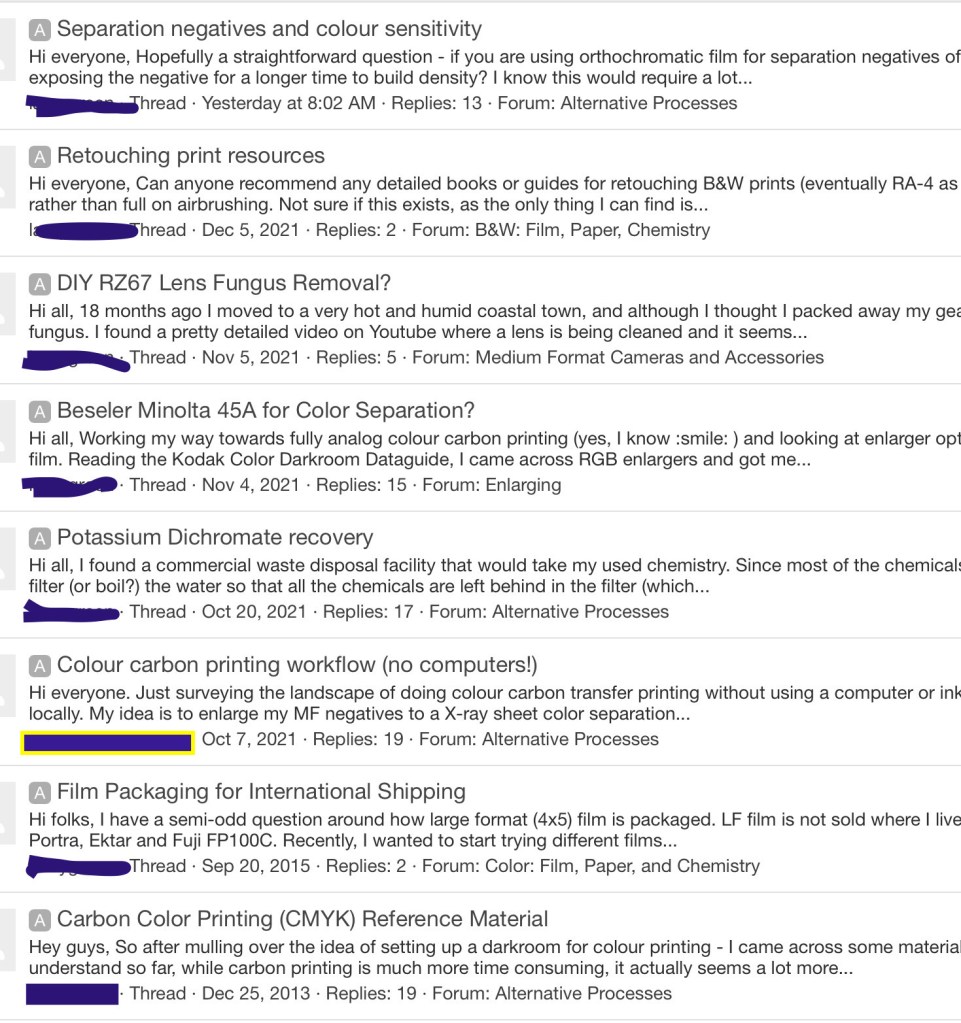
the questions asked. trying to make color prints in carbon. what was simple has become almost impossible.

why does it take someone so long to get to the first actual steps?

This person has asked similar questions in three different forums to same result.

is it just a point of conversation — like picking the best developer — always looking but not expecting a final answer —

How can someone spend years learning how to make a print? How many times, how many people do they have to ask before taking action? I don’t know. Most people rarely arrive at the peak — probably good, otherwise the path would be too worn to travel, the top too crowded to enjoy.

Asking other people questions — better if they had asked themselves more questions.

Taking themself step by step into the past.

So, how does someone get out of an endless cycle — Try something — anything. That is the natural order of studio arts. Make a mark. Examine it. Make another.

After collecting stacks of references, organize them. Make a try to build your own guidebook. That’s how I learned to print dye transfer. I read a couple of pamphlets and the inserts put into the product boxes. They were written by people making the process clear enough to be learned by an interested amateur. Professional labs learned from each other. Later, Kodak hired professional tech writers — the literature became less useful. Professionals milking the assignment a word at a time; an article extended to three months instead of one.

Make an outline. Discover the mystery with a reference about the end, the goal. Answering honestly, where are you starting. What will you need. That is the rub: how do you know if you don’t already know? Go back further in literature. Skip the boards and recent books. Write your outline based upon the past. Fill it in with material from the present.

Getting There:

  • it is an assembly process
  • it is assembled layer by layer — cyan, magenta, yellow
  • each of these layers is made separately — made by separation
  • it is a negative positive process — a negative makes a positive. (positive makes a negative)
  • it is a contact speed process — means the negative will be in contact with the final emulsion — they are same size
  • you may have to make an enlarged negative
  • in this century you will have to make your own “tissue” — you will worry about this far too much
  • in this century you can buy some large film — it is becoming more expensive and less common. Some emulsion runs are made every few years –large sheet film is a specialty item. [Ilford Orhto+ and Bergger Printfilm] 2022
  • Write a rosetta
  • Write a dictionary – terms with sources
  • don’t buy equipment unless you have tried with what you have —
  • know what you know before asking the forum

set yourself word and picture goals. refer back to them often. make measurement of your progress.. if you skip a measurement, demand more of yourself. if the process of learning takes longer than giving birth — give up, you are probably infertile.

amateurs can do early, or they will never do