
Third time on the topic of secret knowledge. Also, the limitation you set as an excuse. Most people don’t achieve a skill because they continue diluting their effort. Instead of achieving a first skill, they attempt the final skill. Knowledge expires with inaction.
DYE TRANSFER INVITED EXPLORATION. REWARDED THE ADVENTURER. When the duplicators of photgraphy arrived, dye died.
Why not there? tldr: they talk it into confusion not clarity. Posting there dilutes the answer.
The superficial elite of the perpetual amateur — the mob of the analog snob; isolated by self profession. Oh the inhumanity of the giclee nozzle crowd. The commerce patrons of culture– so rich, so unaware — so Hollywood — so French — so artspeaky — so not like us. So it goes
As another checkup on the forum results in another, the fourth time I decide to avoid adding to the topic of dye transfer knowledge. For several weeks I have checked a long running talk board thread about dye transfer. Actually, two threads — I check the poster name for their login.
I considered logging in with a simple single post on the topic of learning dye transfer. The group mind of the place deters me. I am unable to read the opinion knowledge, the stuff of the why of imaging, of photography at its fullest point, and expend the effort to add to the pile.
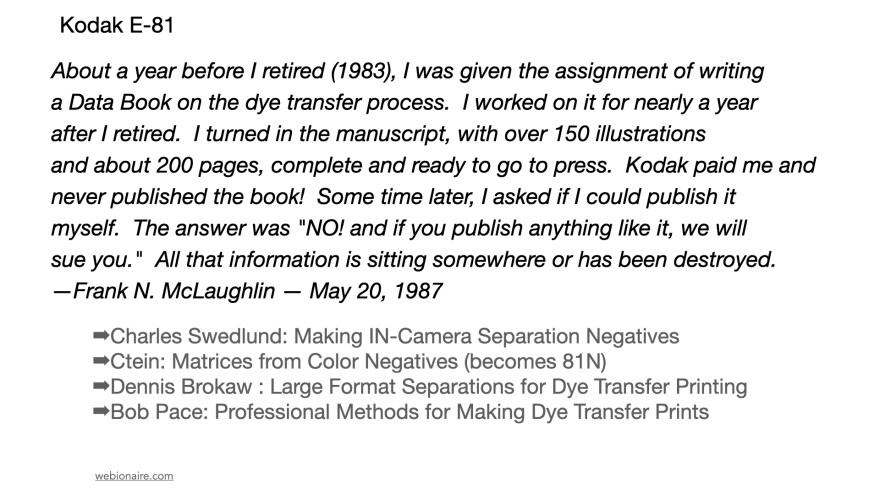
Kodak Lab Days — process imagination diminished
Kodak’s Marketing group served as trainer — no large lab, those with more than 20 employees sent staff to Kodak. The Generals labs did— the GEs, GMs, etc. Who did it serve: the Kidnappers, the Grip-n-Grin in-house, industrial photographers. As well, the Jane & Joe Portrait and Dance studios gaining marketing knowledge along with a how to make prints.
Commercial multiverse labs and the multitude of their spinouts did not rely on Kodak for training. Kodak over the years [1960 -> 1980] became less a point of origin for the practices of commercial photography.
Small time labs, solo shops, these people with much down time between accounts were the writers of pop photo pieces. A prominent reason for failure of the novice is following a path made complex enough to fill pages of instruction. This means that much of the awareness of the process came from people making little use of the process. These writers didn’t encounter a wide enough problem field to have wide enough, nor deep enough, solutions. They give the first answer; the one that Frank McLaughlin would provide over a phone call.

Labs knew more than Kodak. True, they didn’t share. How would they share? Labs weren’t in the business of publishing articles or books. Employees moved across labs, certainly in Pickle Alley. We recruited skilled staff for most roles. They came with portfolio, frequently were given a test. The large labs always needed people into the late 70s.
even knowing how to make tri-x doesn’t mean you know how to use it .. The skill to using tri-x and the skill to making tri-x are very different
Topic Prior Postings: One The Other
My 3 Lectures: I taught twice (the 60s) the first was retouching. The staff attending didn’t grok that proofing could be done using Color (type C) Paper. The second time, I asked if they knew rollup, wipe, and poison meant as dye shop terms. They all said they understood… only one was able to give a passable explanation for poisoned mat. Their staff skill was low. I never hired anyone who said they had been trained by Kodak.
- retouching masks/seps
- order of roll //pickup for removal
- multiple dyes from same mats ..mixing alternate dye types. Making seps for alternate dyes
build a brick at a time. don’t defeat yourself early in your learning. get the minimum amount of equipment; master that, add equipment to build on existing mastery.
look for answers to questions you encounter with your work.
but answering questions by people who are trying to tie their shoelaces when you’ve been through the design and gotten past the question of why do we have laces
if we have better shoes, would we need laces
The solution to Kodak’s magenta long Dmin was solved by a Virgina lab — triethylamine — several labs were using the method successfully so Bob Speck altered the Kodak formula to include the method
Kodak restricted access of dye transfer overseas in Europe to those places they could provide technical support.. One aspiring solo lab came to the states and I gave him two days of instruction he returned and proceeded to smuggle the transfer materials from London to Paris and by train to his lab… Clear motivation increases craft skill more than any other personal quality. it separates the hobbyist, the amateur, the professional, the exhibitor from the exhibitionist.. perpetual novice.. arrogant amateur.. success does not suffer arrogance …
OIC: this century, I was approached by a few earnest film makers interested in dye transfer. I put them into a hunter mode. They succeeded. Dye does live via: Small private chats. And the world, even a small one, of practitioners. So the error places remain in bliss.
[When a meeting, or part thereof, is held under the Chatham House Rule, participants are free to use the information received, but neither the identity nor the affiliation of the speaker(s), nor that of any other participant, may be revealed.]
Wrong effort doesn’t get correct solutions. Those who don’t achieve early will not achieve long. First steps must be accomplished easily if you are to achieve the complex.
In learning dye transfer printing, the quicker you learn the basics the higher your skill will become. Clarifying: if you can’t make a print within three days of effort, you will never achieve high skill in color printing. Everyone who made dyes for/ with me, was printing on their own by the third day of instruction. Those who came to me about a decade ago were able to re-confirm this estimator. By their estimate, dye transfer is easier than learning texture modelling by several orders.
To those talking about labs and their secrets:
- how do you know what labs did
- you never worked in one… not even small ones
- plus, since, you say, they refuse to talk to you..
WHERE DOES YOUR INFORMATION COME FROM? What armchair provides such grand view of the terrain. From which phone booth are you traversing the past?


You must be logged in to post a comment.