Making Film: Subbings

Kodak’s ‘corona’ people where: Yost & Heidke — US3582333 as example
Yost & Willison — US3573916 as example
back around ’12 there was a corona discharge unit made by DIY — posted on YT
corona discharge has short utility as subbing — 24hrs or so. 
3M patents show using the corona to get the subbing started — 
— charge it
— coat with your gel+ components that aren’e light sensitive. this permits you to store a subbed roll for use later

corona discharge causes coating (partial reversal) problems in color materials if they are coated soon (an hour) after being charged. a Yost patent discusses.

an earlier, more fundamental approach is in
 PHOTOGRAPHIC FILM SUBBED WITH HARDENED GelatinGale F. Nadeau and Clemens B. Starck, Rochester, N. Y., assignors to Eastman Kodak Company, Rochester, N. Y., a corporation of New Jersey Application September 16, 1939, Serial No. 295,268

Debunk: Who Made Matrix film? An absurd answer: US Military (army) . That is foolish; the military doesn’t make anything. Not the US military. They may contract for it from some private firm, such as Kodak, or Defender, or ANSCO, or DuPont, but they don’t make anything — not even bullets and boots.

Kilborne made CCA (Tampa) matrix film. Later, they coated Dr. Patterson’s (DTC; Houston) orthomatrix. It had too fine a grain. Matrix film should be a cubic grain, irregular distribution sizes for easier tanning. Defender /DuPont was an original maker of matrix emulsion. Technicolor purchased from Kodak. Fuji made matrix film .

Namedrop: Bob Pace. In NYC he printed for Penn; later he was at Graphic Process Co. (Hollywood) and Pace Color Prints. Then, at Frog Prince (San Francisco)

One place of learning: High School of Printing (49th Street)
Easy Assembly Color

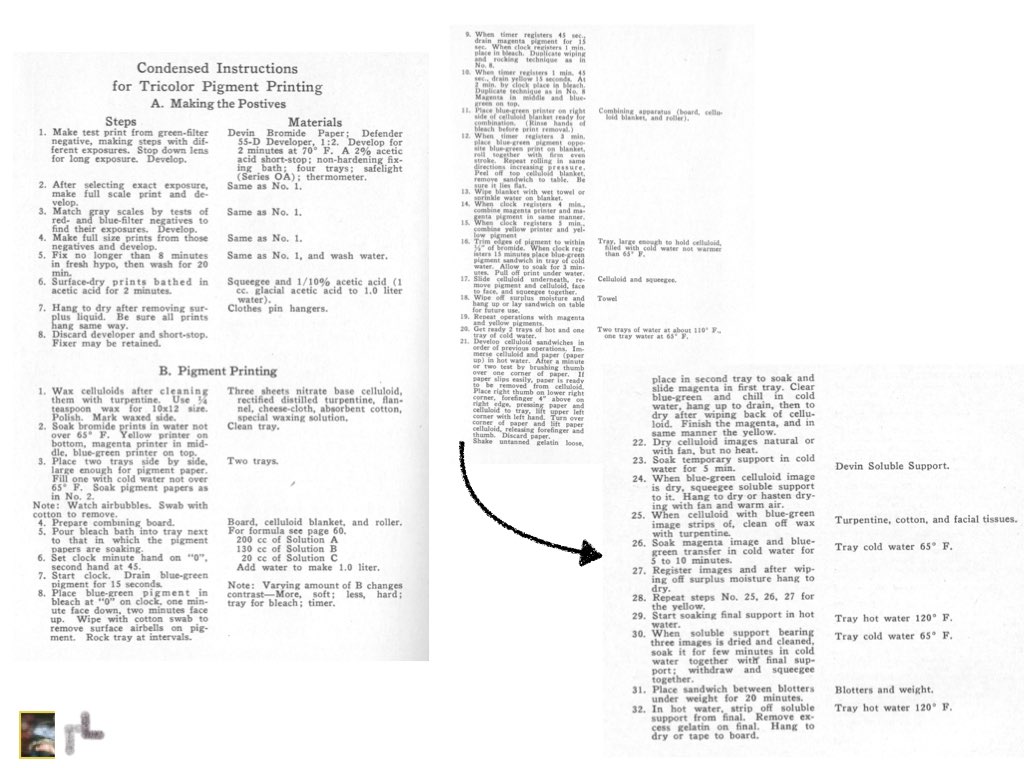
handmade color was once the main way of making a color print. At first, obviously, the first color photograph was made by a technician — not purchased, but made. That process was an assembly process. The print was made by layering separate images until they formed the final single print. This was the synthesis step in a “multi-color” process.

Assembly systems are divided into “roll-up” and “lay-down” methods. Was it a ‘dye’ or a ‘pigment’ that is being assembled. They could also be classified as ‘direct’ or ‘indirect’ transfers. These processes are more mechanical than any other way of making prints. The whole direction of the Kodaks was to do the assembly at manufacture time: the integral, type C process. The key researcher for Dye Transfer was moved from dye transfer to type C print work by 1961.

The two most successful systems, those have large enough commercial backing to sustain many users, were Carbro, and Imbibition printing. Imbibition prints were more often known as Dye Transfer, and Wash-off-Relief.

Either process was time consuming, involving many steps with moderate to high skill needed at each. The difficulty lay in the combining of the steps in such a way as to be able to solve more problems than you created. Each stage offers choices; making the best choice comes from having a nice overview firmly in mind.

Either process could be described as consisting of very few steps. Leave out enough and we could just say: expose then print.

Teaching was always a balance between showing, telling, and knowing what to leave out.

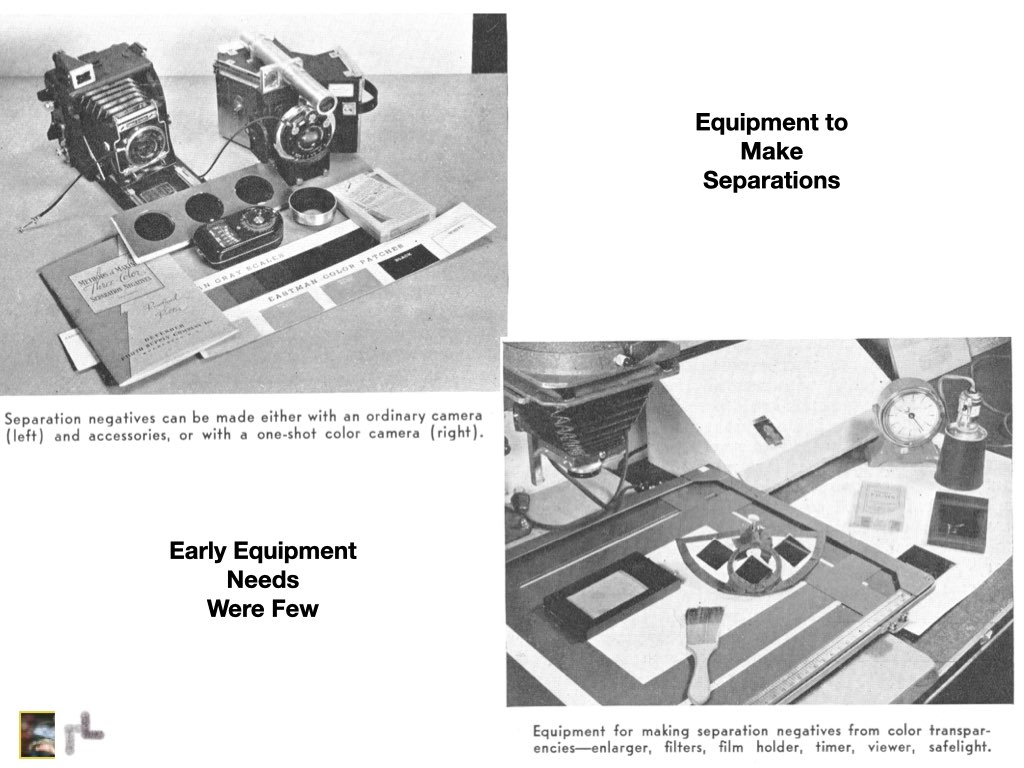
Early Equipment was primitive by what anyone working in this century would have:

The processes compared in “follow list” form make their relative complexity obvious. Obvious about why Carbro was replaced. And why Kodak spend so much effort to follow the imbibition path broken by Technicolor.

The biggest step to take these days is: make tissue, or make matrix film. The history of assembly has returned to the carbon route. Firstly because the alt photography community began it as part of the 60s photography surge.

I’ve posted enough over the past years for someone to be able to make matrix film. There are enough webpages and specialty groups for anyone to be able to make their own carbon tissue. Carbro is a different, but easy enough alteration to carbon printing. Just about any soft emulsion photopaper can be used. Bromoil is harder to make than a carbro.

To begin. Begin. Make your own outline. Start with the minimum, not the maximum. Go faster than you feel you can. Make more mistakes than you want. If you read for an hour, print for three.

Assembly isn’t easy until it is done.