Making Emulsions: Key Patents

Emulsion Making:  US 5132203

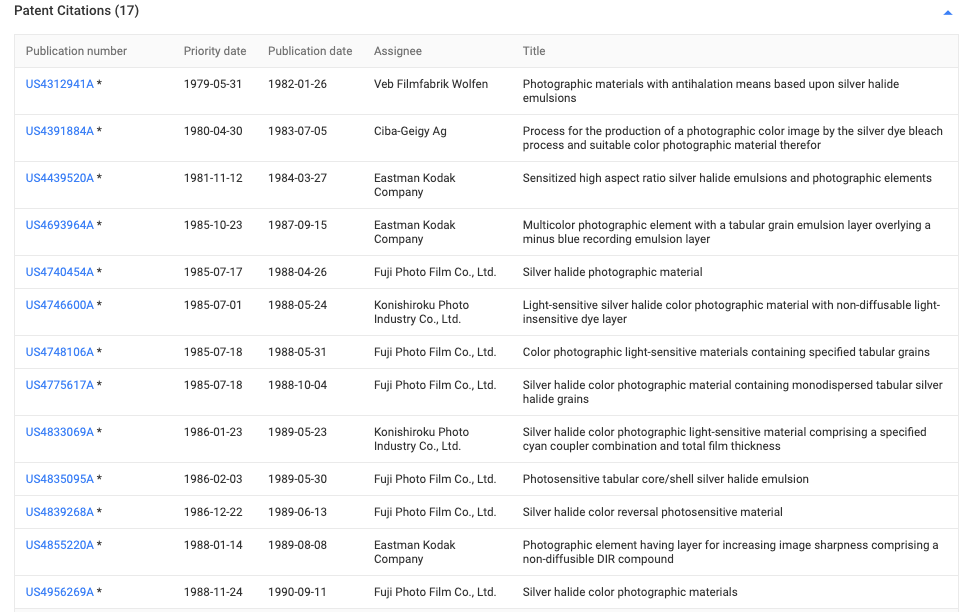
Photographic emulsions are disclosed comprised of radiation sensitive silver iodobromide grains, at least 50 percent of the total projected area of said silver iodobromide grains being accounted for by tabular grains exhibiting a mean tabularity of greater than 5, at least 10 percent of which are comprised of two opposed parallel major crystal faces, a host stratum having an iodide content of at least 4 mole percent, and laminar strata containing less than 2 mole percent iodide interposed between said host stratum and said opposed major crystal faces.The emulsions are characterized in that each of the laminar strata is comprised of a surface layer forming one of the major surfaces and having a thickness in the range of from 20 to 350 Å and a subsurface layer located immediately beneath and in contact with the surface layer containing a hexacoordination complex of a Group VIII period 4 or 5 metal and at least three cyanide ligands. InventorEric L. BellKenneth J. ReedMyra T. Olm // be sure to check the 27 ‘cited by’ items, particularly those by Kodak.

 Coating – US 2761791

THE METHOD OF SIMULTANEOUSLY APPLYING THIN COATINGS OF A PLURALITY OF COLLOIDAL MATERIALS ONTO A WEB SUPPORT IN DISTINCT LAYER RELATIONSHIP COMPRISING THE STEPS OF MAKING A SOLUTION OF EACH OF SAID COLLOIDAL MATERIALS, FORMING A COATING BEAD OF SAID SOLUTIONS IN BRIDGING RELATION BETWEEN THE SURFACE OF THE SUPPORT AND A STATIONARY COATING DEVICE SPACED TRANSVERSELY THEREFROM, SIMULTANEOUSLY FEEDING EACH OF SAID SOLUTIONS IN THE FORM OF A LAYER INTO SAID BEAD AND IN SUPERPOSED RELATION TO THE OTHER SOLUTIONS WHEREBY THE INDIVIDUAL LAYERS ARE MAINTAINED IN DISTINCT SUPERPOSED RELATION, AND CONTINUOUSLY MOVING THE SURFACE OF SAID SUPPORT ACROSS AND IN CONTACT WITH SAID BEAD SO THAT THE SURFACE OF THE SUPPORT ENGAGES ONE OF THE OUTERMOST OF THE SUPERPOSED LAYERS IN SAID BEAD AND SIMULTANEOUSLY PICKS UP ALL OF SAID LAYERS AND MOVES AWAY FROM THE BEAD WITH THE SOLUTIONS IN DISTINCT SUPERPOSED LAYERS. Inventor: Theodore A Russell 1953 // it was based upon patents held by Bell Labs. … see Ilford’s US2941898A for more.

Dopants in Films – US 5360712

A process is disclosed of preparing a radiation sensitive silver halide emulsion comprising reacting silver and halide ions in a dispersing medium in the presence of a metal hexacoordination or tetracoordination complex having at least one organic ligand containing a least one carbon-to-carbon bond, at least one carbon-to-hydrogen bond, or at least one carbon-to-nitrogen-to-hydrogen bond sequence and at least half of the metal coordination sites occupied by halide or pseudohalide ligands. The metal forming the complex is chosen from periods 4, 5 and 6 and groups 3 to 13 inclusive of the periodic table of elements. The incorporation of the transition metal ion dopant and at least one organic ligand into the cubic crystal lattice of the silver halide grains can be used to improve photographic performance. InventorMyra T. OlmWoodrow G. McDugleSherrill A. PuckettTraci Y. KuromotoRaymond S. EachusEric L. BellRobert D. Wilson 1993

note: follow the patent to: WO2013032827A1 classification: G03C7/3041 Materials with specific sensitometric characteristics, e.g. gamma, density

Color Films – US 5302499

A color photographic recording material is disclosed which contains tabular silver halide emulsion grains of specified dimensions in at least two color records to enable improved speed and sharpness. InventorJames P. MerrillLois A. BuitanoAllan F. SowinskiRichard P. Szajewski, 1992

Classifications

G03C7/3022 Materials with specific emulsion characteristics, e.g. thickness of the layers, silver content, shape of AgX grains

Finding the Print

Finding a way isn’t always direct. Comparing one thing to another isn’t always direct; however, knowing the ways of your own learning, in addition to being directed well to similarities among processes is, not merely strengthener it is broadening. You get deeper and wiser. Strength with flexibility.

This is about heliogravure — this is about dye transfer, imbibition printing. It is about ink on paper. It is about dye on paper. It is about both, because it isn’t really about them, it is about learning them; understanding what the hard parts of the problem are. About getting to the harder part earlier, so that you can survive the dull parts: the online dullards, the arrogant ignorant; the drewids.

This began with a review of Lely Constantinople’s work:

Lely Constantinople is a photo based artist from Washington, D.C. who has been exhibiting her work nationally and internationally for over twenty years. Her photographs are held in the collections of the Anacostia Community Museum, the Smithsonian Museum of American History, as well as numerous private collections. She is also an independent photo editor, archivist, and teacher. “

Her newer work is Heliogravure, which she learned from Fanny Boucher. Ms. Constantinople could have also learned from a text; there are many. For my purpose consider that if she’d have read a book, she’d have spent pages on making negatives, exposing, etc., at last coming to something like: “ink and wipe the plate. Let’s look at how these words expand. Lucky for us, Youtube has two good examples:

ink and wipe … a longer view

in the above video you may notice the densitometer in the upper left — it seems quite abandoned, irrelevant to the key part of the process of getting ink onto paper.

And the second, shorter version of a print pull. Notice how much hand work is involved; the importance of the fingers and palms. Every printmaker knows this from experience — not even early references place enough attention on this aspect.

Fanny Boucher — short version

Dye Transfer is much the same. You could spend hours reading, knowing everything about the process. Having a full understanding of masks, separations, ph controls, etc, etc. And you will never get to the real part: dye goes into paper during transfer!

The rollup step is where the work occurs — everything else is intermediate. Important, but not so important that it should be your entire focus.

Printmaking is like making love: somewhere between the bathroom wall, and a specialty in gynecology you will find truth.