Dye Transfer Fantasy

Products fail by being used as merit badges, marks of distinction, instead of making art. With the online photoworld, it is enough to say you do, then hide behind a ready alibi. “You can’t see it on the web, it is too analog perfect to be digitized.” They abhor “art-speak” as they engage, mostly in “craft-speak.”

Parrots don’t print. They hate artspeak. They love craftspeak

The market for dye transfer Materials is nonexistent . it is a fantasy . they transfer materials must be made for someone who is using them intently consistently . The firms which can coat Silver sensitive Materials are reducing their small capacity or closing it completely . In 2010 there were several times more coaters than are available now . In the US, of the three firms that could’ve coded Silver sensitive emulsion, two have left that market . Both of those locations coat emulsions for dry lab photography .

For most of the 21st century dye transfer has existed as a small scale competitive conversation transacted online . very little of the discussion has involved experience based opinion .
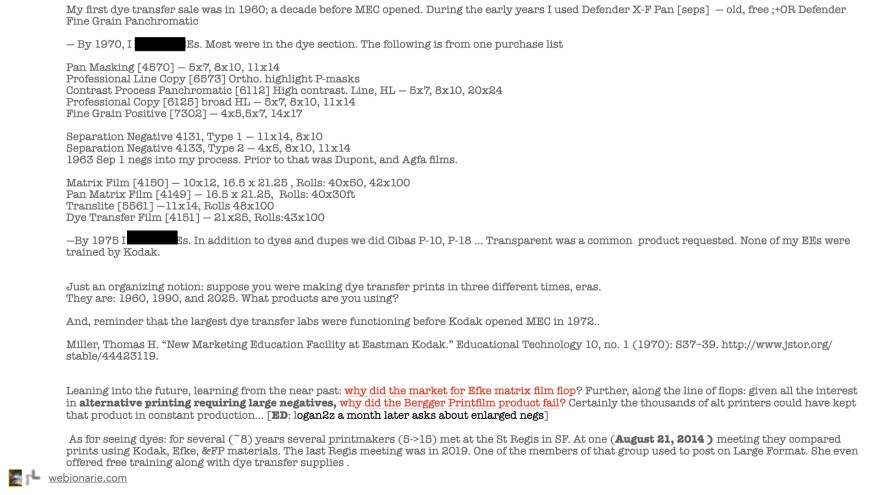
— example order from Pickle Alley days.

 Why didn’t another able coater supply a version of matrix film to the still hungry marketplace after FK’s collapse? Certainly there were coaters with excess capacity along with the ability to formulate their version of the open source Browning/formulation. Even the clamor among the alt-print world for silver solutions to the “make it bigger” topic will not support a lab film. Digital negs rule, even among the darkroom adherents. Oddly, even after many complain about the inferior negatives produced using inkjet / overhead film workflow.

The question ONEIDA posed was about markets for a product once made. If a film sells, others will fill the orders.

EFKE (FK) wasn’t profitable. They couldn’t sell enough film. Matrix film was a risk that failed as revenue.

Bergger Printfilm was a toll coating based upon Efke Printfilm. It was designed, and released to satisfy the ALT photography printmakers searching for solutions to making enlarged negatives for UV sensitive contact processes.

Like AI’s arrogant children, they ignore the question in order to make a point: they know better, not just more, but more as well as better. They don’t need to read the question. Easy as Pie.

Time spent to learn:

Mr. Answerman has accumulated over two years talking about color photography, using as his merit badge knowledge of dye-transfer. This time is if he spends only 5 minutes reading and posting on each of his posts across three frequented forums. Two years is more than enough to master the process. More time than even the name-dropped heros spent.

NB: the durable dye-transfer groups — nope!


  • key patent by Wey and Whiteley.
  • https://en.wikipedia.org/wiki/Debye–Hückel_theory
  • Russell, Chemical Analysis in Photography
  • Croome, Photographic Gelatin
  • Deryagin, Film Coating Theory
  • Zelikman, Making & Coating Photographic Emulsion
  • Gorokhseskii, Spectral Studies of the Photographic Process
  • Duffin, Photographic Emulsion Cheistry

This isn’t tuesday– suppose you were learning a subject that had deep, long-time history, would you start at the end? Which end? This from the early part, that which made the thing possible was a set of references, most of which are lost on the shelves of unvisited libraries. Nonetheless, here, 1945, photochemistry sources used by the original makers of color systems:

AI. Learning Dye Transfer

give it a try. If you know the answers well enough AI chat answers will amuse, or frustrate. The answers the at hand models provide are based upon web posts and link count results which are somewhat circular. The answers provided are incomplete, sounding much like a salesman taking over the help desk during lunch. Or, good enough for an interview, but falling far short of being able to make prints in a commercial lab. But why?

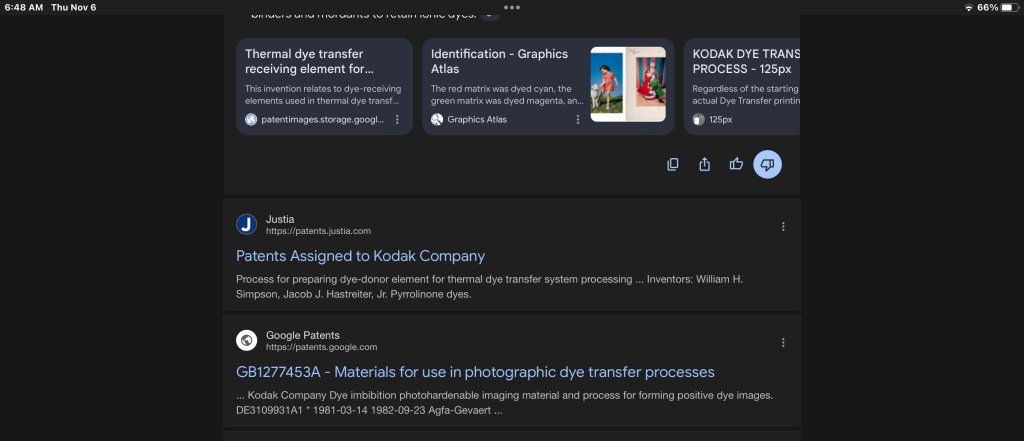
Ask google for dye transfer patents …. they fail

The models seem to have been trained using data collected from internet forums along with, at most, 4 website collections of publications from the 80s. In short, they don’t go back to origins, far enough to source matterials; worse, they don’t detail steps or stages of the process that would be recognizable to a practitioner, nor are they specific enough for the novice seriously intent on reproducing the process.

I asked general questions — most models got close enough for a high-school paper. The more specific I got, the less useful their responses.

my dye transfer chats were with these models as well as Google’s browser version. It was most dependent upon websites which meant that the more detailed my request the less accurate the response. Google’s link valuation system presents the problem of knowledge transfer remaining among those with little direct experience in the hobby fields.

As of this point [Nov 6, ’25 ] I am hesitant to post any direct results… as many of the Models say … bubble, bubble, thinking… bubble.

When asked for references used in answering me, it answered with seemingly plausible references. At least until I checked, first the patent, next two journals … I stopped with those non-existent materials. Who would check? Who, other than me, has the time as well as prior knowledge to even attempt the test, verification cycle.

The bubble is worse than financial.

In Texas Memoriam

James Bones Jr. November 1, 1943 — November 17, 2023 [80] . Fort Davis

News is never new in Texas. Knowledge travels slower than gossip, often missing the train. He lived in the ‘tiny texas triangle’ — a southwest artist.
The world, the urban, the built. Jim bones survived in the tiny triangle, but didn’t flourish . Small grants, wives, persistence, kept him alive. He is noticed by the dye transfer, Porter groupies on internet darkroom forums. Flutters of worship words of those who didn’t make it as far as he did. They covet the craft badge, envy the possible life of an artist. Sadly, they failed all three legs of the triangle.

the Tiny Texas Triangle of west texas. Small, contained worlds are the hallmark of rural america. Art in small places popup around small colleges.

He was one of Eliot Porter‘s printers. ” I printed for Eliot Porter in the late 1970s and occasionally he would have me make a black and white print by using the magenta matrix from a full color image to sequentially apply all three dyes to the same piece of paper.  They were beautiful and had a depth unavailable with silver emulsions. Sincerely, Jim Bones (2003).”

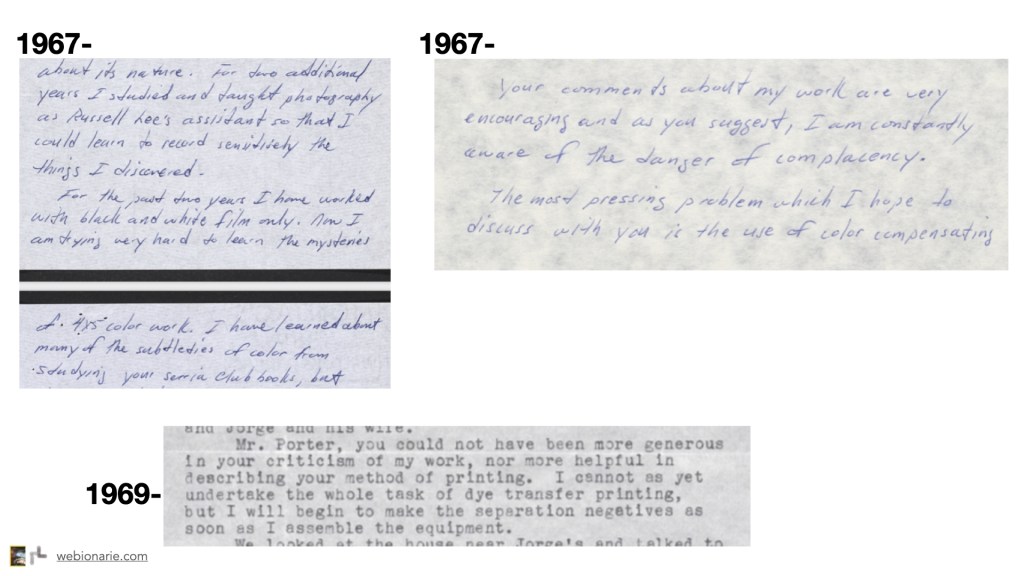
Bones [JB[ wanted to make photographs like Porter’s. To achieve this, he visited and correspondent with Mr. Porter, seeking advice on most topics of making photographs and a living with photography. In 1967, Porter[1901-1990] was 66, while JB was 24.

Scattered posts:

JB printed, 1982, a Russell Lee negative made in 1948. EX: https://www.cartermuseum.org/collection/trucks-loaded-grapefruit-lined-worlds-largest-citrus-juice-canning-plant-weslaco-texas

Film proposal: A Natural Revelation. Film about Eliot Porter and Loren Eiseley.

NB: Oooh is that a dye transfer, for more

How short the memory of online groups… is it because they were never close?

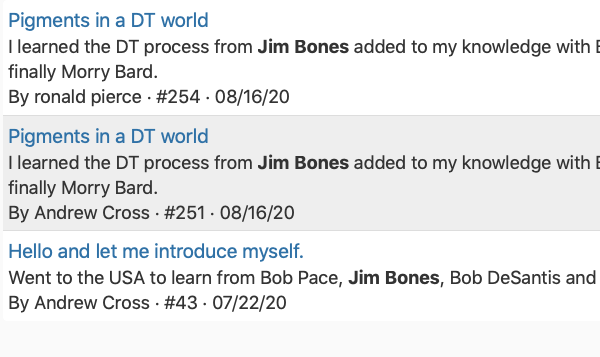
search on the dye transfer group list. No notice of Jim’s death. Not even a grateful student noticed Jim Bones had died. In ’20 a memory of; as of ’25 his passing hasn’t been noticed.

His passing was recently spread by a small IM group by a person in Japan planning a visit. That prompted my checking.

…. so it goes…

;; wives : Ann Matlock ,Ellen Calonkey. Mary Bones

Jim Bones “Finding The Light” Event

Mary Bones, Director of the Museum of the Big Bend, and Ann Matlock are in conversation with Becky Duval Reese, former Director of the El Paso Museum of Art and co-curator of this exhibition. From our special event on March 3rd, 2024.

https://youtu.be/b4H3Pljkar4?si=yUzL923tjTVoLwDL

Jim Bones and Dye Transfer Printing

2016 June 5—16:” “Dye Transfer Printing Process” with Dennis Thompson and Jim Bones. Fees: $350 for one week, with additional $75 lab fee, $525 for two weeks. Alpine.

How much success did he have? The price of living in the shadow of others. His work that is archived was donated.
For example, this: Start Time: 04-01-2017 Time Left: Bidding Closed Value: $495.00 — Even with a grand pitch:
Dye transfer prints are simply without peer. They have a richness, depth, and fidelity unmatched by any other kind of photographic print. They can show extraordinary subtlety of tone and hue, combined with a brightness range of 500:1 from blackest black to whitest white. Nothing else comes close to the magnificence of a dye transfer print.


They all die: David Leigh Rathbun died on April 9, 2020. Jorge Fick (1932–2004)

Success requires skills in two spaces… craft is the easier component.