Learning Dye Transfer

Maybe. Actually, not. Kodak Dye Transfer ran its course — it was a commercial darling, but a market failure.

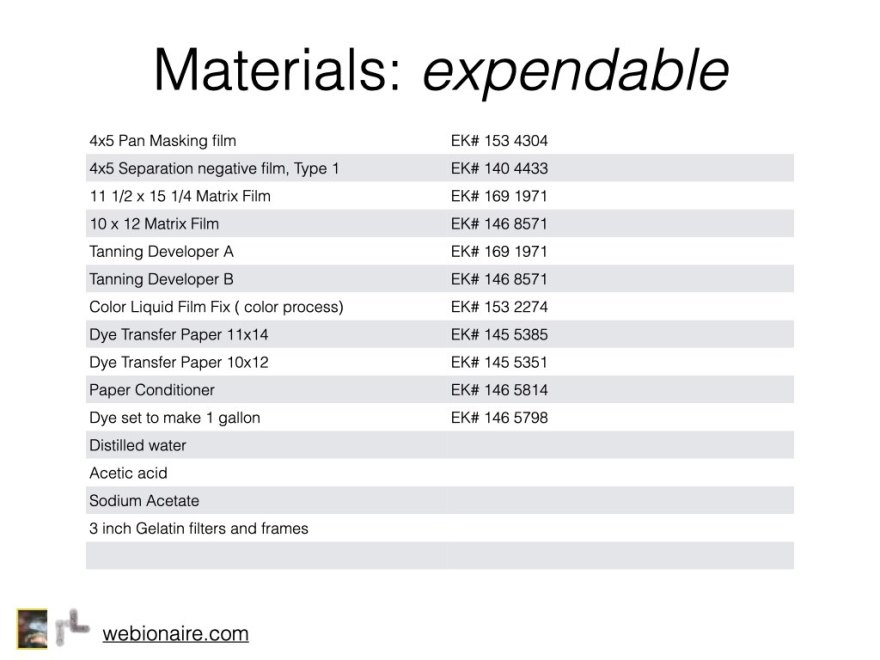
One difficulty with learning the process was in getting the relevant information together. Too often the beginner was stalled with too little information; more often they were showered with too much information. Like most first steps those first choices of: ‘how much is enough’, and ‘where to get it’ stalled most learners. Like this bit of information:

A Table of Contents:

  • Making color separations
  • Separations from masked transparencies
  • Evaluation of separation negatives
  • Post treatment of separations
  • Masking
  • Fake color and other alterations
  • Controls beyond
  • Materials and tools for separations

AND where is it now? You of this post-Kodak world learn from the survivor — the loud survivor. Many of whom are known more today than they were then. They didn’t participate in the labworld, instead they lived on the edge by writing about the process — word by word. Dollar by dollar. Until in this electronic forum they are the only voice. What do they say? Mostly tales of their purchases and notice of their sales — everything is on layaway.

Off site links illustrating the world view of those that did not, as they talked with one newcome who did — She became the spine of OIC, the only group who rolled new prints with a new matrix film (F18).
Separations: start here

notations on making separation negatives. bits from the past intended for today.

DSChromeCN
R252970
G586199
B4747b98
wratten filter numbers

direct seps are easiest, but you create “time seps” as well — trichromie.

contact seps are easier than enlarged seps. 
learn what standard light is -- then you can begin to translate "old" literature. Use the theory and experience of those who made their living in labs.

contact: standard light
 standard light - tungsten -
first, early innovator lab: Evans & Peterson Color 
K&M filtermatic and K&M Point Light … Omega ULE system
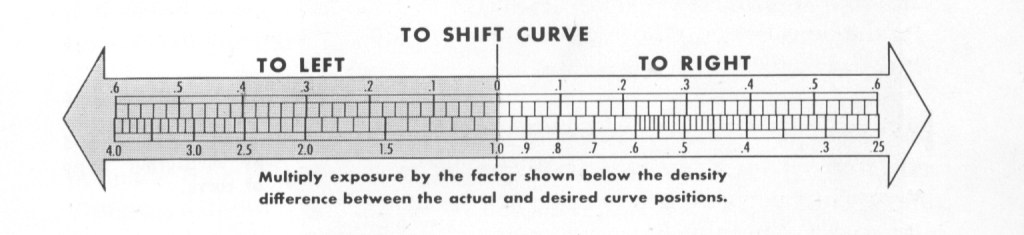
3 FC = .3 density from a 3.0 wedge density
AIM ~= .4 shadow negative

using silver density steps will introduce you to the “green problem” — aka, green gaps
calibrate with color strips &&& silver wedges

derive “Relative Exposures” of the sep set
29, 61, 47b

notes from tabula rosa: super XX to Tmax. XX is twice over. convert those historical refs to current start points. Oh. use HC-110 B at 72F
—
visual evaluation/ no densitometer, make a BW print onto known paper.
print the Green Sep, unless GREEN is the dominant scene color. (then use red)

—
First seps from: DuPont Fine Grain Pan (20x) easy

Grain of seps: 1975-80)
Plus-X -- lowest, best enlargement
Sep Type 1 (reciprocity notes)
XX - highest grain
         -Green: less exposure longer Development
—
DS Base exposure: (working with ‘factors’)
(25) Red ~=~ 1
(58) Green +1/3
(47) Blue + 2 2/3
OR take blue as the base exposure, then apply ND filters to the RED & GREEN exposures.

— newton ring 
offset powder // gum glass
watch RH of film room.
don't mix exposure, storage, processing stages in same room.
—
tmax contact [at asa 6]
29	24 sec
61	14 sec
47b	135 sec

—
HC 110 A,B  // C,F
DK50  st, 1+1 // 1+2, 1+3
D76	st, 1+1 // 1+3
Seps // masks
from back in the day:
Dupont 16D  6,7,8,9  == for gammas of .6 to .9 /.Sure made it easy.
--
watch how you dry the seps. angles matter. never force dry (use "secret" dryer)
learn how to mix D76 so it doesn't "shift" on you. Oh, avoid those who don't know how.

########

two shoes

  • the path is the destination
  • the destination isn’t on any path
  • MA (japanese)

###

PS. what do I currently use? Ilford: delta, ortho plus, fp4+ — not Kodak. I have it. Have used it. don’t now.