Gossip As Knowledge

Specialist forums occupy a large part of the internet; they are presumed to provide a place for increasing the knowledge of a field. Photography has always been an “outlet” for the temporary, ie, weekend artist. Serving that thirst, acting as bridge between seller and consumer has rewarded many people with small skill but large appetite. Those folks formerly  put on workshops, now they host web forums for the seeker.

as wee all know: There’s a Seeker Born Every Minute.
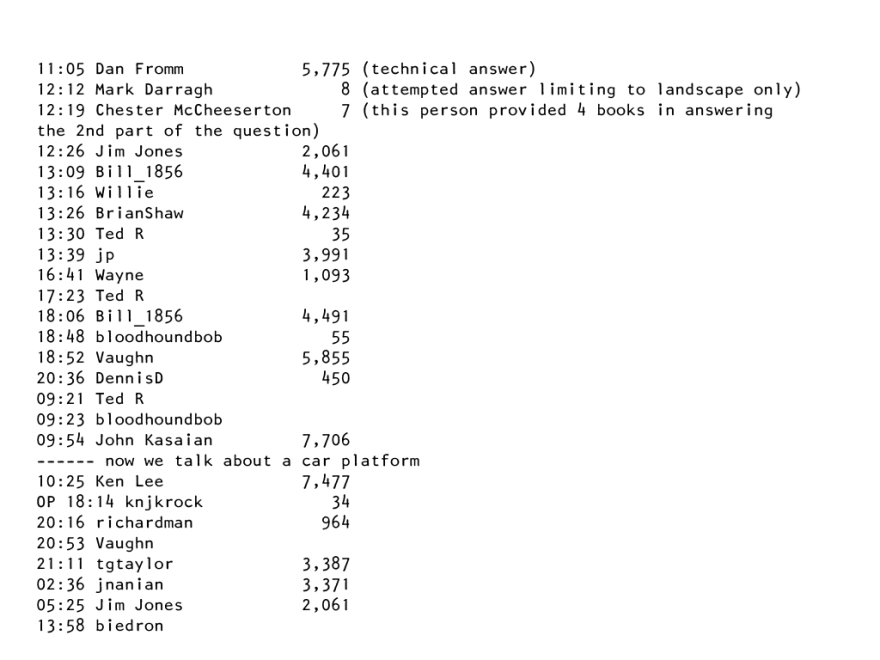
LFF Thread
thread link here

 What Knowledge

Caution: restricting topic restricts growth, resulting in in-breeding, as well as in-fighting

If you restrict your discussion to technical in a field with no growth, you have no growth. You have reached saturation. Adding more examples of addition doesn’t increase the field of mathematics.

The newer members come to the photography forums for two broad reasons. They contribute, first as question – easy ones. But who answers them? The stays are likely the ones to answer first, and frequently. Who are they? What questions can they answer; do they answer?

Q: point me to technical, and aesthetic books limited to Large Format

The first responder was a high-post participant. He provided the technical book list, which was repeated by several of the later posters, who, apparently, hadn’t read the answers already provided.

  • ‘Looking at Photographs’ John Szarkowski, 1973 MOMA
  • ‘Landscape: Theory’ published in 1980 by Lustrum Press
  • ‘The Nature of Photographs’ by Stephen Shore. 1998
  • “Andreas Gursky’ MOMA catalog from 2001, essay by Peter Galassi

28 year span of opinion about photographs. The time period covered the rise, as well as the changed status of photography as an artform held within established museums. It is a good answer – its only problem – it is incomplete, but it will not be added to by the Large Format participants. They don’t grow that way, preferring instead the procrastinator’s aesthetics. They switched from answering the question to opining about a (famous) photographer atop his car with, keeping it large format oriented, a big camera.

Enter the discussion about Dog Houses in the Boardroom. When a topic the meeting members can’t discuss is broached, there is little discussion, however, when a topic of little consequence is raised, everyone can, and will, offer a point on the matter. Group unity with the result being that no important matter is ever settled; no important question answered. This produces an organization that is comfortable but static; passive. It is at its end stage.

Film is dying  because the Forums are Dead-ends – or, maybe Film is at a dead-end so the forums are the gathering ground of the bachelor herds – those without heirs, just stains and limp standards.

What More

There are two current resources that could be used to enlarge the imagination of a View Camera photographer:

  • “Lori Nix — The Power of Nature” ISBN-10: 3868322744
  • “Unspeaking Likeness”  Photographs by Arne Svenson.  ISBN-10: 1931885729


Forum Activity

the first Social Networks, before the grand IPOs, were specialty bulletin boards started & run by technicians for hobbyists; often their hobby.

The remaining active boards are self monitored, well segregated groups that are subject to changes in habits. What they do, mainly, is talk among themselves about “dog house” issues. The most frequent posters are most active over social matters; this is the reason that the social network sites have grown so large, so quickly, and will probably take over the conversations conducted by the “old boards.”

Recent update: scans at 7AM, & 7PM for a week produced these average values for 2 boards; the one dedicated to a self described ‘elite’ photographer’s niche; the other is a digital focused board which serves the high density MFDB hobbyists.

FILM BOARD: Members 34,219 Active Members 3,192  16 posters 11 threads

DIGITAL BOARD: Members 5,470  282 users online. 34 members and 248 guests  29 posters 7 threads

The large format forum prides itself on a “large active” membership, while actually few, very few members post. They also post most actively on the “dog house” threads. Topics about themselves, or about non-photography topics — something everyone is prepared to provide an opinion about.

forums

The smaller digital board heats up mainly during product announcements, otherwise its active threads are over shared imagery. Most of the responses to the pictures mimic those of the Film Boarders — “nice” “well done” “great lens” “what type of ” “where is that at”

other posts on this: http://wp.me/p6UdTM-Zf

Factor X 05

In getting from nothing to something, you travel through else,and else, and else again. How do you do this; how difficult is the travel; are some travels easier? A conjecture of success, by which I mean, being as known as you wish.

Can you get someone interested enough to sustain their interest?

Determining the Contrast

Natural ability makes doing X easier. The factor I’m considering isn’t physical, rather it is

You can’t teach someone to be 7 foot, but you can improve being 7 foot. 

some other set – an X set. Let’s use Steve Jobs as an example of it — he is a 5, the top end of the scale. Most people are 0 on this scale. They aren’t even certain there is such a thing. They mistake X for something else rather than the cluster it is. The 5’s, on the other hand don’t understand why everyone doesn’t know how to do X, and are infuriated when their surrounding 3 & 4’s don’t get more results. This X set is psychological ability. 

In order to succeed at having others assist you, you will share characteristics of the con man. People will be wary of this. But the nature of X is such that you have resilience without being destructive. Many think this means being competitive. It is not. This ability sets out similarities not differences. Successful others will be trustful of you, rather than being wary.

In asking you are giving – not giving in;  not giving up – Those who have will share because they know they aren’t being tricked. You are prepared to give and share, not give and take.

It Goes Wrong

The followup fails because you failed to start off correctly. Further, you can’t correct your actions. You don’t have resilience that is reliable. It isn’t the asking, it is the follow up. Your follow up, not theirs.

Trade Show Effect

I am a reticent attendee of trade shows. In my far past, I attended for training, and, for a few years, I attended to sell. This was my retouching equipment and supplies. It was never easy, but it was the cheapest way to demonstrate to the novice, to convert the mis-informed. Mostly it was to connect with existing customers. Maintain their allegiance. Follow up was key to new accounts. That was the hardest part — who, in what way, with what frequency. When to stop spending this follow up time with this prospect.

The Difficulty:

Determining those people who occupy your time to their selfish ends. Those people who are just killing time, yours and theirs.

I was aware of that caution, so, along with my innate self reliance, I’d find reasons to ‘move on’ to other prospects. One such case, I’d presented to a regional director. Seemed promising, but after a few months I put his card into the ‘annual’ file. But my persistence hadn’t been offensive, just not productive. He remembered and contacted me. In those 6 years he had left _company_, opened a paper box maker, then an outdoor advertising company. He wanted my coating system in that operation, but I’d closed up, moving on to other things. He had persisted. He had remembered. I hadn’t.


The prompt for this post was forum activity over the upcoming Fotofest in Houston.

next: Origin Of This Post