
Updated: Sep 5, 2016 … more info coming on rationalization of stays.
A firm in transition, being directed by a firm hand but uncertain direction. Behind the needs of the member users – those who provide the free labor which drives the value of the investment. Recently the Large Format Photography Forum had another incident of escalating thread closures.
Moderators change online interest groups. Some increasing, but most decreasing member variety and vigor. For decades, psychologists and sociologists have studied control within groups, the simplest repeated experiment is in giving control to someone who doesn’t have great control in their daily life. They tend to increase the exercise of discipline, even to the extreme. Many ‘new managers’ strike a very harsh standard seeking to improve the group they’ve begun managing. Some professions attract these people, reinforcing their existing sub-clinical need to be respected.
This Isn’t About Art

Change over time

The feedback section is the ‘suggestion box’ of a forum. Every time a skirmish happens, the mods change rules in an effort to maintain the order, and keep those they wish. They freely bump/ ban others, usually those new to the board. The big changes occurred over changes in the Buy/Sell section, and in clarification of the definition of Large Format. This was solved by keeping the definition, but in permitting something that had been in the members only area to be brought out into the Indexed domain of the site.


Symbolically, the “image threads” are between “Gear” and “Lenses.”
LFPF origin: when the large format forum opened imagery wasn’t the purpose. The first posts were about lenses(1997) and locations for landscape(1998). The image share and discuss began in 2007. The pace of imagery added, increased with the addition of the “Everything Else” area. The LF arena has fewer new threads — there aren’t new topics in their visual dictionary. This activity is, as every arts teacher experiences, a result of visual maturing.
As artists grow, they need to grow discussions, both in breadth and depth.
AND true to LFPF need to control, to limit engagement, came this new rule:
After digging around, we’ve found several threads that have been long on words and short on pictures. This is an image-sharing forum. Extended technical discussions do not belong here.
This is the direct opposite of what is said by Oren and Denny in the quotes shown at the head of this posting… Images only in Small… This is not an image site in Large…
Where They Are:
- Too complex a set of rules to be understood, therefore they must be enforced.
- People who have little power in the Real World get to exercise unlimited power in the virtual world of the forum. Anyone challenging them must be harshly eliminated, ejected from this ‘better place.’
The Fuse This Time
August, 2016
What was the topic… who lit the match? A troll? Lost soul? Real life/former physician ,,,

Kent (aka Two23) enters questioning a photographic thread with words as not being photography .. His (claimed credential) that he ‘ earning a medical degree’ statistics suggested… sounds credible, but what does that have to do with photography, Kent?
So what do words and pictures have to do with photography? The difference between a place started for the weekend wanderer with a camera, and the photographer is the difference between a community of practitioners and a community of interests.
This is one illustration… cramped without even opening the subject among knowledgeable photographers .. these type of things are standard assignments in art schools–

Then the Mods Fueled the Fire
They closed the thread.. ejected some of the participants, but not the ‘mole’ the one who asked the unanswerable question (almost like this board defines a ‘troll’) Part of doing that raised the question of what this board is for?
O Grad & mods answered.
We reject both the conclusion and the premise. But we’re not going to argue the philosophical point.
Close the thread. Close all the threads. AND
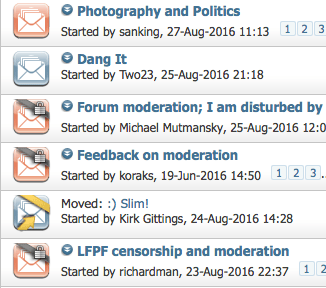
Ejected the Defenders
Defending is offending. Biting the hand that hit you.
A certain way of being ejected is to stand up to other ejections. This arouses the defects in your group. Note the “Dang it” by Two23. Yep, alive, active, still unable to understand what photography is, other than those shots you took on your vacation, or how symbols and images exchange places, making new cultural exchanges possible. Several people were ejected. To my reading, they were the ones offering alternative viewpoints of photography, ones that could form the basis of deeper photographic work. That isn’t the goal of this group of Conformists.
The Good Guys
- Richard Man (his page) — no longer present
- { StoneNY ] (his page) — he was ejected
-
Isaac Sachs [ RHITMrB ] (his page) — he fought and was ejected
- Darin Boville (his page) — though he is a STAY..
The Bad Guys
Tellingly, they don’t have websites, not even free ones. Anonymity isn’t the defect in online photography world (as Kirk Gittings a dedicated LFPF follower holds), the defect is lack of commitment to imagery. With several robust, long lived image sharing sites, free web hosting and management available for the price of an email address, there is no reason for the interested photographer not to have their own online portfolio.
The Stays
Some of the +1ers, those who had liked the thread, like many old drunks, cheered for their rights, but as soon as the floor was mopped, they asked for more free beer and their turn to write on the urinal wall.
There were around 27 people who participated in the threads expressing support, voicing approval, even calling for lighter hand in moderation. They said something, but they’ve done nothing.. well, they’ve stayed, even those who said they were so upset by this they would never return… Their indignation lasted less than 72 hours.
With friends like that, who need enemies– that is all the community that the Large Format Photography Forum provides. A Plus One and Done
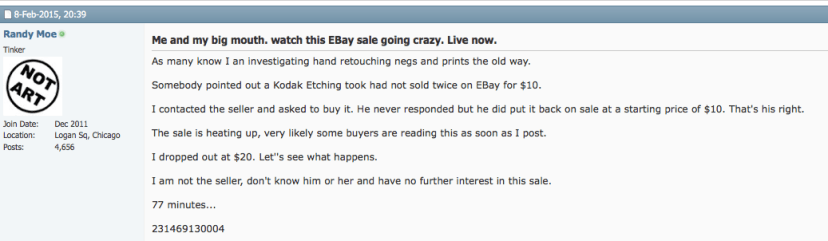
Why? Why turn away, then return. The simple, direct answer is that they have to. They are like the members of a bachelor herd, unable to raise interest on their own, they hang out hoping to get a chance, maybe just one chance. These are the Randy Moe’s. They may not make it; not have the technique or drive, but then in this herd no one else does. We get to hang (out) together, since no one is going to hang anything.
Elsewhere
The original thread, with pictures is (Sep 2,2016) available at Richard Man’s page, here.
“This impulse to enter, with other humans, through language, into the order and disorder of the world, is poetic at its root as surely as it is political at its root. Poetry and politics both have to do with description and with power. ” Adrienne Rich (May 16, 1929–March 27, 2012)
No, this isn’t about art. It is about power; the assumption of property rights; it is about what happens when art isn’t the capstone of technique



You must be logged in to post a comment.