Chemistry fundamentals don’t change, not in 70 years. Few mature subjects re-define their doundations, certainly not the theories. The practices change. Photographic chemistry as an industrial process has changed greatly since 1950. Even those changes are not as great as an enthusiastic, excitable weekender may think. The laten image must be “amplified” in a developer. Developer specifics change even though the theory doesn’t.
Ingredients change because of commercial or social reasons– lumped together as business. Sold as progress. Chemical photography has realized greater changes in the emulsion making, that being at the industrial control level — that level being as that of the end of the 20th Century. It got so far, but not further.
D-72 is Dektol.
Paper developers are very active developers. Paper is less sensitive to light than film. The latent image needs a stronger developer to make it visible. (halides to silver)
[read the cards]
Developing Agent
D-72 (paper developer)
D-76 (film developer)
Elon (metol) developing agent
3.0 grams
2.0 grams
Hydroquinone
12.0 grams
5.0 grams
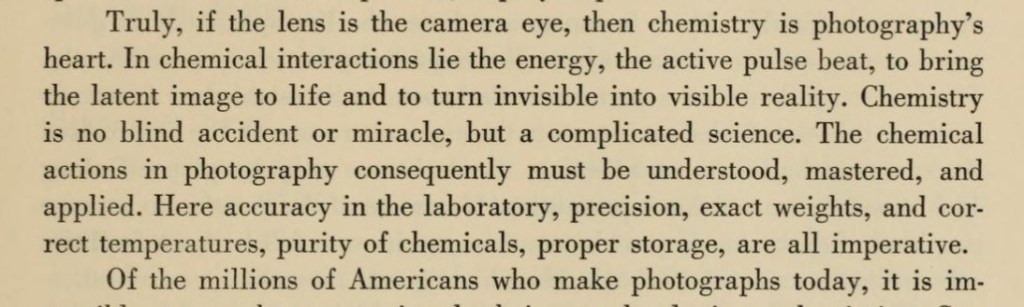
Berenice Abbott, New Guide to Better Photography (1953)
Not knowing what the brand name means, means not knowing.
the time of expanding meanings. longer times. industrial chemistry. big mechanical things. roads. trips. group darkrooms.
transition decade. continued the 60s. expanded it. extended it up to the edges of the 80s. the last time to be, to become liberal.
Consider the circumstance: you know that ISO 100 film is more sensitive than Ilford Multigrade paper. You may even know by what factors. How you learned to gauge the exposure for paper also applies to film. If your darkroom prints are exposed for 8 to 20 seconds, what would you guess the exposure would be for an ISO 100 film? Certainly not the same time. Film is much more sensitive than paper. You could determine a relationship between the film and the paper used in your darkroom.
The standard light has been a mark of lab experience for more than 70 years.
Direct questions deserve direct answers.
Direct answer: The exposure is 5 seconds at 3 footcandle at the film plane.
As one form of claiming power, of having influence among the Hobby Snobby Forums, you gain points by being obtuse in your answers. The more complicated the answer, the less likely you will have to demonstrate the answer. Hobbyists are filling idle time. They don’t need the answer; if they did, they could test their system, learning the answer specific to their methods and tools.
What would be useful is teaching them how to setup, configure and use their specifics. That can be done using Web2 features. Not interested. The last group I taught has grown onto their own studios… Ask them how.
Key point: learn how to question the answers given. This will free you to find your answers to your questions.
many small notes, again. Starts and wanderings. Have been in the darkroom most of the time over that past ten days. That isn’t what I will post about… some of that is on instagram, vimeo, in forms that make meaning only to my interiors
This is another collection of things I wish I could have ignored. A lesson to myself about staying away, even in a passing way from those deadly school ground spaces of the camera land. There are some things, prompts, which could lead to better ideas — lessons even from the worst of us. More about those another time.
Success is often achieved by those who don’t know that failure is inevitable.” — Coco Chanel
COLLECTION: [Just developed in FX 39 and scanned my cache of CHS 100 II in 120. I’ve decided that’s my film for the winter (when I shoot only B&W, going back to color during “leaf” season). So, hoping it’s available again. I love it.] Hobbyists have seasons.. as do yentas
[My wife‘s anatomy instructor in Med shool died from long term exposure to it(formalin)] — too bad she had to attend such a poorly managed nursing school[ Samuel Merritt College] To the point of work exposure to cadavers, NIH has appropriate references to statistics, additional to that was a study by Serbian researchers about the point of greatest exposure, further, Johns Hopkins has an article on anatomy study — all these are just GOO-Fu away. Summary: the storage lockers are unsafe, those technicians who are smokers and/or heavy drinkers are more likely to have lung or liver cancer. Not so much anyone else.
[And I for one don’t don’t appreciate anyone pooh-poohing safety topics they don’t have the background to fully appreciate. I would have been dead long ago if I hadn’t been “paranoid” about certain chemical categories.] so, what is his background: purchasing agent for a softwood store. he is without credential or credibility.
Partial information is better than personal strutting :
an introduction to personal masks for work
[why would you want to alter a rather hard to find, expensive, top-of-the-line ‘Apo N” 150?] PERHAPS to build their world rather than defend, or conform in yours
And here was IS a list of prices … [Demand for analogue photography is surging, with the so-called ‘Newtro culture’ gathering momentum and pushing renewed growth in sectors that predate the adoption of digital technologies, such as knitting and vinyl records. In fact, the global film camera market value is set to reach almost £311 million by 2030, growing by 5.2% each year from £223.2 million in 2023.] A DREAMCAST.
Ctein dye transfers on aftermarket… between 50 and 500, although they are lowering. Maybe wait. Notice that the Berlese has higher asking price. Ctein prints are getting to the original cost of making. Perhaps the market has more wisdom than I believed.





You must be logged in to post a comment.