two ways of minimizing dye bleeding. We always dried our prints on a drum dryer. The other was not to condition paper for more then thirty minutes. Any left over paper was used for test prints. — dye transfer
Other notions collected this week
Early reference made to Three-color methods and processes with special detail about Jos-Pe and Pinatype.
I’ve been going through notes on matrix making along with tanning methods: why developer replaced bleach.
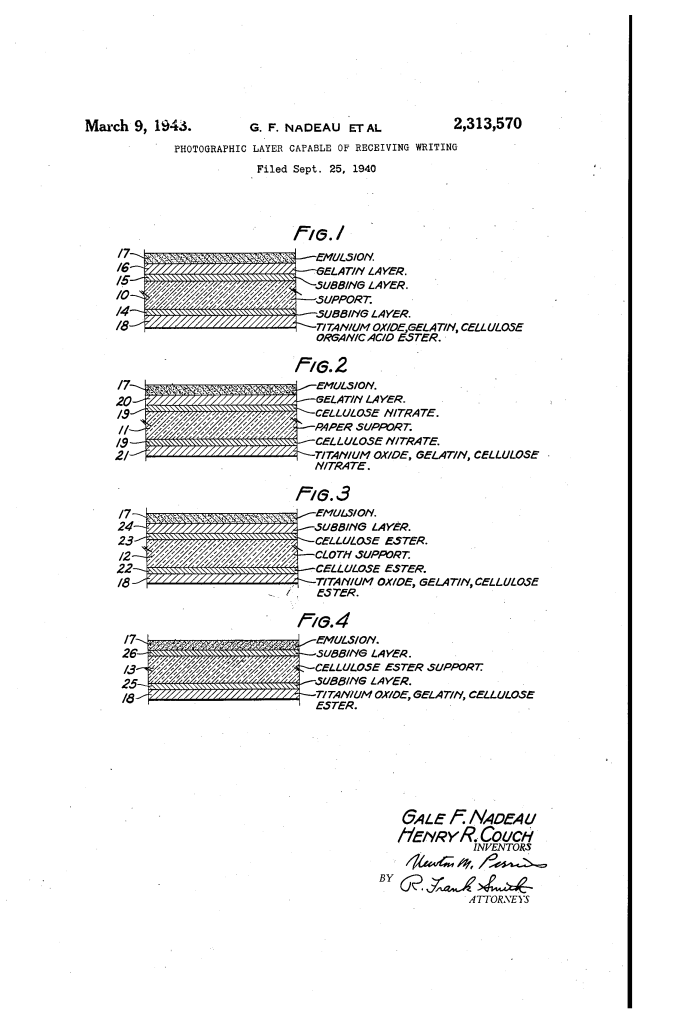
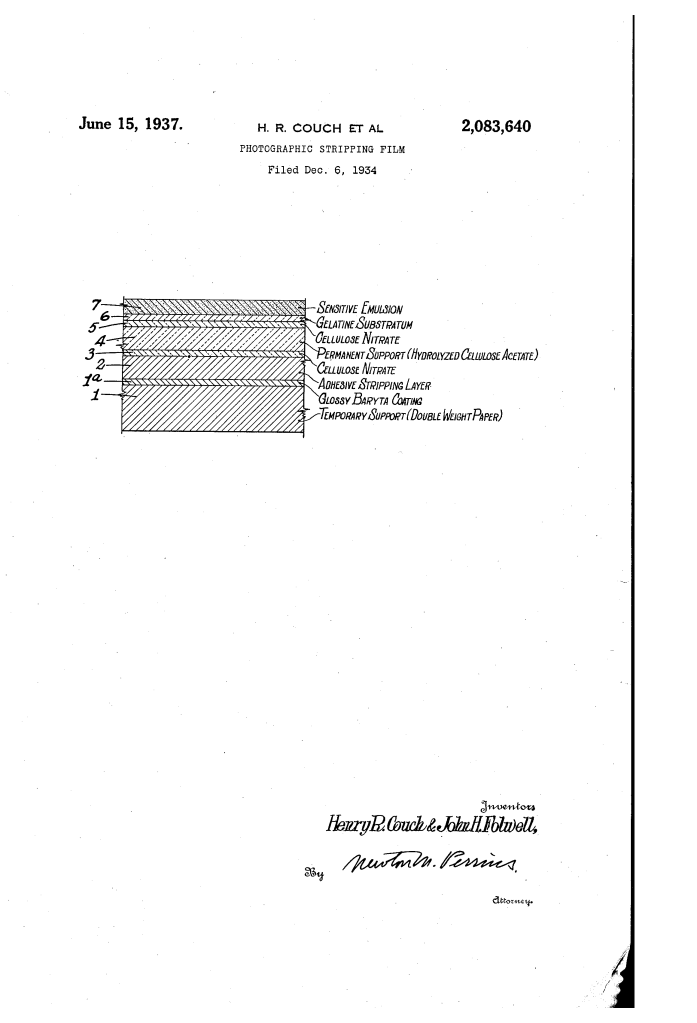
finding the person behind the process leads to much more information about the process. These two people were the keys to Kodak’s emulsion coating discoveries. Nadeau and Starck are on many patents that would be key to making matrix film or Flexichrome emulsions.
While digging into the past there is the challenge of staying focused, limiting attention, and missing serendipitous materials such as:
a mix from deskside. Notions about dye trransfer, color assembly process bibliography, colloids, newton rings and their control. The typical range of notions from the overnight kitchen.
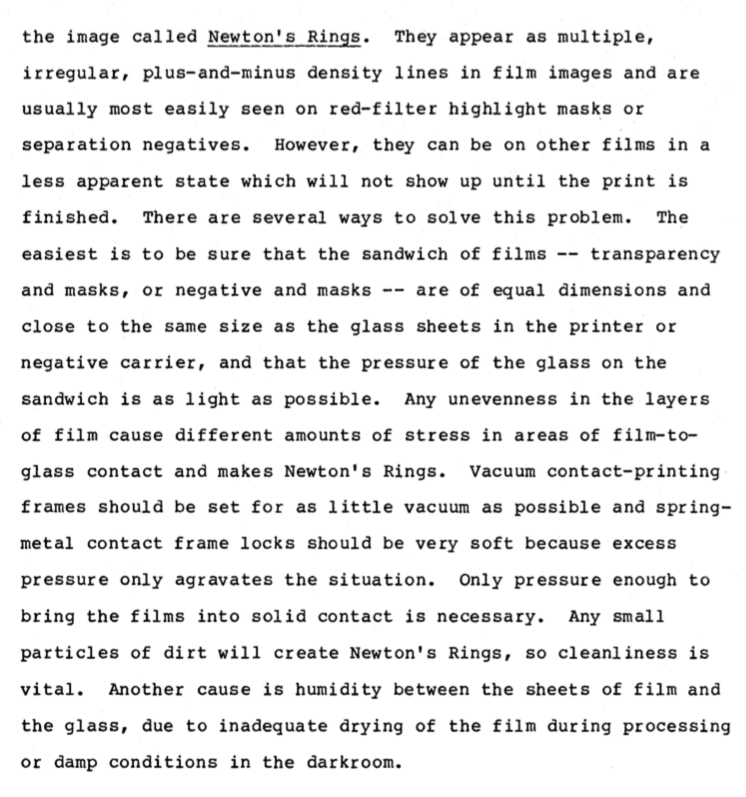
newton rings:
pressure of platen
beware dirt
control humidity
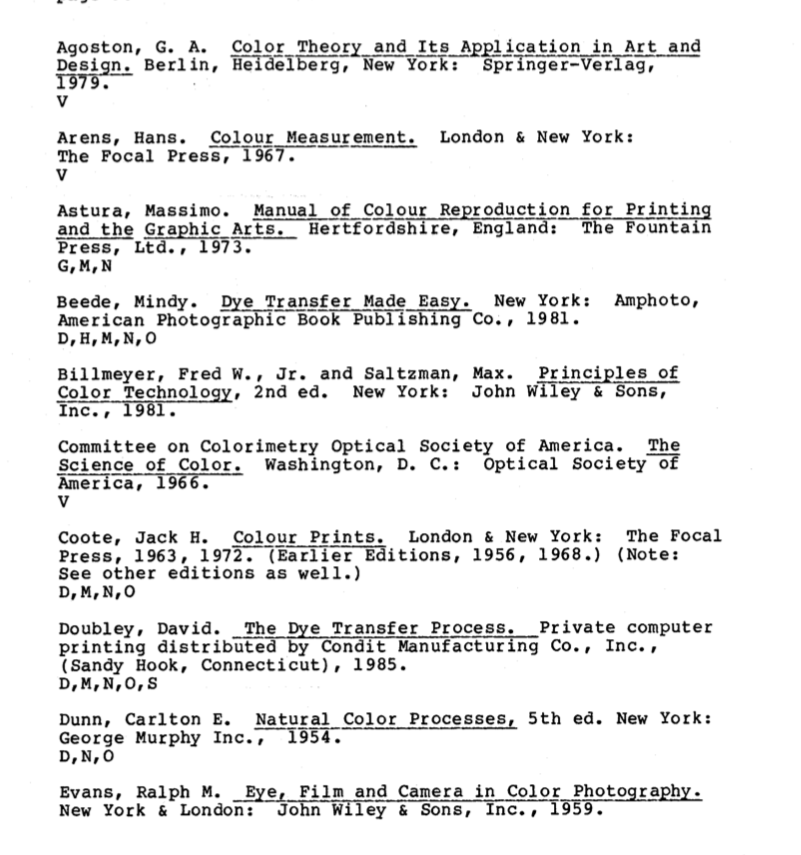
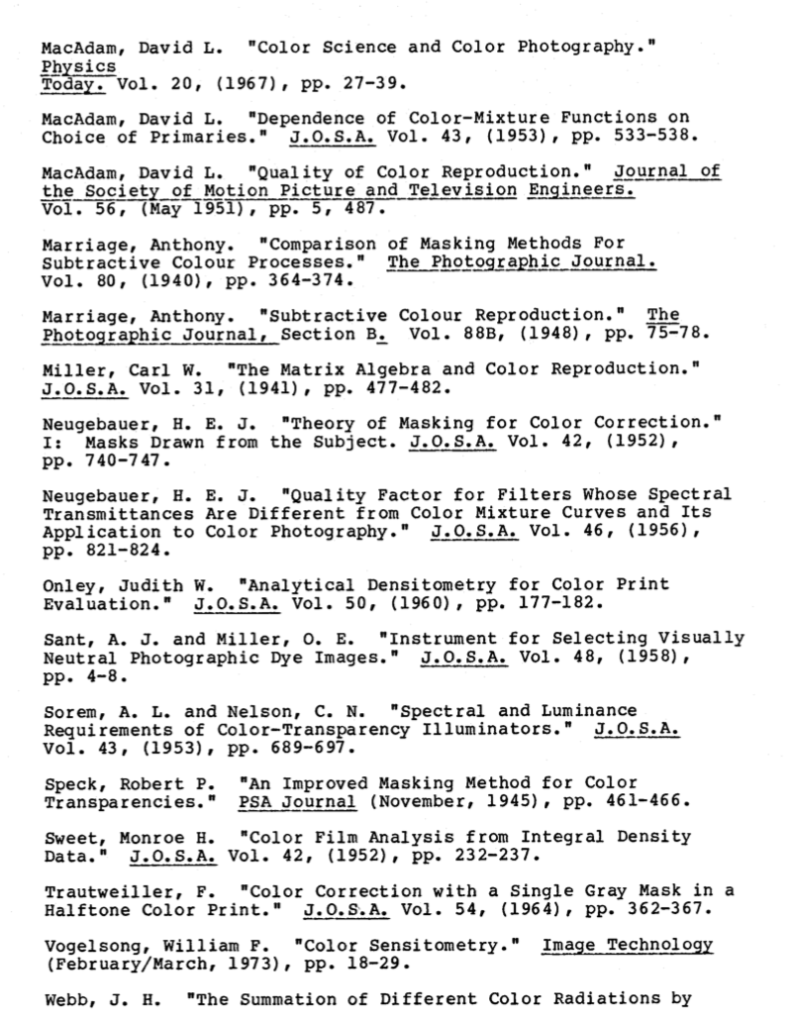
Items from a color bibliography designed for those doing assembly processes — either rollup, or laydown forms.
Some Name Drops from the dye transfer world:
Dennis Brokaw (1939
*Bob Pace
Charles Swedlund (1935- )
*Frant Tartaro
*Bob DeSantis, (in LA)
Ernie DuSablon , who ran the Color Works Lab in Detroit, Michigan
Floyd Lee
John Wawrzonek
*Jim Bones
Jim Wallace
Eliot Porter
Mindy Beede
David Doubley
Warren Condit
Morry Bard
Joan Matochik
Frank McLaughlin
Bob Speck — key inventor 1935 with Louis Condax (in Philadelphia)
Missing are the many teachers and most of the artists making use of the process between 1964 and 1988.
References on colloids
1. J. N. Armes “The nature and amounts of aldehyde in gelatin” Jour. Phot. Sci. vol. 14 pp. 143-148 1966.
2. H. Borginon “Photographic properties of the gelatin macromolecule” J. Phot. Sci. vol. 15 pp. 207-214 Sept. 1967.
3. R. J. Croome and F. G. Clegg Photographic Gelatin London and New York:Focal Press 1965.
4. H. Dehio G. Polla-Mattiot M. Gillio-Tos and G. Saini “The Influence of molecular weight of synthetic hydrophilic colloids on their protective action and on the ripening of silver halide crystals” J. Phot. Sci. vol. 10 pp. 302-305 1962.
5. J. W. Gates W. G. Lovett and P. E. Miller Photographic Emulsions Containing Carboxymethylated Pigskin Gelatin Eastman Kodak Co. May 1965.
6. M. N. Vrancken A. H. DeCat and J. F. Willems Improvements in or Relating to Gelatin Derivatives Gavaert Photo-Producten N.V. July 1961.
7. T. T. Hill “Laboratory-scale photographic emulsion technique” J. Chem. Educ. vol. 43 pp. 492-498 1966.
8. T. T. Hill “Literature of gelatin” in Literature Resources of the Chemical Process Industries Washington D.C.:American Chemical Society vol. I June 1968.
10. B. Idson and E. Braswell “Gelatin” Adv. in Food Research vol. 7 pp. 235-338 1957.
11. T. H. James and W. Vanselow; “Adsorption as a factor in the rate of photographic development” Phot. Eng vol. 6 pp. 183-189 1955.
12. W. D. Kelly “Purification and chem. sensitization of phot. gelatin” J. Phot. Sci. vol. 6 pp. 16-22 1958.
13. C. E. K. Mees and T. H. James “3” in The Theory of the Photographic Process New York:MacMillan Co. 1966.
14. G. H. Nawn; “Interferences with the abribat test for labile S in gelatin and some implications with respect to chemical sensitization rates” Phot. Sci. & Eng. vol. 12 pp. 108-16 1968.
15. Y. Ohyama “On the action of some chem. sensit. as ‘anti-retarders’ or’ physical ripening accelerators'” Proceedings of RPS Centenary Conf. 1953.
16. Y. Ohyama and K. Futaki “Grain growth of silver chloride susp. in polyvinyl alcohol” Bull. Chem. Soc. Japan vol. 28 pp. 243-248 1955.
17. Y. Ohyama and K. Futaki “Var. alkyl amines & ammon. comp. as accelerators for grain growth of silver chloride susp. in polyvinyl alcohol sol’n.” Bull. Chem. Soc. Japan vol. 31 pp. 10-16 1958.
18. Y. Ohyama and K. Futaki “Relation betw. accel. and retard. tendencies of some active subst. in phys. ripening of silver chloride suspensions” Photo. Sci. & Eng. vol. 2 pp. 128-30 1958.
19. F. G. Russell Method of Preparing Washed Photographic Emulsions Eastman Kodak Co. Oct. 23 1956.
20. G. Russell and D. L. Oliff “Nucleic acids in gelatin” J. Phot. Sci. vol. 14 pp. 9-22 1966.
21. Process for Prod. Silver Hal. Emulsions cont. Gelatin Derivatives June 1965.
22. W. Timson A. Steigmann G. Nawn and W. Kelly “Microconstituents in gelatin etc.” Photo. Sci. & Eng. vol. 10 pp. 281-286 1966.
23. H. M. Wagner; “Competition for gelatin” Perspective vol. 4 pp. 208-15 1962.
24. H. W. Wood; “The Process of silver-digestion and implications” J. Phot. Sci. vol. 6 pp. 33-38 1958.
25. H. W. Wood; “Role of gelatin in phot. emulsions” J. Phot. Sci. vol. 9 pp. 151-6 1961.
26. T. Yano N. Itoh and S. Iguchi “Behavior of hydrophilic polymers as protective colloids for silver halide crystals Part V” J. Soc. Sci. Phot. Jap. vol. 30 no. 2 pp. 83-89 1967.
27. T. Yano N. Itoh and S. Iguchi Influence of the kind of cationic groups in polymer molecule on the growth of silver chloride crystals 1967.
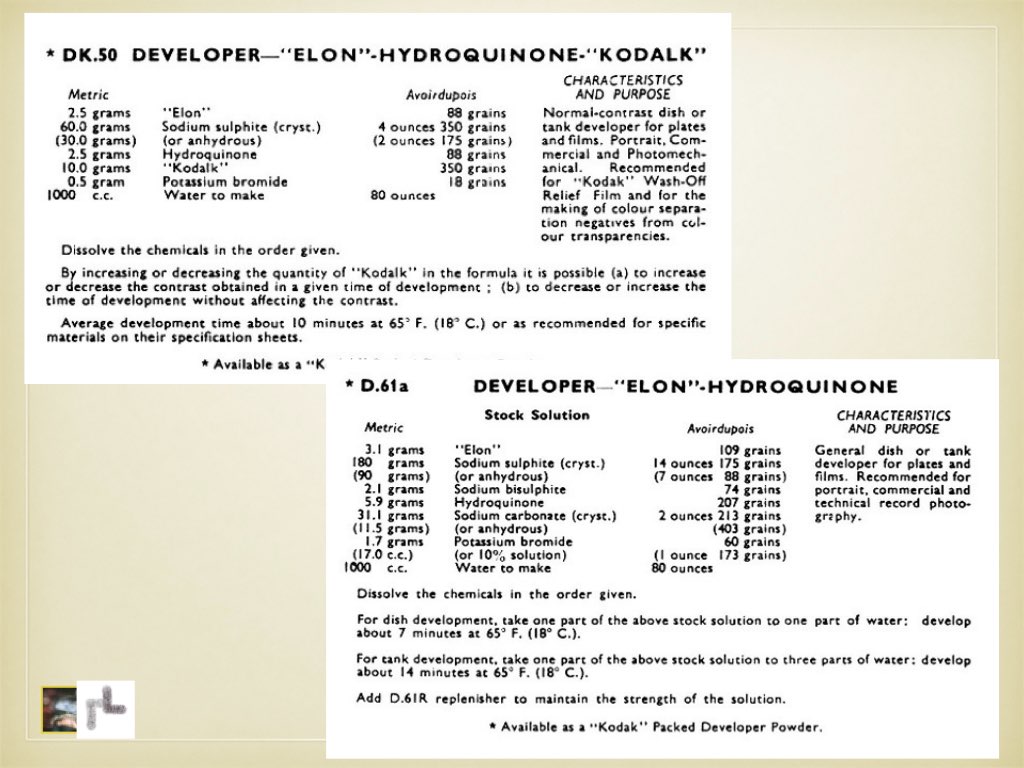
Final Final: The formulas used by most dye transfer labs until wide acceptance of HC-110 around 1970.
Kodak Dk-50 and D-61a
61 gave more lift to the separations. often, the blue needed extra help.
labs that served some ad agencies always punched the seps using D-61a — also helped those chromes that were shot using the “darker is better” standard.
[DK-20,DK-50, DK-60 formed the WOR chest of developers]
learning from the hobby lobby means you may never know a reason. you probably won’t ask them questions, after-all, you and they are just hanging onto each other’s opinion. You will never ask where he saw that work. Unless you remember, because you were a member of the academy, you wouldn’t realize that geography was a strong barrier to exhibitions in the 70s and 80s.
Dichromated Gelatin
ask the other camps. look in books and journals. maybe google has a bigger, better memory than you realize.
The advantages of Dichromated Gelatin over Silver Halides are:
More efficient recording material.
Has less scattering.
Is more transparent.
as dichromate is exposed absorption spectra changes.
the broader the exposure spectrum, the deeper the hardening reaction.
characteristics are listed below.
Initial thickness of the gelatin layer
Initial hardness of the gelatin
Concentration of sensitizing dichromate bath
Drying conditions: temperature, humidity, and time
Exposure, wavelength and energy
Time delay between exposure and processing
Alkalinity and temperature of processing baths
Composition of processing baths
Time in processing baths
Recording geometry
Factors Influencing Light Geometry
(a) Size of the light source. The larger a source, the greater becomes the angle of light rays travelling from its edges and therefore the degree of undercutting.
(b) Position of the light source. The nearer a light source is to the vacuum frame the greater is its effective size. Conversely if the lamp is moved further away, so its effective size is reduced. It is good practice to increase lamp distance when exposing very fine detail work to reduce the effect of light undercutting if at all practical, (do not forget that the exposure time will have to be adjusted if an integrator is not fitted).
the “printing out” tanning is similar in contrast effect as the “developing out” of tanning developers. DAS / Dichromate systems share the exposure effect: judge by depth of “cure” — tanning, hardening of the colloid. DAS exposure should begin with 365nm wavelength.
Absorbance and sensitivity are different. This is partial explanation for why color of exposing light should be broader with a longer (more depth) exposure requirement.







You must be logged in to post a comment.