One Picture More

Making across picture manners. consider this a continuation of my recent “Picture Post” .. the images in that, with this additional, are from the same situation, bounded by the same initial consideration. My prompt was the same. In that PP, I consider only the first points of making a picture. Often, that is enough. The first place is the last place.

Subjects have powers — these come from their prior treatment, by the naive consumer, the amateur producer and the needs of the driven “by any other means.”

conceptual work has no shadow; is without dimension.
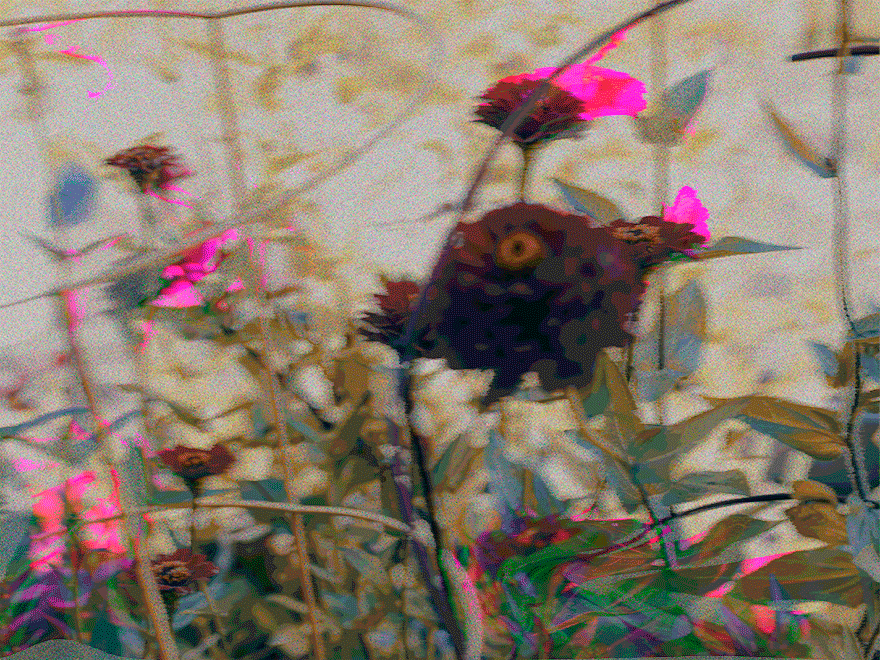
These are two variations on simple structural relations. This [oct22,23] is a first rendering. Rather than make added posts, I will add to this post.

[this method has become my revised mode of postings … add to existing. ]

I won’t be writing about the “how” they are done… I am reminded of a conversation with John Orentlicher: my position on answering didn’t go well for my time at EXS. [To John Orentlicher ( or liquor) because it makes it more powerful to me and I have no interest in translating them; spending my life as a translator of rather than an author of. My first react comment to him was: That’s a question I’d expect of a student, not the head of the department. — I didn’t make tenure track… and so it goes.]

Added Monday Oct 24–> heading along the edges

John Chiara: Process

American. b. 1971, in San Francisco, California

 It’s rare for a photographer to push the technical edge of the medium. And rarer still to reanimate corners of the world seen and forgotten by hundreds of thousands of eyes every day. — Ian Bourland

After dedicating an extended period in 1995 to making contact prints from his 2-1/4″ x 2-1/4 inch negatives, John Chiara decided that too much information was lost in the darkroom enlargement process. Over the next six years he developed his own equipment and processes to make first-generation unique photographs without using film. 

Chiara developed a process that is part photography, part sculpture, and part event. It is an undertaking requiring invention in his tools and patience in using them. [from his bio]


Process isn’t the same as procedure. Mr. Chiara has extended his process to such an extent that it has become a featured point in discussions around his imaging.

Large. Tonal inversion. Color inversion. Put paper in the wrong place. Expose paper to the wrong light-type. Use the much seen, the much ignored. Take as much time as needed. These are the procedures that he uses.

It is easy to overlook these works. Easier for those of us who can readily understand the means and methods, the mode of this process. We shouldn’t. We should take his work on his terms, trying to get to where he has gotten — not in recognition of his work, but so we can use it to open our own work… or, for some, renew our efforts.

Find your process within your procedure.