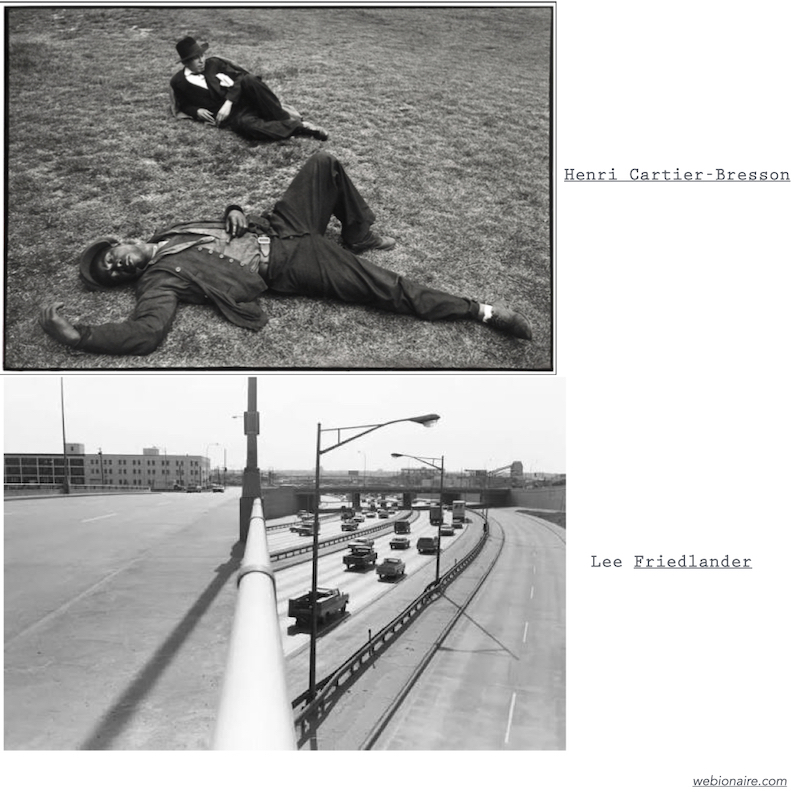
A very short post. A question in as many parts as you take it. Why did I gather these two pictures is a starting one.
Why: ask enough of yourself; always ask more. Two photographers offering distinct values.
What do they share?
[ not my pictures ]
All general knowledge, meaning that which can be used by some other, or be modified by someone to modify themself, is found in the taking X from the box and revealing it in the X from some other box.
Oops, rather page2.. I used to show, using dual projectors, comparisons of Atget and Friedlander — 4 carousels worth. Comparison, juxtapositions frequently expand awareness of why a strain of visual mind morphs.
Rem: anyone who understands Atget should realize how good Lee Friedlander is; how much more skill he has. That’s often the arc of a field.
items noted– an artist speaking about impulse. And, to those who are not a participant in current communities conversation, they don’t recognize her Art references. Her practice references, note how smoothly she uses them; how thoroughly she has absorbed that dictionary.
Paloma Dooley. (b. 1993, New York, NY) lives and works in Los Angeles. a BA in photography from Bard College. In 2016, she completed a monthlong residency at the Vermont Studio Center. recently completed a four-month residency at Quinn Emanuel Artists in Residence. She is a recipient of a 2024 Puffin Foundation Artist Grant. About is brief, unlike her image making method.
“I was born and raised in New York. I spent an influential and magical year of my youth in Roswell, NM, which instilled in me a love of the landscape and being on the road. As a teen, I turned to photography as an outlet for longing, searching, and wonder after losing my dad, who was an artist. I photographed his studio and I photographed in the landscape as a way to work through grief. I attended Bard College and earned a B.A. in Photography in 2015; my thesis project was awarded the Stuart Strizler Levine Award. In 2016 I completed a monthlong residency at the Vermont Studio Center, where I gave an artist’s talk and slide lecture. My work was included in “Too Good to be Photographed,” ed. Paul Paper, a publication that investigates the strengths and failures of photography as a medium, in 2017. In 2018, I was commissioned to create a new body of work, “What it Feels Like to be a Beautiful Rectangle,” for “Augenblick Mal,” a Swiss publication. My recent project Ground Control and accompanying text was published in Carla Issue 21 in August 2020. I am also included in “Primal Sight,” 2021, a groundbreaking look at contemporary black and white photography edited by curator Efrem Zelony-Mindell. When I’m not focusing on my own photographic projects, I am working on the small artist-run exhibition space, Hermitage, that I co-founded in 2020.” – Paloma Dooley
PD: In 2020 my garden became my only creative outlet, and a source of peace and strength amidst the crushing uncertainty of the pandemic. I had lost my job in the art world and felt totally disconnected from photography. Working – and making my own work – was how I had always found my way through the world. Photography was my guide and a mode of exploration, but it didn’t feel available to me at the beginning of the pandemic. Feeling a dearth of change and growth in my own life, I set my camera aside and focused instead on the quick lives of my plants. Growth, abundance, decline, death – caring for my plants was a way to care for myself.
With images and texts by Michele Abeles, Takaaki Akaishi, Lotta Antonsson, Walead Beshty, Lucas Blalock,Andrey Bogush, Brian Bress, Bianca Brunner, Stefan Burger, Antoine Catala, Phil Chang, Talia Chetrit, Joshua Citarella, Sara Cwynar, Bryan Dooley, Jessica Eaton, Shannon Ebner, Marten Elder, Jason Evans,Sam Falls, Brendan Fowler, Victoria Fu,Daniel Gordon, Darren Harvey-Regan, Leslie Hewitt, Nancy de Holl, John Houck, Go Itami, Rachel de Joode, Farrah Karapetian, Matt Keegan, Annette Kelm, Soo Kim, Yuki Kimura, Josh Kline, Lucas Knipscher,Owen Kydd, Josh Kolbo, Taisuke Koyama,Nico Krebs and Taiyo Onorato, EladLassry, Brandon Lattu, John Lehr, Anthony Lepore, Alexandra Leykauf, Matt Lipps, Florian Maier-Aichen, Phillip Maisel, Annie MacDonell, Emmeline de Mooij, Carter Mull, Nerhol – (Ryuta Iida and YoshihisaTanaka), Katja Novitskova, Arthur Ou, Matthew Porter, Timur Si-Qin, Eileen Quinlan, Jon Rafman, Sean Raspet, Clunie Reid, Abigail Reynolds, Will Rogan, Asha Schechter, Hugh Scott-Douglas, Shirana Shahbazi, Daniel Shea, Erin Shirreff, Elisa Sighicelli, Brea Souders, Kate Steciw, BatiaSuter, Yosuke Takeda, Miguel Ángel Tornero,Sara VanDerBeek, Artie Vierkant, Anne deVries, Hannah Whitaker, Charlie White, Lindsey White, Chris Wiley, Letha Wilson, and Amir Zaki. – See more at: http://aperture.org/shop/photography-is-magic-3229/#sthash.ydUkCFM5.dpuf


You must be logged in to post a comment.