Making up HC-110

was it a key. who knows who knows what they know.

HC-110 entered the stream as an addition to dye transfer printing. My view. It appeared in literature distributed to the avid darkroom “enthusiast.” — what we called the Dentist Darkroom. Over time, Kodak taught the duo Super-XX and HC-110 to the weekenders and small, part-time printers. The reputation grew thru repetition. This century, with a sense of failing industry, HC-110 held onto its claim of mystic value by being difficult to make, hence, it would be a catastrophe for it to disappear. The value of association plays background to this.

Dye transfer, large shops, had multiple lines. The small ones could use HC-110; however, the large, deep lines would never be taken over by HC-110, so, DK-50 remained.


Enter the gossip track…

IN A SLIP OF THE LIE, HE TOLD THE TRUTH.

Back to HC-110 original style. MSDS sheets aren’t required to list every ingredient, just hazardous ones, and with trace or trade secret ingredients exempt from being listed. I know someone who didn’t formulate a personal batch; but he had access to a major research lab, and the right background to do it. It was tricky. Certain ingredients aren’t ordinarily available.]] photrio. He probably meant to say he knows someone who DID make it. The reason he makes the claim is to bolster his standing among those of little standing.

final state of ausi — info being sent to chemists.

Of course, all this work was for the Old HC, the syrup, not the current HC-110.


The patents tell more. The 1959 patent is about concentrated developers. The motive is for reduced storage space, faster mixing as well as modifying gammas of film without resorting to multiple developers. The 1964 patent provides information about dilution effects. Dilution reaches a limit, which is why Kodak listed the few dilutions they did. Patents do tell a story to those familiar with reading them.
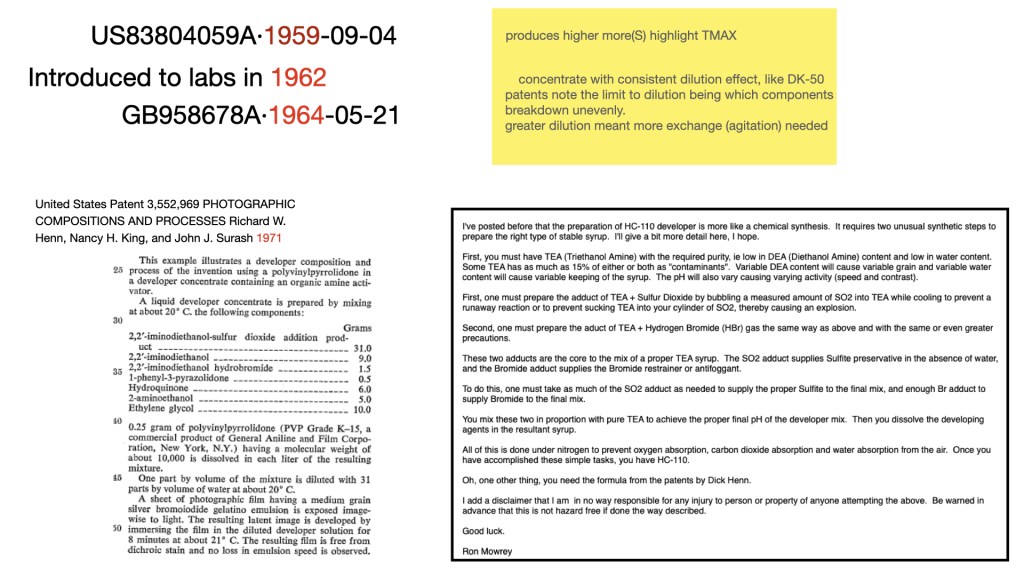
agitation changes shape of curve. Same film, & developer(DK50 1:1) difference is agitation scheme.

I used HC-110 after using DK-50. I began making masks and seps with DK-50 — after the HC syrup disappeared, I returned to DK-50. My lab films are Ilford: Delta, PanF+, FP4+, and Ortho Plus. These films provide what is needed to make masks and separations for color and BW procedures.

Avoid the forums (my recurring theme) — use manufacturers first; then check with old texts. Use google books. Most important: try things, keep notes. Be certain to follow the information of those who have done more than repeat overheard counter-talk.

Once the syrup hit the water, its main purpose is lost. Once the syrup left the manufacturing, the major value of those researchers was lost.

for the Syrup, (kodak Honey) version. HC-110 thick is gone, only thin remains

Characterizing film+developer combination isn’t as time consuming as re-formulating a compounded chemical like HC-110. Falling back to DK-50 from HC-110 is a few hours effort, not days, certainly not the months expended trying (and failing) to compound the Aussie HC-110.
lab. 12/18 Fujifilm

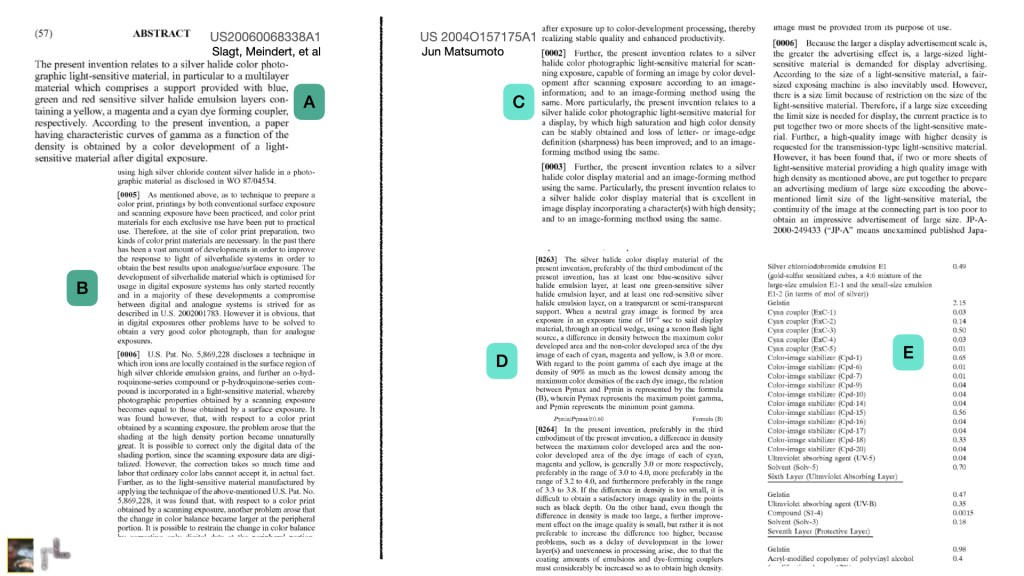
What Fujifilm knows. Two interesting patents about color print/ display materials. Also contain light sources used during testing of the new material.

People. Patents. Products. Find the people behind the knowledge and you will learn what the product solves. Meindert Slagt has few patents. This one lists several people with multiple patents. Jun Matsumoto came about in reviewing other patents of the holders. He is a key researcher for Fujifilm. Finding the addresses of each of these researchers locates their research building.

The need to provide a different print material, one designed to solve the problems of prior silver/color printing in being used in a digital /scan printing system.

  • A: “light-sensitive material after digital exposure.”
  • B: “it is obvious, that in digital exposures other problems have to be solved to obtain a very good color photograph.”
  • C: “a high-quality image with higher desnity is requested for the transmission-type light-sensitive material.”
  • D: “if the difference in density is too small, it is difficult to obtain satisfactory image quality in the points such as black depth…” difference too higher, problems such as delay of development in lower layer(s)…
  • E: a snippet describing a single layer (the Fifth) of the display material. This is the Red-Sensitive layer. Notice that there are 5 Cyan couplers indicate, and eleven “color-image stabilizers.” Describing all the chemistry would take months.

>> https://patents.google.com/patent/US20060068338A1/en ” as to technique to prepare a color print, printings by both conventional surface exposure and scanning exposure have been practiced, and color print materials for each exclusive use have been put to practical use. Therefore, at the site of color print preparation, two kinds of color print materials are necessary. In the past there has been a vast amount of developments in order to improve the response to light of silver halide systems in order to obtain the best results upon analogue/surface exposure. ” Inventor Meindert Slagt Akira Kase Peter Franciscus Van Asten Yasuo Iwasa

>> https://patents.google.com/patent/US20040157175A1/en “As a method to expose a light-sensitive material according to digitized image information, an image-forming method in which scanning exposure is carried out using a light source of high light intensity such as a laser or LED, has been rapidly gaining popularity. Resulting from the recent popularization of laser printers and digital prints, the above-said image-forming method has been common. Accordingly, there has been a continual need for a light-sensitive material having characteristics suitable for laser exposure and digital exposure. As print for a display advertisement, higher image density is requested, because a vivid image must be provided from its purpose of use.” Jun Matsumoto Shinichi Nakahira Hidekazu Sakai

—- plus, updated posts: this on portra

Power of Dog Story

A western film set in Montana, filmed in New Zealand. A re-westernized examination, so the meta goes, about machismo — destructive mannerisms of maleness.

The movie unrolls like a silent era film. Every plot point made in pantomime deliberateness. So much so, you know by the middle of the movie what the ending will be. Unless, as my gang said, you sit in the back of the bus.

Wyoming in New Zealand. Coming to terms with changes of an age. A movie I’d hoped to rewatch. Instead, it is a movie I watched, will consider, probably not watch again. I’ve too many other films, books, tasks to do. I don’t think I will get more from another watching than from some other film a first time.

The movie in one scene: the rabbit in the pile of timbers. By now the masculine and the feminine are coming together to stick a post into the hole. A rabbit runs under a pile of timbers. A game begins: toss timbers aside until the rabbit runs. 

He can’t. He is injured. The female man lifts the rabbit to comfort it — seeing it is injured, snaps its neck. 

The clear morality point: men kill the weak . These two men are gay. One clearly, the other remaining hidden, like a dog in the distant hill— only some can see.

Not an easy point for the larger audience: the dangerous persons in this film are gay. perhaps that is just the contrarian me. The widower’s son is the killer. 

Toxic masculinity – come upance, originally told in 1967 by Thomas Savage. The movie is composed with simplified symbolism. References to the dead, the posers, the educated seer. It is of its time, the fading sixties, and the looking back to a baby-boomer whistle vision of the 20s.

Those who liked the film:

>> On April 6, 2023, it ranked number 15 on The Hollywood Reporter‘s list of the “50 Best Films of the 21st Century (So Far),” calling it a “brilliantly uncomfortable chamber piece about corrosive masculinity fed by sexual repression” and a “psychodrama whose epic scope is echoed in its majestic landscapes.”

>>August 24, 2023, it ranked number 8 on Collider‘s list of “The 20 Best Drama Movies of the 2020s So Far,” saying that Campion “unravels an understated love story in the heart of the American west, and shows how forcing someone to conform can lead to tragic circumstances.”

>> The March 2022 issue of New York magazine included the film as one of “The Best Movies That Lost Best Picture at the Oscars”.