
Principles of color photography.

Selective and nonselective neutrals– a foundation concept in the technology of color photography. The illustration that we have many paths to grey, none of them is the perfect path. For any decision about a colorant (dye or pigment) we must consider more than making a neutral, even a set of dyes making a neutral results in different color volume. This is the why a film looks different: the relationships among the real color and the created color. Industry chooses the colors that they can sell. Old texts, as well as the experiments, remain useful, valid today. They form the foundation. Those equations are accurate — math has a way of doing that.
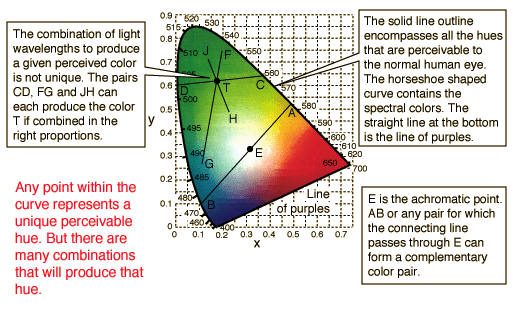
The means to the solution. The tools of presenting or testing, examining the experiments have changed drastically since the foundation years. We can readily present to others results they couldn’t imagine. That has changed the learning, not the theory.

we can easily compare gamuts using at hand Apple tools. this color cube is what a set of balanced Kodak dyes from dye transfer (1985) covers compared to the background cube of an HP Z printer on glossy baryta paper from 2015.
Clearly, implementation of the theory has advanced.
dye transfer color inset into HP inkjet
Key names: Evans, Friedman, Spencer, Wall.
- R. Burnham, “Visual Selection of Color Film Neutrals,” J. Opt. Soc. Am. 48, 215-224 (1958).
- W. Brewer, W. Hanson, and C. Horton, “Subtractive Color Reproduction. The Approximate Reproduction of Selected Colors*,” J. Opt. Soc. Am. 39, 924-927 (1949).
- Wall, History of Three-Color Photography
- Friedman, History of color photography,
- Spencer, Colour photography in practice
- Evans, Principles of Color Photography




You must be logged in to post a comment.