Perfect Alibis

Who do you envy?

Do they show or do they tell. Their perfect alibis for doing so much talking without any pictures is because only the print matters. That is the answer you are to see. See? Only see? It is so present, so magical, you must stand in awe before it. find a gallery to buy from; hunt but you will not find. The alibi set is so exclusive they have no gallery representation. The gallery wasn’t good enough.

finding gods to follow: repeating their phrases, singing seeking their praises.

Do you begin with answerable questions; do you permit answers other than yours. If you gave up by the 70s, do you have anything useful to say in your seventies?
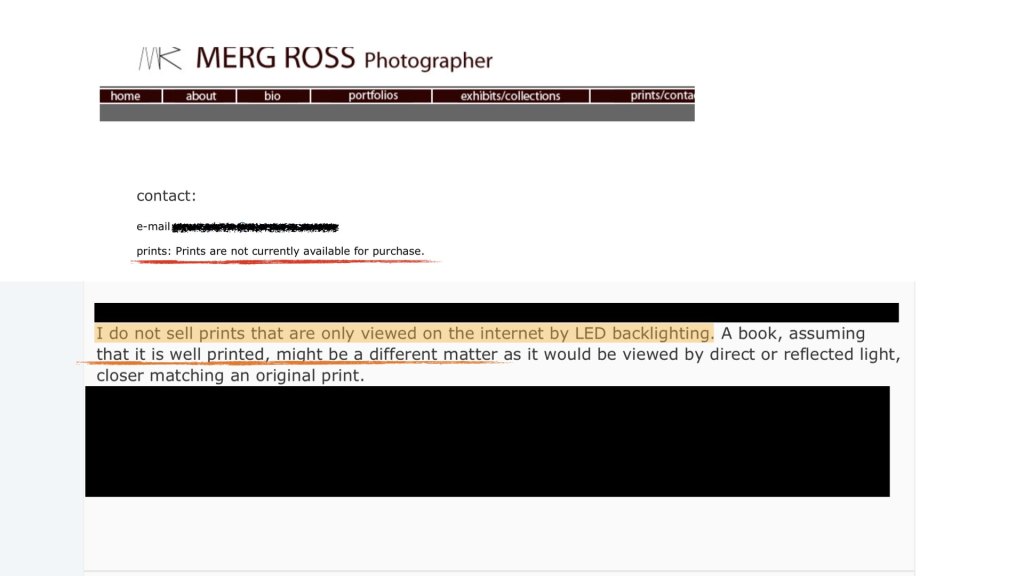
you can buy the print, but only in person.

I have no prints for sale. (catch 22)

Like the old: we could have ham and eggs if we had ham and we had eggs.

he has to defend his commitment. maybe explain his stumble — potential in youth isn’t enough. knowing the weston’s isn’t enough. knowing isn’t enough.

Of course alternatives are okay, if they are “well printed” — and, anything other than silver-gelatin can’t be well printed. Unless it was sanctified in some way — like from my book publisher.

[am in drafting-mode of a Stieglitz post ]
What’s so hard about Dye Transfer

Back in the day of dye transfer, photography was a trade taught in the US Miitary as well as private trade schools, many of which gladly accepted GI Bill tuition payments.

Large labs, processing hundreds of prints a week, divided the work into skill layers. As someone improved they were assigned to other tasks. Prove yourself often enough and you will have made it to a secure will paid career.

jobs. skills. steps

  • load film, clean, mop
  • soup film
  • mix chemcials for lab
  • make masks/seps
  • make mats
  • manage dyes and do rollup

The last task is key to the final result: rollup. This is primarily autographic; skill of hand, eye, timing with feedback. All the previous steps come together well, or the print fails.

Most of those who fail at dye transfer do so because they lack courage. They make the task harder than it is. Not even rollup is difficult, just needing attention.

Anyone who can teach dye, can teach anyone who can learn, in about 45 hours. This assumes you can get film in and out of a camera, and in and out of chemicals.

The hardest part about dye transfer was those who sold their weekend teaching skills to timid camera counter conversationalists.

Kodak’s Frank McLaughlin used to take people through the steps over the telephone. That’s how hard it was.

Frank wrote the latter editions of Kodak’s Dye Transfer Guide, the edition I pan elsewhere. I discount it since it was incomplete, as it tried to be thorough. The editions from the 50s was thicker, better, but referenced other materials. They were usually given away upon request; they did have prices marked.

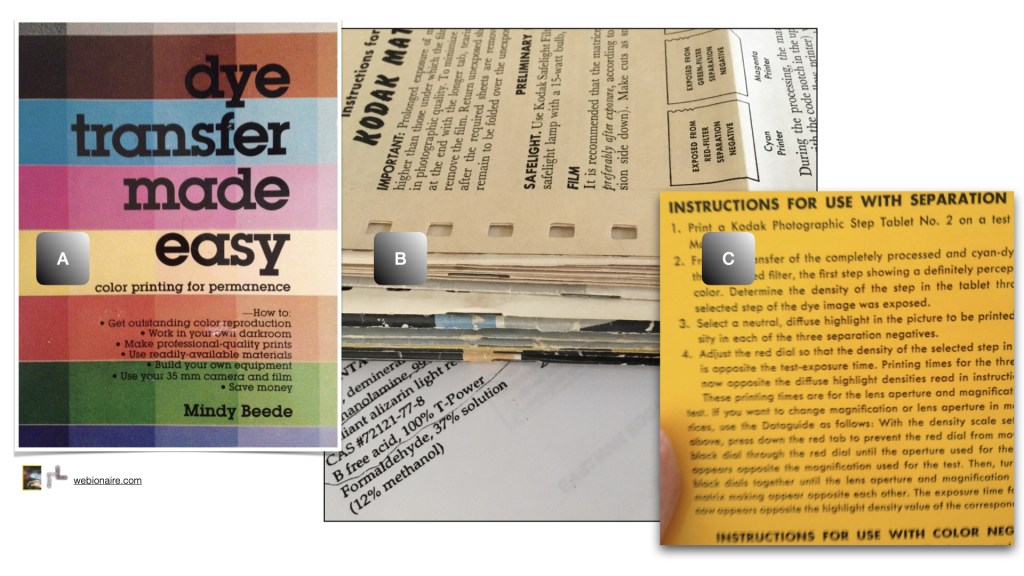
A text that was used by many during the buildout of the Silver Rush was written by Mindy Beede. She is derided by many of the “not so many” print crowd. The slow brews that make as many as 20 prints in a career. If you wanted to learn, start with her book.

learning dye transfer

A — doesn’t match the information in B, and C; however, it is available. Items B and C are from my materials collected over years as a commercial printer.