2025 healthcare dropping .. investment anticipating AI’s influence in the office world.. The office is not diagnostics. the office is dance. automated intelligence, even robotic transport isn’t interactive enough ,accurate enough ,responsible enough to dance in the organizational hive.. it will be introduced; it will work in those places which are most like a machine, and it will fail the organizations which are most flexible, most humane… AI is touted as being perfect for the unstructured data, but structure is data… organization means data.
until AI is human, you will have to be AI; it’s still a dog that bites and shits more than anything else …
wealth alone always sucks air out of the life of an economy, out of distribution… it’s just another form of market farces … AI’s bubble is air for the top, for the top of the moneyed. They know this. The bigger the boat, the better at riding a tide. They also know that tides are essential for their ship.
The buildout of infrastructure will not benefit those on the side.. they will be displaced further. Ever been to the trailer parks among the switchbacks. Hows that internet cable doing. Maybe the satellite brings you a FOX report about what others are buying — sorry, not available at the corner store one town over.
next: The middle wall fall, the bottom will stall
[ AI transcription couldn’t get that phrase even though it will replace 60 to 80% of all entry level white color positions by 2027]
This is an expanded version of { Everyone loves a secret…. } with questions. Avoid tidepools of inactivity; don’t get caught in their stagnation.
THE SECRET IS: TRY. NO SCHOOL TEACHES COURAGE.
The secret case of Eggs. You cook eggs at home, getting very good over the first dozen. A chef trained at CIA will cook that dozen eggs several ways in their first morning. The secret is variation — faster feedback between effort and result.
How to poach an egg… or, how I poach an egg… based upon its size, use of poach … cooking is easy, but it is a manual skill. The analogy should be obvious. I would never spend time trying to teach someone how to cook, if they are afraid of making mistakes. The arrogant amateur is deadly in a commercial lab.
Commercial labs had more information, more experience than Kodak about the the use of dye transfer materials. We even told them about ways of correcting the magenta dye (restrainer). Labs experimented more frequently. The bigger the lab, the more varied the requests. Full shift labs had more types of products. Only small labs specialized in dyes . No one kept secrets from anyone else. okay, we tried to keep client lists hidden. At least we didn’t publish them.
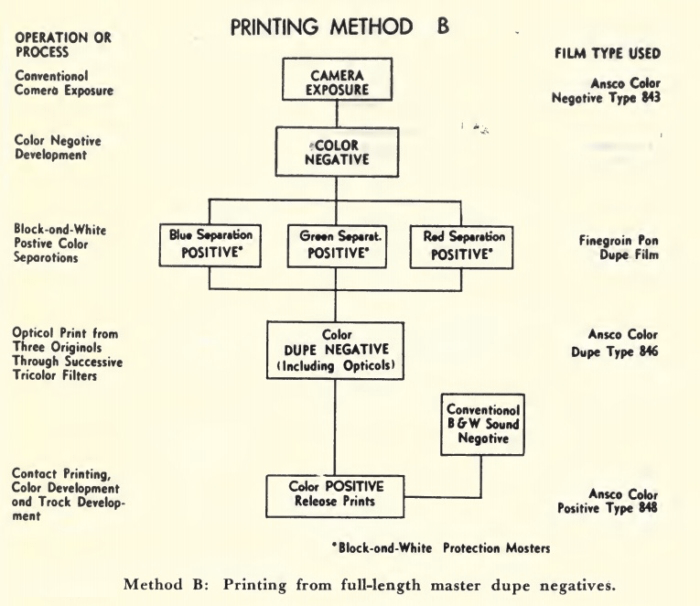
Big labs probably came to dye transfer after it became a mature, consistent product. Mixed dyes was the first success. Type C’s, Printons, dupes, etc … these products provided the profit for dye transfer to be a service. Dyes were, for the most part, a glory part. Those in “pickle alley” specialized in dyes almost to the product type; their photographer clients did, so they did.
Kodak made different papers …one retouchers and illustrators preferred, another popular in portrait studios, and the common one, Type F.
Would you take a class to learn dye transfer printing? Would it take you nearly 20 years to make your first print? If it did, whose problem is that? Suppose you bought the supplies, the books, equipped a lab; all that, yet you never used a box of the material. What secret kept you from trying to print?
In my experience, I have never known anyone to succeed without ernest initial effort. With dye transfer, the printers who make their third print within the first week of effort get the furthest. These are the printers that are solving new, more complex problems for most of their thousand image career.
Frequently, timid people never acquire the skills they think they should. AFter all, they are literate; they collect information, data sheets, magazine articles. Every article they read tells them of the difficulties, as the author promises great reward. What a view from the heights.
Prints? Uncovered conspiracy?
IB Photochemistry — from Aug, 2007 to Feb, 2025 – a very long journey getting to a point of.. what… what does he have? A manual from a small Northern California lab. This manual reveals: the answers are on their wall placards, not in this document. [ may be Garelick, or Teoli]
someone spending time uncovering a conspiracy… of their invention?
Lack of knowledge doesn’t mean someone is hiding it from you. Lack of experience is your failure.
How many prints do you think he has made?
Kodak had a training facility in Rochester. It served their marketing group’s learning needs . The dye transfer commercial labs didn’t learn from that facility. In-house, industrial labs like GE, or GM, etc went there. Labs with many dye transfer employees wouldn’t go — the information would have been geared to too low level. MEC was opened in 1972. What did all those labs, the largest of which began before 1960, do for learning before ’72?
Multiiple shift, commercial dye labs, had wider range of experience than Kodak. We saw many problems, having to solve them with elegant, complete answers — usually at a small profit. We optimised by experience. Knew more by doing more.
big labs had a head start. They had employees who had learned in the forties … were running sections in the 50s. The process experience transcended single-vendor, single product type.
Theory was studied in service to experience.
Try it..
if it doesn’t work, explain
write it up…
stick it on the wall
Kodak Lab Days.
Kodak changed over the decades of my contact with them. In the 60s, they seemed very accessible. By the 80s there seemed less knowledge, but with more datasheets. Instead of information, they provided brochures… many handouts.
—this day in 1898, the U.S. Supreme Court, in United States v. Wong Kim Ark, ruled 6-2 that Wong, who was born in the United States to Chinese immigrants, was an American citizen. It was the first Supreme Court decision to rule on the citizenship status of a child born in the U.S. to noncitizen parents.
To the Wileys-and-Garelicks: please, get the dates correct; woth that achieved, your data may make sense.
Possible set of dates: 1936 – 1957 [ much foundation; most of the theory] 1957-1977[ the changing nature of Kodak along with the nature oc the commercial color lab] . Next, the dates become, in my file folders: 1981, 1986, 1988, 1991, 1996.
price as power. power of condit. belief in power. so it comes to this.. hold onto it long enough… you don’t use it, neither does anyone else. What could have been $400 useable wasn’t of interest, nor of use. In these ongoing times, money vanished. The chosen become beggars.
INFLATION DEFLATED.
Condit 4×5 pin registration equipment
–[So I’m holding onto it for them. But even if they don’t, $1000 is more than a fair price for the gear if it’s something you need… and if it’s not something you need, $400 is a waste of your good money! [smile] –— 2019
slowly we flip calendars… stations change… so, too, voices of options.
The big name dropper posts: I want to sell my set of Condit 4x5 pin registration equipment:
-- 4"x5" Precision Negative Carrier -- Two of the rectangular/diagonal cut upper-class inserts for the carrier -- Two of the rectangular lower-glass inserts for the carrier. The end of one is broken off, but it doesn't intrude into the image area with 4 x 5 separations. -- Two film punches, one set up for four-inch wide film and the other for 5 inch wide film -- Two Condit wooden contact printing frames, 7" x 9" inner diameter -- Three pin-register glass plates, 7" x 9", for the contact frames -- Some odd mounting brackets and bits of hardware and screws that apparently are used to affix the Precision Negative Carrier to some enlargers. I never needed them with mine, so I don't know how they work.




You must be logged in to post a comment.