FOCUS: Todd Walker

gallery notes from 70s. origin story of photography entering the world of walls for the people.

San Francisco early years of photography into art gallery. the wall and the bins were filled with unknowns, and early risers. Todd Walker was making a transition and name. His work was an early pathway into the alt-photo world. When alt meant “not Kodak” and a precedent to Post-Industrial photography.

Focus Gallery was founded by Helen Head Johnson (1916-1989) in 1966 on Union Street in San Francisco. She had worked for the de Young Museum as public relations director. She decided to open a “people’s gallery.” Over the nineteen year span of Focus Gallery, she presented over 300 exhibitions, showing work of more than 500 photographers. She closed the gallery in 1985.

Grapestake gallery was functioning in the period 1970-1986.

I remember the bins for photographs. Bins had prices. Prints were in plastic, much like a record store.

Helen Johnston left her private photography collection to the de Saisset Museum, the Oakland Museum of California, and the San Francisco Museum of Modern Art.

The show prior to Todd Walker’s was Eikoh Hosoe’s.

  • 1969, Aug :” enclosed is check for sale of portfolio at $9.00 less gallery commission of one third… Glad you are not dependent on our sales to keep the wolf from the door! I always say.. can promise no sales.. but certainly can promise exposure.

  • Sept 1969, from Todd: “Thank you for the check and most especially for the invitation to show in your gallery. Do you have a drawing or measurements of the gallery space so I can plan the number of prints and how they might fit?”

  • 1969, Nov 14: “dates for exhibition would be Feb 3-28. We instal over the weekend…. the other show will be by Tom Baird…we could use about 40 to 45 prints….. Am wondering what you plan to show? Would it be the same show as was “Camera Work?”

  • Dec 1969, from Todd: “I would also like to print the announcment and will get it to you two weeks ahead of time. I think the show should just be called Photographs by Todd Walker.

    FG: [announcement photos] if you have both abstract and representational probably representational would be better.. … printing enough copies of the announcement to send us copies for our mailing list of about 400 mostly poster sources and regular customers?

  • Jan 6, 1970: Received of Todd Walker. three portfolios and a sample to sell for $30 less gallery commission of one third and 450 announcements. [HJ]

    [HJ] We don’t have them (openings). However if there are photographers that you would want to see and might not have a chance to see them otherwise we could arrange one.

  • Feb, 1970: [HJ] … and I’m so glad we have the explanation for the techniques. There has already been much favorable commen on it. … Could you send us about two more press pictures? The one most representative of the show… The landscape is just too dark for newspaper reproduction and besides I’m afraid they would think it was not really representative of your show.

  • June 1970: [HJ] … I hear so many wonderful reports of what you are doing.. how exciting is your present work. We were fortunate to have had it at Focus. .. enlcosed is a check for the sale of the 16 print portfolio (30) less gallery commission and thank you!

    Aug, 1970: [HJ] Enclosed is check for sale of one of your portfolios … Your show at Focus was one of the best we ever had..

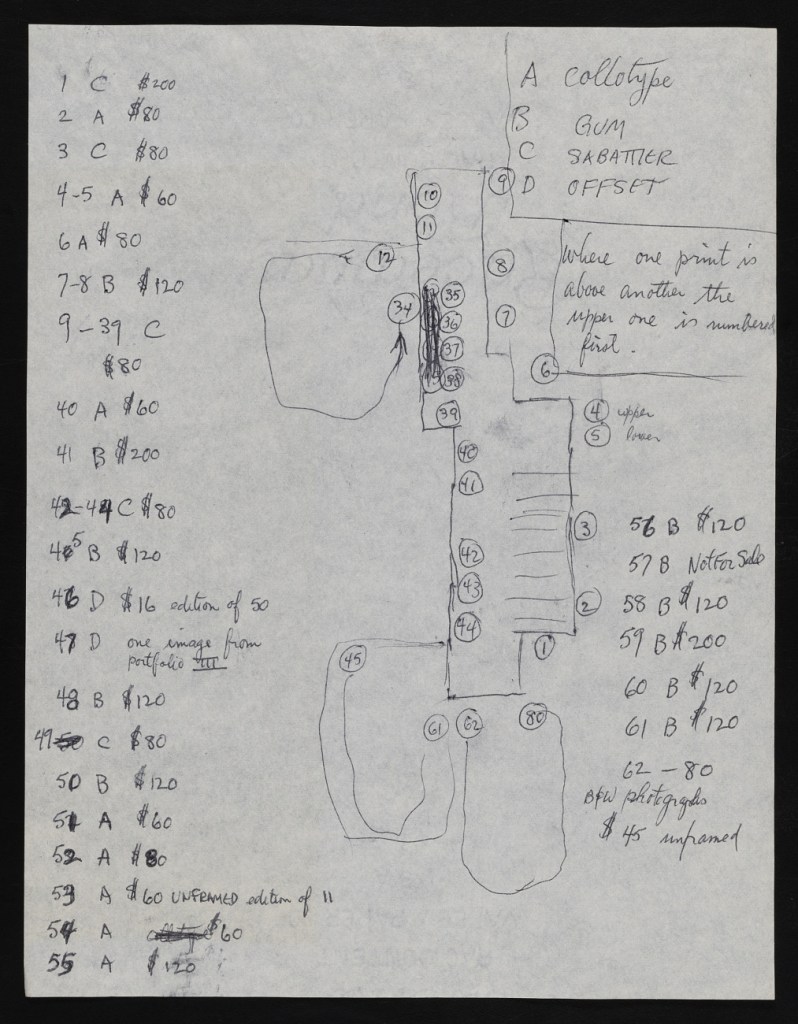
Todd Walker Focus Gallery layout with prices

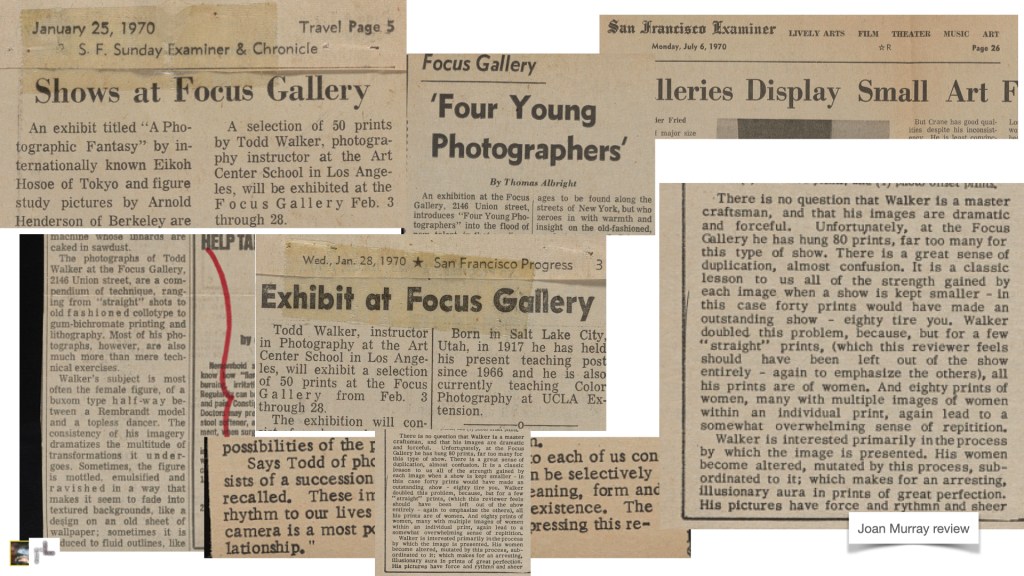
Arts coverage in the 70s was printed in Travel sections of papers. It fell into foundation journalism, being somewhat enlarged form of a Press Release. Some reviews were only that, a re-write for space.

1970 Press clippings; Focus Gallery shows.

Todd Walker: “Reality to each of us consists of a succession of images which can be selectively recalled. These images provide the meaning, form and rhythm to our lives as they relate us to existence The camera is a most powerful means of expressing this relationship.”

Joan Murray (reviewing): ” Unfortunately, at the Focus Gallery he has hung 80 prints, far too many for this type of show. There is a great sense of duplication, almost confusion. It is a classic lesson to us all of the strength gained by each image when a show is kept smaller. … Walker is interested primarily in the process by which the image is presented. His women become altered, mutated by this process, subordinated to it; which makes for an arresting, illusionary aura in prints of great perfection.”

Calvin and the Shallow Market

The try-buy: one order to try, then done.

A one-buy try and done. The curious will lead you into market deserts — a product for his own use if more useful.

First Factor of Success: willing to fail

The pigment market exists because of the failures of …. nope. It exists as an extension of the alt-photography born in the alternative 60s. Finding a different way, a distinct path was a significant landscape of the 60s conversion of photography and art. Pigment printing, gum or carbon is advanced as being archival, long-lasting, and durable; far more lasting than dye-based photography.

“After two years of research, the Natural Pigment color pastes are now on sale. I also restocked the synthetic pigments, and updated the yellow. “ 2022

I thought the pigments didn’t succeed in market, but reading his current site, they are all in stock, in different packaging than before, ready to ship.(Jun 2023) ‘rl’

Often, shallow markets are maintained by persons supplementing their worklife, bringing skills of one field into another. Electronics crosses into chemical darkroom.

// pools: why don’t they readily form? LFF /Kodak requires proper intermediate — success bridge gap// age-skill

ability to recover. resilience after failure. time to fail. Salvich/Efke ..

//how does Backer Market work, succeed in funding success.

Can it support you, how well, for how long. Can you grow; more people, more products.

Why aren’t others making, doing what you do? Questions any investor would ask; ask yourself. Sometimes the only answer is that it is the only thing you can do to satisfy the deeper part of yourself. That part unreached by financial analysis.

Your reason can be, as many people’s are: you hangout with interesting people.


  • Moe, W., and Fader, P. (2003). Using advance purchase orders to forecast new product sales. Mark. Sci. 22:146. doi: 10.1287/mksc.21.3.347.138
  • Mollick, E. (2012). The dynamics of crowdfunding: determinants of success and failure. J. Bus. Ventur. 29, 1–16. doi: 10.2139/ssrn.2088298
  • Mollick, E. (2014). The dynamics of crowdfunding: an exploratory study. J. Bus. Ventur. 29, 1–16. doi: 10.1016/j.jbusvent.2013.06.005
  • Burtch, G., Ghose, A., and Wattal, S. (2016). Secret admirers: an empirical examination of information hiding and contribution dynamics in online crowdfunding. Inf. Syst. Res. 27, 478–496. doi: 10.1287/isre.2016.0642
  • Burtch, G., Hong, Y., and Liu, D. (2018). The role of provision points in online crowdfunding. J. Manag. Inf. Syst. 35, 117–144. doi: 10.1080/07421222.2018.1440764
  • Butticè, V., Colombo, M. G., and Wright, M. (2017). Serial crowdfunding, social capital, and project success. Entrep. Theory Pract. 41, 183–207. doi: 10.1111/ etap.12271

Variable, Multi contrast patents

Just two summary patents. One from each of the key patent holders of the field: Kodak, and Ilford.

The first, from Ilford:

Photographic variable contrast material – European Patent Office – EP 0675400 A2

The first commercially available variable contrast material were produced by ILFORD Limited following 5 the methods set out in British Patents 494088 and 547883. In these variable contrast material is produced by combining two silver halide emulsions of which each emulsion has its own gamma value and is sensitised to a particular wavelength region of the light spectrum to which the other emulsion is not substantially sensitive. In practice one emulsion was sensitised to the blue green region of the visible spectrum and the other emulsion which is of soft contrast was not spectrally sensitised. When printing a io pale magenta filter was used to yield a low contrast print and a deep yellow filter was used to yield a high contrast print. Shortly after the introduction of the ILFORD variable contrast material the Defender Photo Supply Company of the US introduced another type of variable contrast material. This was described in British Patent 547060. In this system use is made of sensitising dyes which have a preferential action on some of the silver halide particles and such sensitising dyes are used in less quantity than to produce 75 maximum sensitivity. Thus the selected dyes impart to the emulsion a softer gradation when exposed to light within the spectral region to which the silver halide has been made sensitive than when exposed to light in the region of the spectrum to which the emulsion is naturally sensitive. But such material provides a

limited contrast range because some dyeing of all the silver halide crystals occurs.
Improvements have been made in the production of variable contrast material as described in British 20 Patent 547060 and in particular blends of emulsions having different levels of sensitisation have been employed. However in order to be able to achieve very low contrast from variable contrast material which comprises blended emulsions, when exposed to yellow or minus blue light, it is necessary for the spectral sensitivity of the emulsion component with the highest level of sensitising dye to be as high as possible in relation to the emulsion component which has not been spectrally sensitised. Unfortunately it is usually the 25 case that spectrally sensitised emulsions tend to have a contrast at least as high as their unsensitised precursors. Thus when a blend of emulsions is exposed under conditions adjusted to provide minimum contrast, that is to say when the sensitivities of the individual emulsions of the blend show maximum separation the contrast of the most heavily dyed component of the blend will be evident as a region of high contrast over the extreme low density end of the density/log exposure characteristic curve. This results in loss of highlight detail when printing high contrast negatives.
It is the object of the present invention to overcome this problem.

and this developer formula for Multigrade paper was provided:

Ilford paper developer for multigrade emulsion testing.


EP0675400A2.pdf

And from Kodak:

When making prints from photographic negatives, it
is desirable to use photographic paper which has a contrast selected to achieve satisfactory tone-reproduction of the original image based upon the contrast of the negative. Papers having higher contrasts, for example,
are useful in printing negatives that themselves exhibit low contrasts, so that a satisfactory final print can be achieved. As such, photographic manufacturers offer several grades of photographic paper. In order to avoid the need for separate papers of different grades, “variable contrast’ papers possessing the ability to achieve
different, selected, contrasts depending upon the wave-length of exposing light have also been employed.
A useful element is described in commonly assigned copending applications of Henry et al. Ser. No. 774,392 filed Oct. 10, 1991 and Price et al. Ser. No. 774,440 filed Oct. 10, 1991. A problem with variable contrast systems employing such elements is that the contrast range that the emulsion is capable of producing has been extended
to such an extent that existing filters are not able to take full advantage of the capabilities of the light sensitive element.
Accordingly, it would be desirable to provide an element/filter system that can take greater advantage of the contrast range of the improved light sensitive elenet.

The yellow spectral absorption characteristics can be
provided by a filter like a Wratten 4 filter and the purple spectral absorption characteristics described above can
be provided by a filter like a Wratten 34 filter. To optimize the Wratten 4 and 34 filters for use in this system, their density can be adjusted so as to give transmittance values like that shown in FIGS. 1 and 2 so that the
exposure times with these filters are in the same approx imate exposure range as are used with existing filters for
light sensitive elements of this type.


from my character of paper.