Dr. Beers is the widely known version of variable contrast developer, but in the 40’s and up to around 1955, D-64 was likely the choice. This was the time that Dupont Velour Black was a significant paper in commercial and industrial photography studios. Ansco Cykora also benefitted from D-64. These graded papers had uneven steps of contrast along with vary different exposure factors; this made changing contrast under production constraints a problem in need of a solution. D-64 was that solution. And the multi tray developing system. (using more than one developer at a time: one ‘hard’ & one ‘soft’)
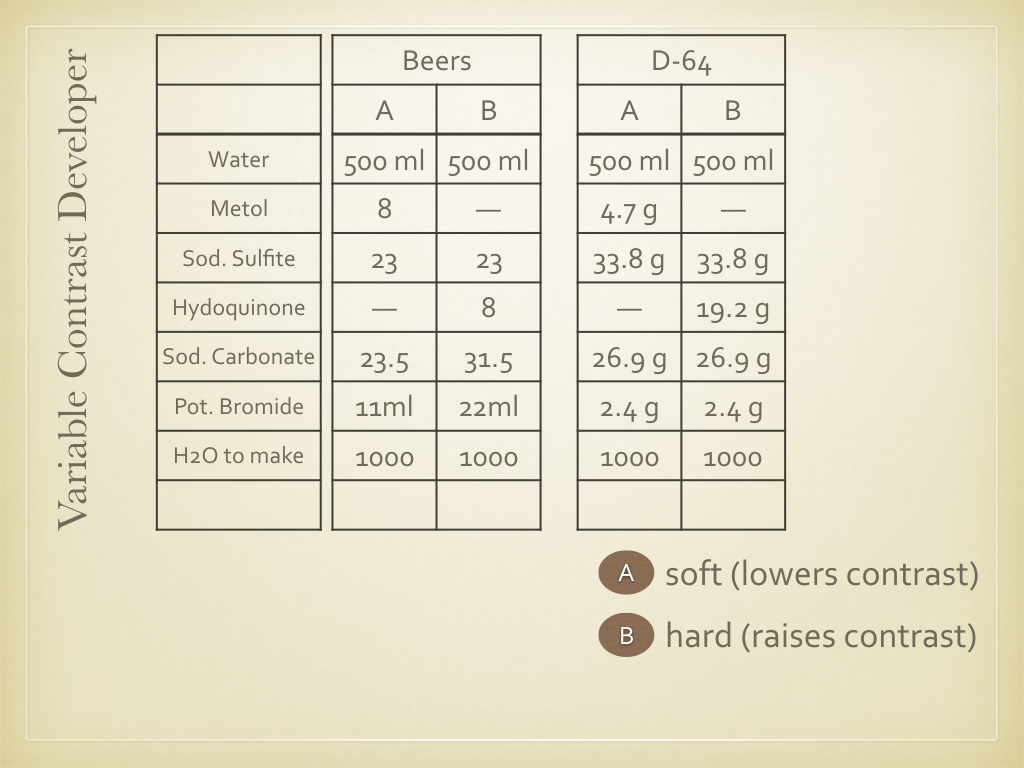
Beers & D-64 Formulas
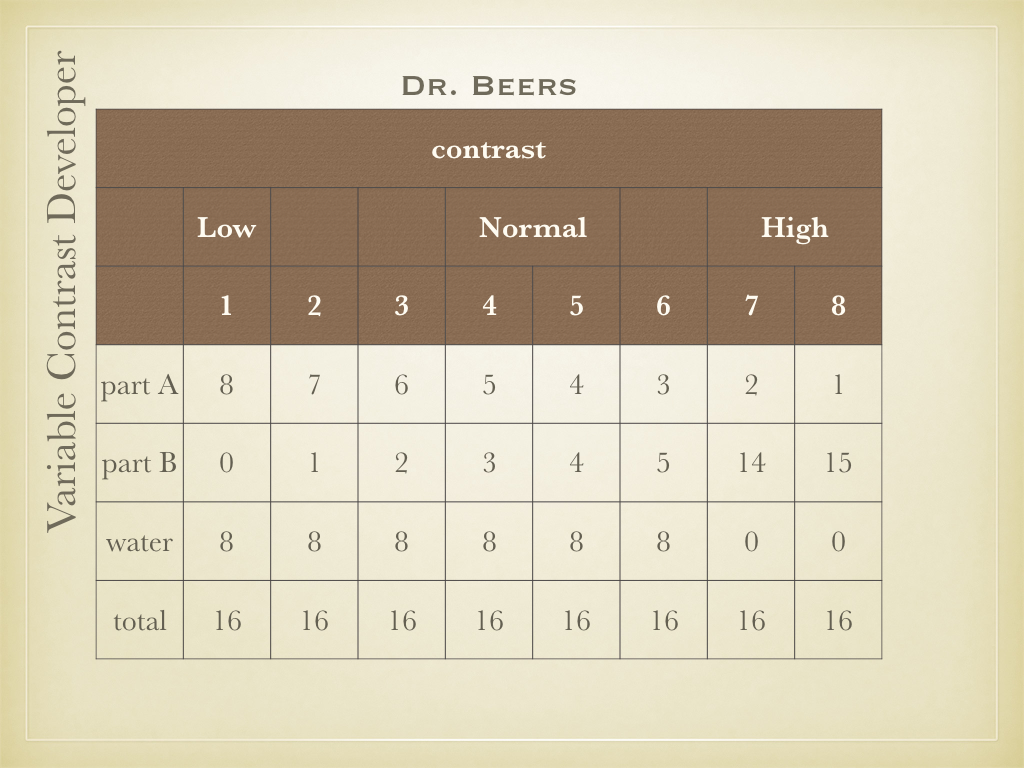
Dr Beers (Dr. Roland F. Beers) Developer
In the Beers formula I have used Sodium Carbonate rather than his original Potassium Carbonate. This has been a standard practice since 1963 when I learned the formula. It produces slightly more neutral prints — did on DuPont and Agfa papers; does now on Slavich, Adox, Foma papers. I don’t use Beers as a developer for Ilford papers, instead, I use 2 tray developing using developers from Moersch, LPD, or Dektol.
Dr. Beers Variable Contrast Developer
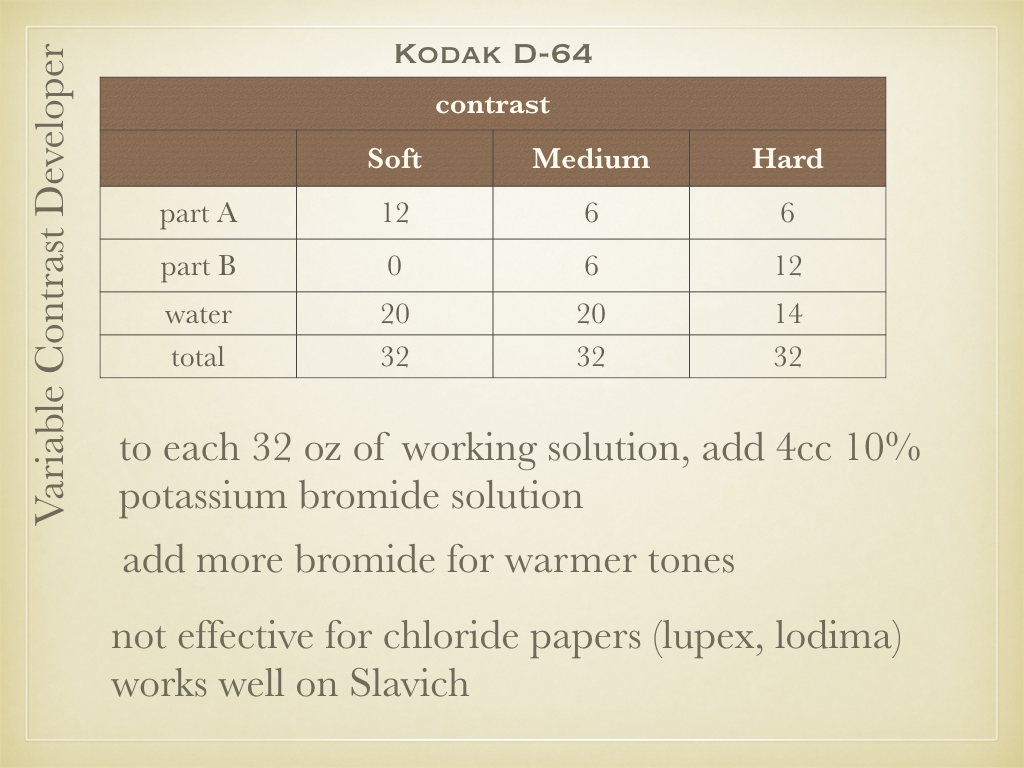
Kodak D-64
I use D-64 for film positives and internegatives as part of my repro process pipeline. Film, ortho copy and litho films are single graded (none) — their contrast is dependent upon the developer and where the exposure places them on the native response curve of the film.
I also use D-64 ‘soft’ for solarization of paper. This includes ALL papers that I use, even Ilford, my most frequently used paper.
Kodak D-64
To make a 10% bromide solution, add 100.0 grams of potassium bromide to water to make 1.0 liter.
… as a place holder. eventually, notes on printing color will appear
Gathering of notations:
Kodak recommends Portra for internegatives. It is pull processed to give the proper reduced contrast. Use 2′ 45″ or 3′ as start point in your darkroom.
The dye impurities exist in most dyes as it is difficult to create a dye that does not impact some of the spectrum outside its target range. For example the cyan dye, which filters out the red light, also filters some of the green light. The color mask is an attempt to correct that. Slide film resorts to other chemical methods.
The application of this type of coupler to color photographic films requires a knowledge, of the optical characteristics of the colored-coupler images and the control of these characteristics so that they conform with the known practical requirements for producing color photographs.
1 E. Albert, German Patent 101,379 (1899); German Patent 116,538 (1900).
2 W. T. Hanson, Jr. and P. W. Vittum, J. Phot. Soc. Am. 13, 94 (1947).
3 Vittum, Sawdey, Herdle, and Scholl, J. Am. Chem. Soc. (to be published).”
(Hanson, Wesley T., Jr. (1950): Color Correction with Colored Couplers. In: Journal of the Optical Society of America, 40,3, 1950, pp. 166–171, on p. 166.)
US Patent: 2428054 august 1945
RA-4 Printing
use RA-RT developer replenisher for 45 seconds at 100 degrees F.
contrast saturation controls:
You can change saturation and contrast both by use of Sodium Sulfite, pH, and Hydrogen Peroxide. Sulfite and lower pH for down, and H2O2 and higher pH for up. You can also use Citrazinic Acid for down or H-Acid or J-Acid.
Mixing Chemicals
Kodak and Fuji chemicals are interchangeable. However, you cannot interchange part A of one with part B of another. One whole Bleach = one whole bleach.
C-41
The general rule is that what you buy is identified as either “developer” or “developer replenisher.” If it says “developer,” then it is ready to use as mixed. If it is labeled “replenisher,” this is intended to restore strength to your working “developer.”If you want to mix a “replenisher” solution to directly develop film, it should be diluted and have “starter solution” added {per the directions}.
— Summer 2018 —
Here’s an update with links to Unique Photo’s products and pricing (USA only). Note the new/different packaging of the final rinse.
The first two items are needed to make ~6.5 liters of working solution developer. The mixing instructions are on the packaging (though you’ll have to adjust for proportions). You will have starter left over. The third item is a box containing two bladder bags of bleach and fixer. Use the bleach straight, mix the fixer 1+1 with water. Final Rinse is mixed according to the instructions (~1+100 with water).



You must be logged in to post a comment.