Some References: Theory

books from the theory shelf. Would be considered as starting places in a course approaching the image making process. These are theory texts. Use these to build out a vocabulary. Build that vocabulary into your dictionary of ideas and image prompts.

— Barthes, Image-Music-Text. “consists of thirteen essays published by Roland Barthes between 1961 and 1973. As a whole, the pieces track Barthes’ movement from an influential early theorist of semiotic analysis and structuralism to his emergence as a major poststructuralist thinker. Sometimes, indeed, one essay will challenge, revise, and correct the preceding essay: having offered an “Introduction to the Structural Analysis of Narrative” (1966), the next essay, “The Struggle with the Angel” (1971), asserts that it is attempting “textual analysis,” not structural analysis. Stylistically, the essays include methodically analytical essays laden with highly specialized terminology (like “Structural Analysis”), ” see this

— Barthes, Camera Lucida. This title served as prompt for me to pull out this list of texts. “The book investigates the effects of photography on the spectator (as distinct from the photographer, and also from the object photographed, which Barthes calls the “spectrum”).”

— Bolton, The Contest of Meaning. The Contest of Meaning summarizes the challenges to traditional photographic history that have developed in the last decade out of a consciously political critique of photographic production. Contributions by a wide range of important Americans critics reexamine the complex—and often contradictory—roles of photography within society. Douglas Crimp, Christopher Phillips, Benjamin Buchloh, and Abigail Solomon Godeau examine the gradually developed exclusivity of art photography and describe the politics of canon formation throughout modernism. Catherine Lord, Deborah Bright, Sally Stein, and Jan Zita Grover examine the ways in which the female is configured as a subject, and explain how sexual difference is constructed across various registers of photographic representation. Carol Squiers, Esther Parada, and Richard Bolton clarify the ways in which photography serves as a form of mass communication, demonstrating in particular how photographic production is affected by the interests of the powerful patrons of communications. The three concluding essays, by Rosalind Krauss, Martha Rosler, and Allan Sekula, critically examine the concept of photographic truth by exploring the intentions informing various uses of “objective” images within society. from publisher

— Burgin, Thinking Photography “The essays presented in this collection contribute to the[ THEN , 1982] emerging theory of photography, aiming to establish a materialist analysis that transcends traditional criticisms. They explore the significance of photography as a practice of signification within specific social contexts, advocating for an interdisciplinary approach that acknowledges the complex relationships between representation and the represented. Key discussions include the distinction between photography theory and criticism, sociological dimensions of photographic institutions, and the importance of meaning production in understanding photography’s role in society.

— Campany, The Cinematic, “The cinematic has been a springboard for the work of many influential artists, including Victor Burgin, Philip-Lorca diCorcia, Stan Douglas, Nan Goldin, Douglas Gordon, Cindy Sherman, and Jeff Wall, among others. Much recent cinema, meanwhile, is rich with references to contemporary photography. Video art has taken a photographic turn into pensive slowness; photography now has at its disposal the budgets and scale of cinema. This addition to Whitechapel’s Documents of Contemporary Art series surveys the rich history of creative interaction between the moving and the still photograph, tracing their ever-changing relationship since early modernism.”

Cotton, The Photograph as Contemporary Art, “Arranged thematically, the book reproduces work from a vast span of photographers”

— Sontag, On Photography, “In On Photography, Sontag examines the history and contemporary role of photography in society. She contrasts the work of Diane Arbus with Depression-era documentary photography and explores the evolution of American photography from Walt Whitman‘s idealistic notions to the cynicism of the 1970s.”

— Trachtenberg, Classic Essays on Photography, 1980, “Containing 30 essays that embody the history of photography, this collection includes contributions from Niepce, Daguerre, Fox, Talbot, Poe, Emerson, Hine, Stieglitz, and Weston, among others.” Alan Trachtenberg was Neil Gray, Jr., Professor Emeritus of English and American Studies at Yale University.

Secret Dye Transfer School

This is an expanded version of { Everyone loves a secret…. } with questions.
Avoid tidepools of inactivity; don’t get caught in their stagnation.

THE SECRET IS: TRY. NO SCHOOL TEACHES COURAGE.

The secret case of Eggs. You cook eggs at home, getting very good over the first dozen. A chef trained at CIA will cook that dozen eggs several ways in their first morning. The secret is variation — faster feedback between effort and result.

How to poach an egg… or, how I poach an egg… based upon its size, use of poach … cooking is easy, but it is a manual skill. The analogy should be obvious. I would never spend time trying to teach someone how to cook, if they are afraid of making mistakes. The arrogant amateur is deadly in a commercial lab.

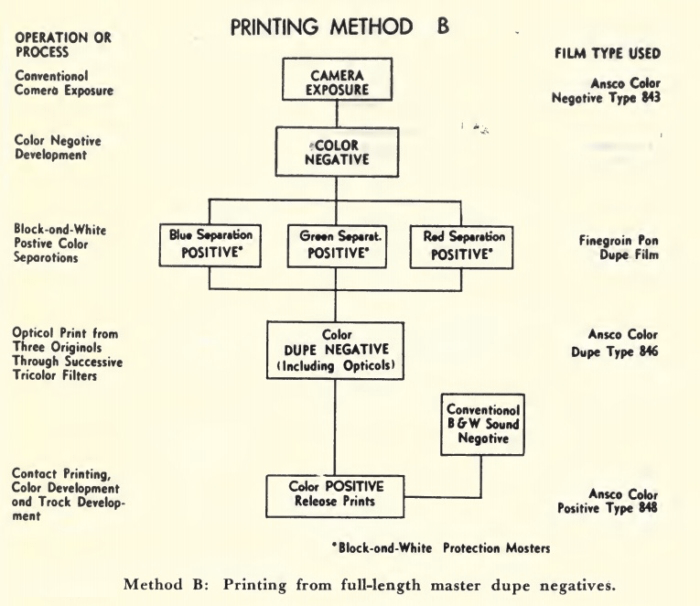
Commercial labs had more information, more experience than Kodak about the the use of dye transfer materials. We even told them about ways of correcting the magenta dye (restrainer). Labs experimented more frequently. The bigger the lab, the more varied the requests. Full shift labs had more types of products. Only small labs specialized in dyes . No one kept secrets from anyone else. okay, we tried to keep client lists hidden. At least we didn’t publish them.

Big labs probably came to dye transfer after it became a mature, consistent product. Mixed dyes was the first success. Type C’s, Printons, dupes, etc … these products provided the profit for dye transfer to be a service. Dyes were, for the most part, a glory part. Those in “pickle alley” specialized in dyes almost to the product type; their photographer clients did, so they did.

Kodak made different papers …one retouchers and illustrators preferred, another popular in portrait studios, and the common one, Type F.

Would you take a class to learn dye transfer printing? Would it take you nearly 20 years to make your first print? If it did, whose problem is that? Suppose you bought the supplies, the books, equipped a lab; all that, yet you never used a box of the material. What secret kept you from trying to print?

In my experience, I have never known anyone to succeed without ernest initial effort. With dye transfer, the printers who make their third print within the first week of effort get the furthest. These are the printers that are solving new, more complex problems for most of their thousand image career.

Frequently, timid people never acquire the skills they think they should. AFter all, they are literate; they collect information, data sheets, magazine articles. Every article they read tells them of the difficulties, as the author promises great reward. What a view from the heights.

https://www.photrio.com/forum/search/754152/

Prints? Uncovered conspiracy?

IB Photochemistry — from Aug, 2007 to Feb, 2025 – a very long journey getting to a point of.. what… what does he have? A manual from a small Northern California lab. This manual reveals: the answers are on their wall placards, not in this document. [ may be Garelick, or Teoli]

someone spending time uncovering a conspiracy… of their invention?

Lack of knowledge doesn’t mean someone is hiding it from you. Lack of experience is your failure.

How many prints do you think he has made?

Kodak had a training facility in Rochester. It served their marketing group’s learning needs . The dye transfer commercial labs didn’t learn from that facility. In-house, industrial labs like GE, or GM, etc went there. Labs with many dye transfer employees wouldn’t go — the information would have been geared to too low level. MEC was opened in 1972. What did all those labs, the largest of which began before 1960, do for learning before ’72?

Multiiple shift, commercial dye labs, had wider range of experience than Kodak. We saw many problems, having to solve them with elegant, complete answers — usually at a small profit. We optimised by experience. Knew more by doing more.

big labs had a head start. They had employees who had learned in the forties … were running sections in the 50s. The process experience transcended single-vendor, single product type.

Theory was studied in service to experience.

  • Try it..
  • if it doesn’t work, explain
  • write it up…
  • stick it on the wall

Kodak Lab Days.

Kodak changed over the decades of my contact with them. In the 60s, they seemed very accessible. By the 80s there seemed less knowledge, but with more datasheets. Instead of information, they provided brochures… many handouts.

Frank M. –[ someday, more..]

Kodak’s final days … from letter sent to labs in their marketing mailings list.

We also received such things as:

  • CIS Current Information Summaries
  • and my favorites: From the desk of — the best were from Jeannette, Frank, Louis, Bob S., “girl group”

this day in 1898, the U.S. Supreme Court, in United States v. Wong Kim Ark, ruled 6-2 that Wong, who was born in the United States to Chinese immigrants, was an American citizen. It was the first Supreme Court decision to rule on the citizenship status of a child born in the U.S. to noncitizen parents.

To the Wileys-and-Garelicks: please, get the dates correct; woth that achieved, your data may make sense.

Possible set of dates: 1936 – 1957 [ much foundation; most of the theory] 1957-1977[ the changing nature of Kodak along with the nature oc the commercial color lab] . Next, the dates become, in my file folders: 1981, 1986, 1988, 1991, 1996.