by now it is clear that you aren’t returning my check; it is clear that you didn’t keep your commitment to provide reprints, or return my check.
it is clear that your structure is the same as any other business, run simply, sloppily made rules, carried out by functionaries aware of their vacation, treating research requests as interruptions.
I expect dishonesty, false promises from a profit business; that is the founding basis of opaque blind commerce. That shouldn’t be the basis or philosophy for a non-profit, otherwise, there is no need to make tax or structural distinction among them. If they act the same, they are the same.
now isn’t then;
then when Visual Studies Workshop was a fertile place, bold: attracting the committed, driven by a mission spirit, with a goal of a broadening, rather than a deadening future. a place beyond the market drivers, something other than a tax deduction.
what may not be clear to you
is how much VSW has changed. what you were, and what you’ve become; where you were headed, and how far off course you’ve gotten.
Turning a non-profit into an organization that is as layered, with interactions like a profit business is pretense and false promise. It is also bad mimicry. No small business succeeds with so much pretentious departmentalization over such small amounts of money. They would die of overhead and organizational inertia.
The biggest detour is the detail. Paper clips and pencil sharpeners are the enemy of good writing; so too the enemy of good photography is the search for a better developer, lens, film, or, worst of all, opportunity.
Opportunity doesn’t knock, it hides right behind you.
Students teach their delays to their teachers. In teaching adult learners, while also teaching full time students, I noticed a significant differences. Those people who had to use the picture made better pictures earlier. The just followed the notes on the wall; used the chemicals provided; bought the student pack from the local store. At the end of a month they were making prints and talking about elements other than the ‘how do I’ of photography.
There were some who took to the process quickly, effortlessly absorbing details of the process, while also shooting. Shooting a lot. In fact, that was the secret of the successful student — they advanced themself — dedicated effort. They took the assignment: ‘a roll a day for a month’ in earnest, even extending it to the entire first year.
Basic Silver
Three Kings
…. In the chemical age, in every age of commerce, we move among choices; are moved, actually, thinking we have choices, so there is the belief that we can be better, newer, improved with only another mixture. Rarely is that true.
These developers are my at hand mixture. LPD, Dektol, & D-76. I keep them mixed because they are useful, and are delivered as a powder. These days, LPD is also sold as a a liquid. I always suggest to the novitiate that they buy liquid, even though you are paying for water, you are getting freedom from air borne chemical dust. This is as close to magic as we get.
Basic Bullets
My key point is that those who pursue a better developer/film/camera/ .. anything such as that, lose sight of the image; what it is, where it is, and why. To cover the lack of understanding of the power of an image, or in being lost to understanding aesthetic growth, or “shock,” those folks cover their lack with a homily about being after the process or the print. They are only lost, and covering their tracks. They are only addicts, not artists.
The magic bullet isn’t something you will buy; it isn’t something outside you that is missing. You lack the magic.
Besides, silver bullets always go bad, and actually carry little impact.
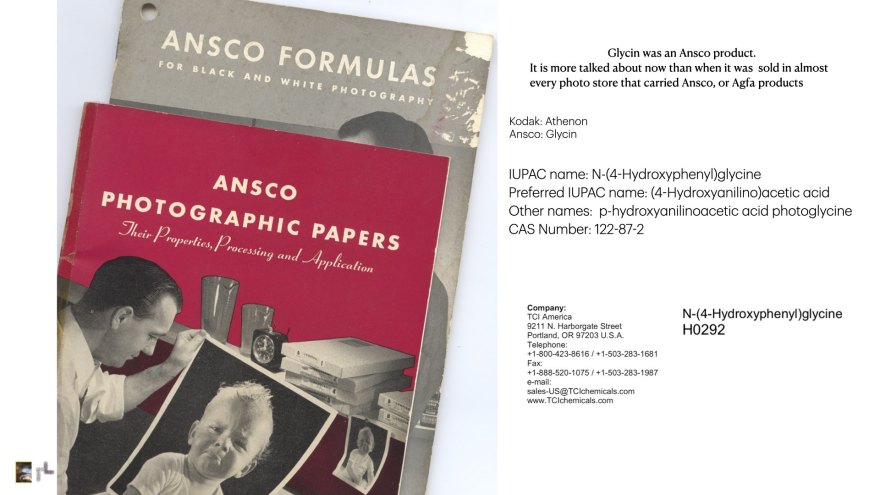
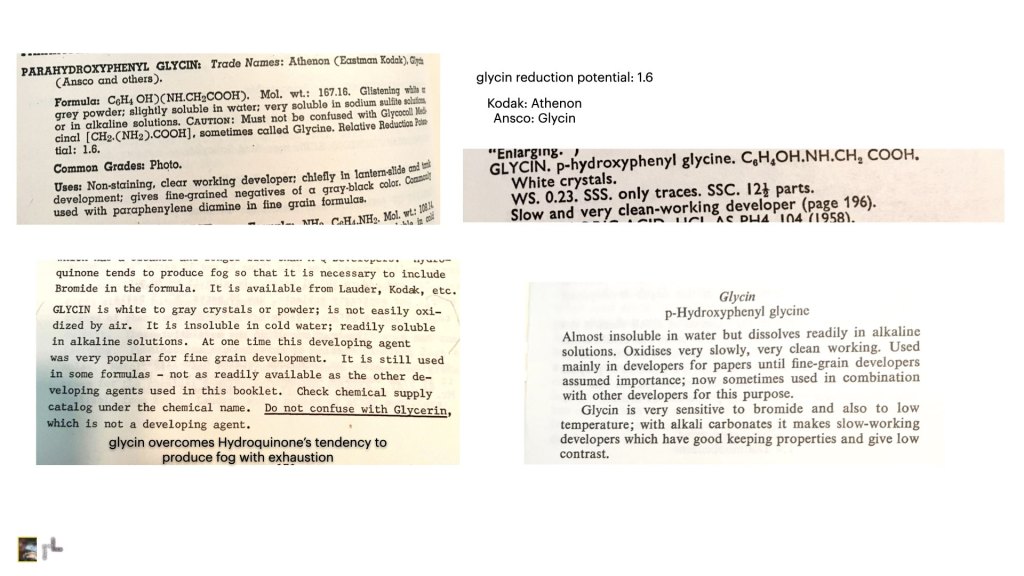
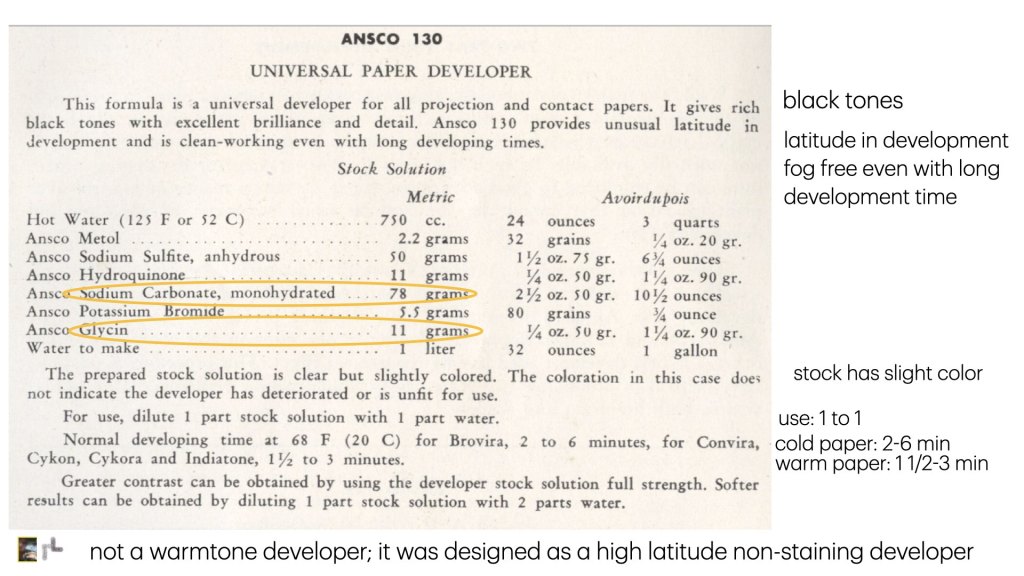
The Magic Beans, as exchanged in the halls of the camera cult, are Amidol, Pyro, and Glycin. I have posted about Amidol; while Pyro has so many vocal advocates, just ask ‘google’ … however, Glycin is do some airing out.
GLYCIN
In the beginning there were several beginnings — however, the history of the Camera Crafters is drawn across the landscape in the Zone Shades of Ansel Adams.
This: “With some papers glycin gives a light “stain” to the very high values and this appears as a “glow” which I have found rewarding at times. Usually a slow-working developer, glycin is sometimes preferred when a considerable number of prints are to be developed together.” Ansel Adams, The Print
His first series of technical articles was published in Camera Craft in 1934, and his first widely distributed book, Making a Photograph, appeared in 1935. Most important, in 1936 Stieglitz gave Adams a one-man show at An American Place.
So, Glycin — a trademark, which is close enough to ‘glycerin’ which was used in the darkrooms of dye-transfer printers, but definitely not the same stuff.
catechol has been reported to be capable of image development even in the presence of considerable amounts of silver halide solvents, making this developin agent suitable for combined developing and fixing solutions.
Pyrogallol.. in developers containing low concentrtions of preservative, the oxidation products of pyrogallol development produce a residual yellowish-brown stain. This stain reinforces the silver image and is expecialy effective in obtaining maximum emulsion sensitivity and fine grain from the photographic material
the possibility of providing developers that improve both the graininess and sharpness was the objective of a study by Alman and Henn. [Effect of developer composition on the structure of photographic igmages. Phot. Sci. and eng.,5:129 1961
converting a developing agent into better surfactant will improve it electron-transfer capability and, hence, its ability to serve as a developing agent. [haist, 170]
William Evan, New Ways with Pyro, Am. Phot., 39(5) May 1945
Behrens, A Versatile Developer: Pyro, Am. Phot., 43(7) 1949
1948: Kodak lists SD-1 for pyro stain. SD means special developer; little use. Kodak needed a tanning developer (they had one) but they didn’t want stain.
Specialist forums occupy a large part of the internet; they are presumed to provide a place for increasing the knowledge of a field. Photography has always been an “outlet” for the temporary, ie, weekend artist. Serving that thirst, acting as bridge between seller and consumer has rewarded many people with small skill but large appetite. Those folks formerly put on workshops, now they host web forums for the seeker.
as wee all know: There’s a Seeker Born Every Minute.
Caution: restricting topic restricts growth, resulting in in-breeding, as well as in-fighting
If you restrict your discussion to technical in a field with no growth, you have no growth. You have reached saturation. Adding more examples of addition doesn’t increase the field of mathematics.
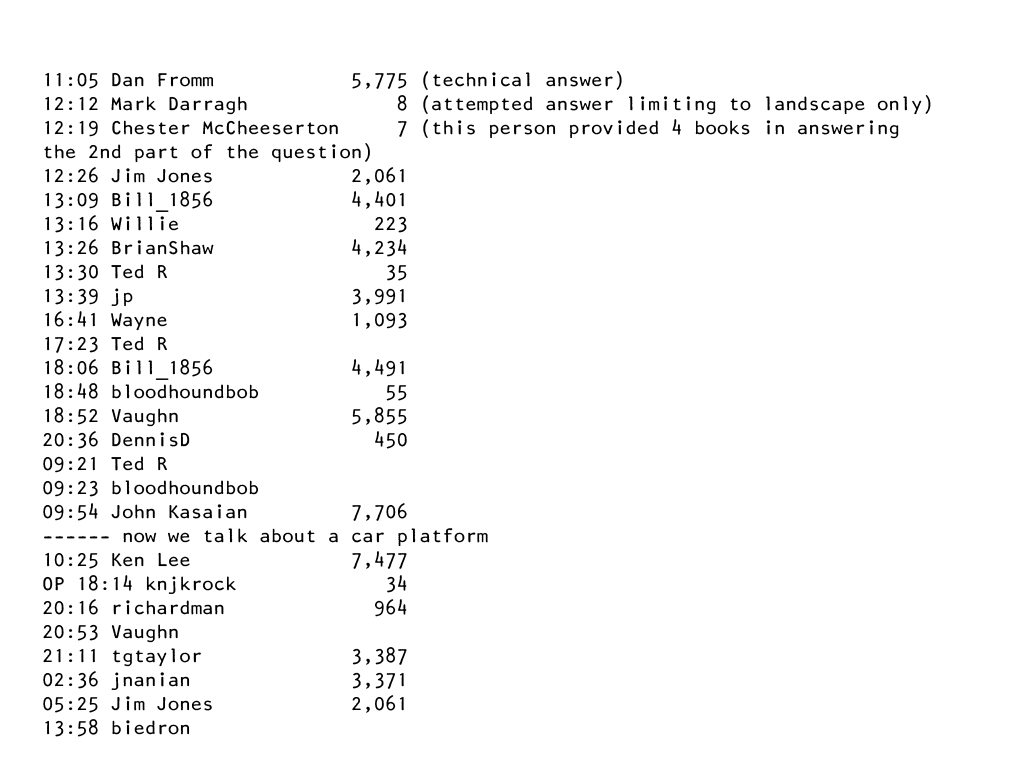
The newer members come to the photography forums for two broad reasons. They contribute, first as question – easy ones. But who answers them? The stays are likely the ones to answer first, and frequently. Who are they? What questions can they answer; do they answer?
Q: point me to technical, and aesthetic books limited to Large Format
The first responder was a high-post participant. He provided the technical book list, which was repeated by several of the later posters, who, apparently, hadn’t read the answers already provided.
‘Looking at Photographs’ John Szarkowski, 1973 MOMA
‘Landscape: Theory’ published in 1980 by Lustrum Press
‘The Nature of Photographs’ by Stephen Shore. 1998
“Andreas Gursky’ MOMA catalog from 2001, essay by Peter Galassi
28 year span of opinion about photographs. The time period covered the rise, as well as the changed status of photography as an artform held within established museums. It is a good answer – its only problem – it is incomplete, but it will not be added to by the Large Format participants. They don’t grow that way, preferring instead the procrastinator’s aesthetics. They switched from answering the question to opining about a (famous) photographer atop his car with, keeping it large format oriented, a big camera.
Enter the discussion about Dog Houses in the Boardroom. When a topic the meeting members can’t discuss is broached, there is little discussion, however, when a topic of little consequence is raised, everyone can, and will, offer a point on the matter. Group unity with the result being that no important matter is ever settled; no important question answered. This produces an organization that is comfortable but static; passive. It is at its end stage.
Film is dying because the Forums are Dead-ends – or, maybe Film is at a dead-end so the forums are the gathering ground of the bachelor herds – those without heirs, just stains and limp standards.
What More
There are two current resources that could be used to enlarge the imagination of a View Camera photographer:
“Lori Nix — The Power of Nature” ISBN-10: 3868322744
“Unspeaking Likeness” Photographs by Arne Svenson. ISBN-10: 1931885729




You must be logged in to post a comment.