Characterizing Paper: darkroom printing

The darkroom is the eater of paper. Paper comes in; prints come out. The in-between is the bulk of the mystery (magic?) of photography — at least in the land of chemical photography.

Printing is a process of cumulative learning; each time you print, you gain skill, the procedures become background until a new paper… With a new paper/chemistry, comes learning, trial, error, etc. – The way out of endless, useless trials is systematic testing.

After calibrating a new paper, work prints are achieved with little waste of time or material. It takes one sheet of 11×14 paper cut into 5×5 & 4×5 pieces. The leftover strips are used to determine ‘first white’ exposure. In less than 2 hours a full test session is completed.

If you are using a 21st century darkroom electronics system, such as from RH, or Heiland, or DA, they each come with ‘calibration’ instructions (or kits) These systems ship with some common programming for the frequently used Ilford papers. They do not have data for unusual papers such as those from Slavich.

New Paper: Slavich Bromoportrait

[2018, no longer available] Paper has a white and a black. A lightest and darkest. Even if color, there is a light and dark — our intent is to determine the least amount of light to make a useable first tone. this first tone is our off-white – the OW — max white is paper itself. The base tone of all prints.

My Test: Slavich Bromoportrait #3 developed in Moersch SE-1 Sepia developer.

Increase Certainty

The use of a transmission step negative gives a known range of tones to expose the test paper/developer to. With a Stouffer T2115 we have 21 steps spaced at half-stop intervals, just this little bit of standard is all that we need to make an accurate profile of our paper/developer.

I begin with making a step test to determine the first white of the paper. The result of my test is shown in the bottom left image. Those steps were made in quarter stop increments.
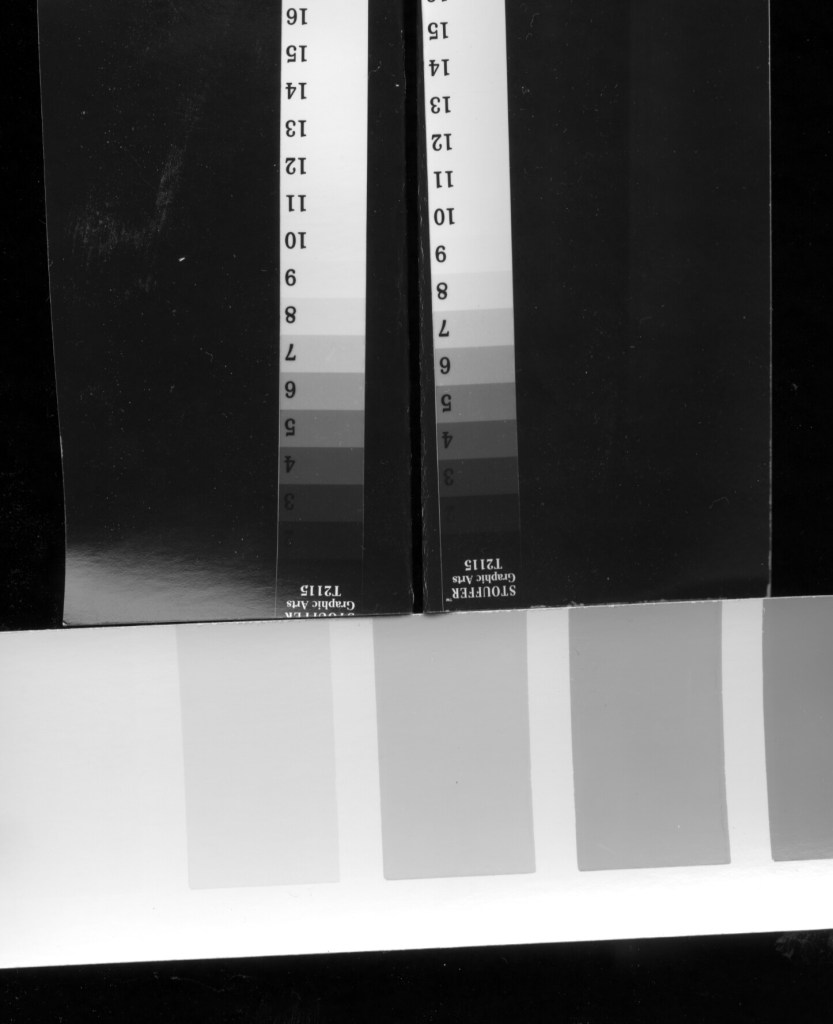
The result of this “white” stage tells me a starting point for this paper.

Since I make several thousand prints each year, using standardized start points, in addition to darkroom electronics, means my throughput remains high while lowering my costs. Additional advantage is being able to change paper with the same image without starting from complete zero. I know in advance the exposure changes between papers. I also know the contrast range of papers I use, which means I have a better estimate of what paper this negative will match …

NOTE- if you’re APUG, or Large Format Forum registered, you may not use this material. Please, leave this site now!

continued…

beseler NEGATRANS

but those damn O-rings…

NOTE- if you’re APUG or Large Format Forum registered, you may not use this material. Please, leave this site now! https://webionaire.com/2023/09/17/drew-wiley-photrio/ & this are some reasons.

from the patent:

A film carrier for use in photographic or projection apparatus in which a film supported on a pair of aligning film guides is transported by means of an endless belt ..

It is that ‘endless belt’ that breaks. The replacement parts are no longer easy to locate, at least not from the usual sources; however, these items were not made by beseler, only sourced by them. These belts are o-rings to most of the world. Size it; buy it; install – get back to making prints.

I measured a broken belt, finding it ranged from .91 to .96 in diameter – with that, and an approximation of length (using a string threaded through the roller path) I arrived at a McMaster-Carr part.. usasealing (shelf life est: 15years)

I have 2 negatrans for 120 film: one fitted with an omega adapter, the other, the one broken is for my beseler 45. I also have the negatrans for 35mm. Makes life with roll film much easier in getting through a batch of ‘work’ prints.

If you’re near UTD, or Marfa contact me for the part number; maybe one of my spares.

Large Format Quits

because of questions asked me after my post on the Meltdown , I’ve put together some notes on why people stay, or why they leave.

After the fight, who gets back onto their barstool, to talk about shoe-laces, lens makers, plastics adhesives, dilutions, destinations after their job closes. Who are these inveterate photographers, dedicated to talking about only photography – well aren’t these the topics of photographers? They are in the Land of Large Format Photographers.

Who Stays Anyway

The Hall Monitors

Why do Garret, Sal, Randy, Kirk .. stay -simple: they aren’t offended. In fact, they voice weak interest in the topic, only becoming upset when their (Gittings) self sanctioned art house is proclaimed, quite honestly, not a place of art. But that only applies to Kirk Gittings, the others have no argument with what is done. They may even think more discipline is needed.

Kirk has used the forum for career advice, website advice, complaints about pricing, hell just about anything. He has even accepted, and explained the reason that discussion beyond lens and film is a problem with the Large Format Forum. Wonder how his students like learning from a Batch Teacher.. someone who soups so infrequently that he comes to the forum to get an update on procedures.

The Unknowing

The vast majority are simply unknowing. They don’t know what photography could be, or is to large chunks of the art world. They don’t know because they don’t come across it. They came across this site (LFPF) because they have a buying, or technical question. Something of general interest. Presto, that is what the Google does well. Route easy questions to a common point.

Who Stays & what do they call art?

This exchange between a long timer and new entrant will clarify the mindset of the STAYS.

lfpf
What Passes For Helpful Crit

The exchange is over a Landscape thread- one of the longer threads on LFPF, between Corran (screen name for Bryan Garris [ web ]

The highlighted phrases demonstrate the restrictions these people place on, not just themselves, but on everyone else. These limits, these boundaries are limitations of their working aesthetic. They limit, not just the preferred subject, but its mode of rendering. The ‘INTERESTING THING’ should be “beautiful light or textured sky,” or quite unhelpfully: “something else.” As long as it meets the expectation of the other devoted weekend photographer.

The triggering phrase that fomented the exchange “I would not waste film.” can only trigger someone who trusts the statement enough to give it more value than his own internal aesthetic. “Corran” seems the insecure stay behind, not trusting his own ability, saying (for explanation) “I am learning a new place.” — must mean that photographs must be made of places you’ve known. Again, this is reading the world from a vary limited visual vocabulary. Sadly, Corran was one of the supporters of the DOOMED THREAD of Richard Man. He commented enthusiastically in favor of it, as well as condemning the heavy handed Oren Grad, et. al. for chopping it off,along with terminating the threads of dissent.

This is a form of the weakest stays. They protest, but not enough, not in a way that matters, because they have no other way of satisfying their need. Sadder still, they don’t know enough to understand what they need. Saddest of all, they may be teachers!

The Uncaring

This is the bulk of those who stay. They are dependent, unable to work on their own, therefore, no matter how much battering, bickering, bluff, or bullshit comes their way, they must stay. This is the great 85%

The Stays, Stay to Quilt, calling memorabilia photography.. the people who wanted to discuss and grow in understanding photography just quit. 

What’s The Matter

Photography draws fine distinctions between its practitioners. A place that can’t permit those who would develop their range of possibilities isn’t a place that should be of interest to people with growth potential. If you want to grow your artistic practice in photography, do it with better people than the stay behinds at such places as LARGE FORMAT PHOTOGRAPHY FORUM.

NB: Organic Turns, Quits, or escape should be 5-15% …