Peaceful Bliss Day

hello Margaret are you still here ?

reminder it wasn’t the first bliss day missed, and it won’t be the last. Fearsome hunger fuels the inkwells, collection plates and ballot boxes of our empty passageway.

We know that people can maintain an unshakeable faith in any propositions, however absurd, when they are sustained by a community of likeminded believers. — Daniel Kahneman (1934-2024)


[The Great Disappointment in the Millerite movement was the reaction that followed Baptist preacher William Miller’s proclamation that Jesus Christ would return to the Earth by 1844, which he called the Second Advent. His study of the Daniel 8 prophecy during the Second Great Awakening led him to conclude that Daniel’s “cleansing of the sanctuary” was cleansing the world from sin when Christ would come, and he and many others prepared. When Jesus did not appear by October 22, 1844, Miller and his followers were disappointed


published in 1956, detailing a study of a small UFO religion in Chicago called the Seekers that believed in an imminent apocalypse. The authors took a particular interest in the members’ coping mechanisms after the event did not occur, focusing on the cognitive dissonance between the members’ beliefs and actual events, and the psychological consequences of these disconfirmed expectations.

‘During his lifetime, many of his adherents believed that he was the Messiah. ‘
[The concept of the Messiah is central to Judaism, representing an anticipated savior and bringer of universal peace and justice. Expected to restore Israel and gather in the Jewish diaspora, the Messiah is often linked to the Davidic lineage as foretold in the Hebrew Bible. Over centuries, beliefs about the Messiah have shaped Jewish Life.

Since Schneerson’s death in 1994, some followers of Chabad have persisted in believing in him as the messiah. Chabad messianists either believe Schneerson will be resurrected from the dead to be revealed as the messiah, or go further and profess the belief that Schneerson never died in 1994 and is waiting to be revealed as messiah. 

[“He will soon rise!” they proclaimed. Others said, “He’s not really dead. This is just a test for our physical eyes.” Some even camped out near his gravesite, waiting for his resurrection]

T’chiyat Hameitim is a core tenet of traditional Jewish theology, referring to the revival of the dead, the physical body being reunited with the soul during the Messianic Age. The Resurrection of the Dead is considered the 13th cardinal principle of Judaism. 

Does this mean that Judaism and Christianity remain the same?

and what’s this got to do with Art ; well, what does Art have to do with belief . From much to everything — 0 to 1’finity. belief guides choice . Artists are foundational; here before counting..ANd, artists don’t kill other artists; don’t round them into camps; don’t make claim and lay waste to each other. artists don’t make barbed wire 

At least not yet.

The chosen, accountants, automated their job . now, the chosen, programmers automate their job . The task of AI isn’t imagination it’s duplication, regurgitation and AI can only eat the digitized .

Certitude is not the test of certainty. — Oliver Wendell Holmes, Jr. (1841-1935)

In Texas Memoriam

James Bones Jr. November 1, 1943 — November 17, 2023 [80] . Fort Davis

News is never new in Texas. Knowledge travels slower than gossip, often missing the train. He lived in the ‘tiny texas triangle’ — a southwest artist.
The world, the urban, the built. Jim bones survived in the tiny triangle, but didn’t flourish . Small grants, wives, persistence, kept him alive. He is noticed by the dye transfer, Porter groupies on internet darkroom forums. Flutters of worship words of those who didn’t make it as far as he did. They covet the craft badge, envy the possible life of an artist. Sadly, they failed all three legs of the triangle.

the Tiny Texas Triangle of west texas. Small, contained worlds are the hallmark of rural america. Art in small places popup around small colleges.

He was one of Eliot Porter‘s printers. ” I printed for Eliot Porter in the late 1970s and occasionally he would have me make a black and white print by using the magenta matrix from a full color image to sequentially apply all three dyes to the same piece of paper.  They were beautiful and had a depth unavailable with silver emulsions. Sincerely, Jim Bones (2003).”

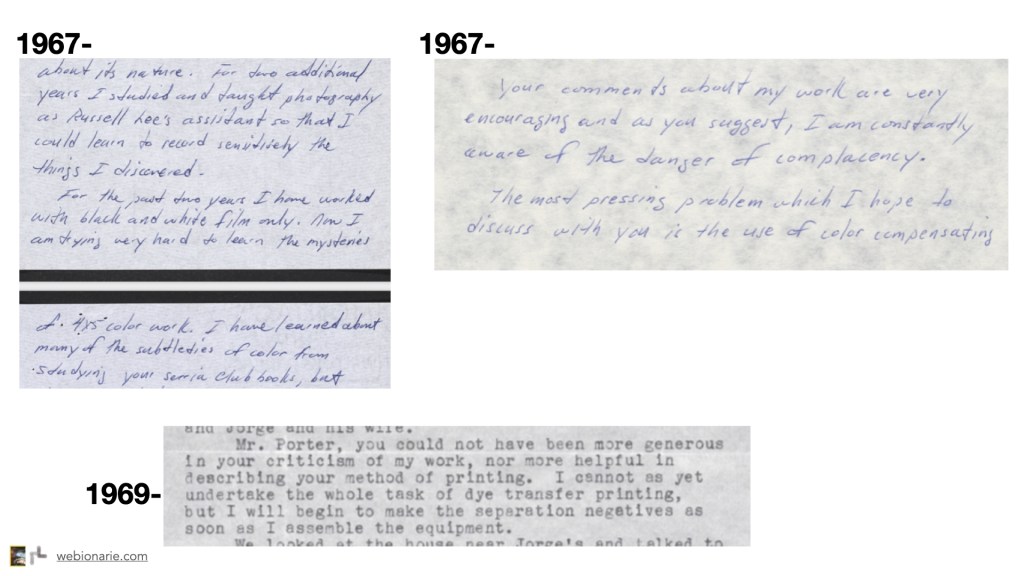
Bones [JB[ wanted to make photographs like Porter’s. To achieve this, he visited and correspondent with Mr. Porter, seeking advice on most topics of making photographs and a living with photography. In 1967, Porter[1901-1990] was 66, while JB was 24.

Scattered posts:

JB printed, 1982, a Russell Lee negative made in 1948. EX: https://www.cartermuseum.org/collection/trucks-loaded-grapefruit-lined-worlds-largest-citrus-juice-canning-plant-weslaco-texas

Film proposal: A Natural Revelation. Film about Eliot Porter and Loren Eiseley.

NB: Oooh is that a dye transfer, for more

How short the memory of online groups… is it because they were never close?

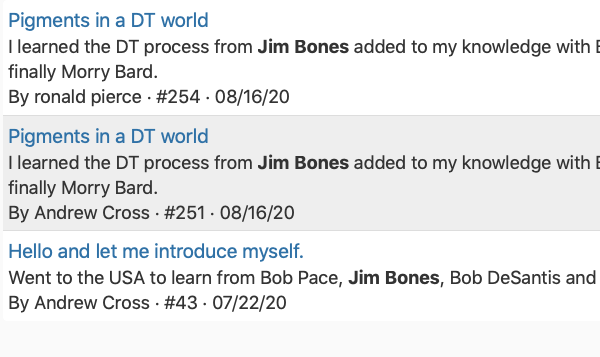
search on the dye transfer group list. No notice of Jim’s death. Not even a grateful student noticed Jim Bones had died. In ’20 a memory of; as of ’25 his passing hasn’t been noticed.

His passing was recently spread by a small IM group by a person in Japan planning a visit. That prompted my checking.

…. so it goes…

;; wives : Ann Matlock ,Ellen Calonkey. Mary Bones

Jim Bones “Finding The Light” Event

Mary Bones, Director of the Museum of the Big Bend, and Ann Matlock are in conversation with Becky Duval Reese, former Director of the El Paso Museum of Art and co-curator of this exhibition. From our special event on March 3rd, 2024.

https://youtu.be/b4H3Pljkar4?si=yUzL923tjTVoLwDL

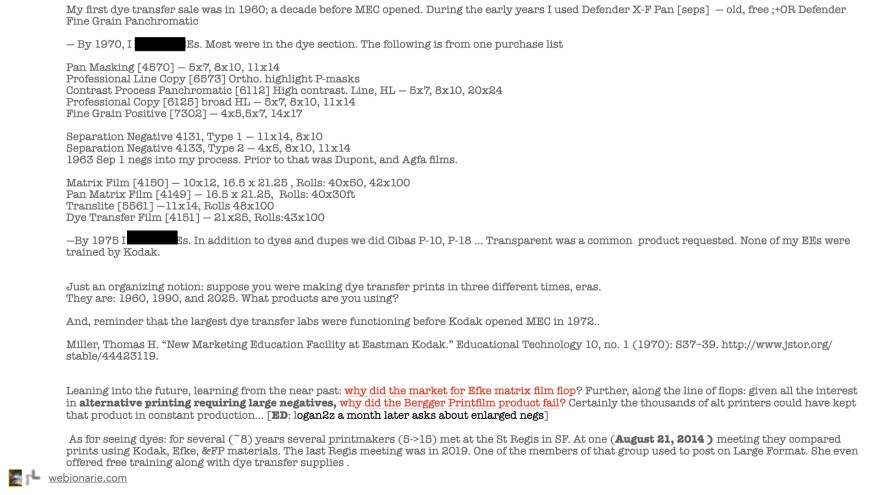
Jim Bones and Dye Transfer Printing

2016 June 5—16:” “Dye Transfer Printing Process” with Dennis Thompson and Jim Bones. Fees: $350 for one week, with additional $75 lab fee, $525 for two weeks. Alpine.

How much success did he have? The price of living in the shadow of others. His work that is archived was donated.
For example, this: Start Time: 04-01-2017 Time Left: Bidding Closed Value: $495.00 — Even with a grand pitch:
Dye transfer prints are simply without peer. They have a richness, depth, and fidelity unmatched by any other kind of photographic print. They can show extraordinary subtlety of tone and hue, combined with a brightness range of 500:1 from blackest black to whitest white. Nothing else comes close to the magnificence of a dye transfer print.


They all die: David Leigh Rathbun died on April 9, 2020. Jorge Fick (1932–2004)

Success requires skills in two spaces… craft is the easier component.

Index Prints

The idea print. Collecting visuals. Stages of the darkroom process. Beyond the wild guess. Looking more than once, while looking at more than one. Building the comparative response.

This index is from the librarians, not the linguists. /’ that it contains so much contradictory information that a verbal message is needed to fix its meaning ‘/ 

WHY make contact sheets — to see the roll, thereby providing selection by comparison.. provides an editorial overview as it reveals your progression of action in the event-scene.

The key point of this post is using “jigs” as aid to determining exposure of a print. They provide an efficient way to make several attempts, or tests of settings in making darkroom prints. Typically, they are used to determine exposure setting, however, they could also be used to test changes in contrast filters, or color balance filtration, since while the “flaps” are closed, enlarger settings may be changed.

These devices are the commercial form of what was frequently a kludge made by the printer from cardboard, tape, or, perhaps, scavenged sheet film holders. My initial, 1960s version was made using scrapped film holders. These were sold by the cardboard box full at the surplus stores.

The start point. finding a way in the dark. What is the exposure setting for darkroom materials. Color or black-white paper exposure must be tested; determined by making trial exposures. These are called “test strips” — strips, small samples of the material you will use to make your print.

Durst Test Print Tool
Ways of making test strips.

Drawing patterns, making conclusions.
Index prints are also known as “contact sheets,” or “proof sheets.” Most uses of these are as first edit device for selecting among negatives/slides. The exposure, contrast and processing controls are sometimes lax. I try for a first best use setting for the most interesting of the negatives. This sheet serves as my point of search into my file of pictures. Rather than shuffling through the negatives, I shuffle through my index prints. These prints, in some cases, provide my an easy notepad of what was printed and when. The details of the printing will be in a print/darkroom notebook.


What is the start point of making a darkroom exposure

By using test jigs, I was able to characterize film for making separations for dye transfer in as few as 6 sheets of film. A morning’s work. It was sixty years later that a boastful amateur told a student of mine that wasn’t possible.

Good to know. #OIC