Open Registration

Much of darkroom work is hand waving. Aligning images to build a print is part of the world of assembly processes.

Projecting a beam of light through a modulator, such as a piece of film, is the way of the darkroom. The enlarger is light and lens. We increase our control by being able to change the color and intensity of the light. These are the little pieces we build a world with.

Many Added

Here, we see a color print, made from separate BW negatives, using filters, manual registration, and RA-4 color paper.

tricolor type C printing

Notice how casual the assembly is. No film punch; no micro calipered, glass carriers; none of the carping crap posted on the Film Forum by slow moving Flim Flammers.

Many Divided

Next, Jerry Uelsman shows his method of making combination prints. He uses several enlargers, each with a negative of one element of the finished image.

Uelsmann in darkroom

There are people who use the computer to write their essays and there are people who still use a yellow pad and a pencil. They both can write excellent essays, stories or whatever. The process is the means by which you complete the image, but you don’t want it to be the end. There was a point at which the emphasis was on the Zone System that was all so technical. So you had this precise full tonal scale image, but what was the subject matter? It’s a cat or a sunset. So what? I’m committed to the darkroom, but I believe that if I had been 20 years younger when Photoshop came out with its visual options, I might be sitting in front of a computer rather than standing in front of an enlarger.

Jerry Uelsmann

Chloride Papers

NOTE- if you’re APUG or Large Format Forum registered, you may not use this material. Please, leave this site now!

Chloride papers are lower in sensitivity than are bromide papers, but they are faster to develop. Silver chloride papers usually are fully developed in 60-75 seconds, while typical bromide enlarging papers develop to the same level in 120-140 seconds.

Chloride papers are ‘contact’ speed. They are used under a bright light, not an enlarger, with a negative in contact with the paper. The final image size is the size of the negative, which, probably, means you are working with a large format film.

Current chloride papers are the revived Azo styled “Lodima” and the newly introduced Adox “Lupex.”

current chloride papersAdox announced Lupex with a very considerate offer of free shipping, so I bought a sample pack, and then a box of 8×10. I like the paper. The shipping from Germany to Texas takes 10 days — be patient. Lodima shipment takes only 4 days.
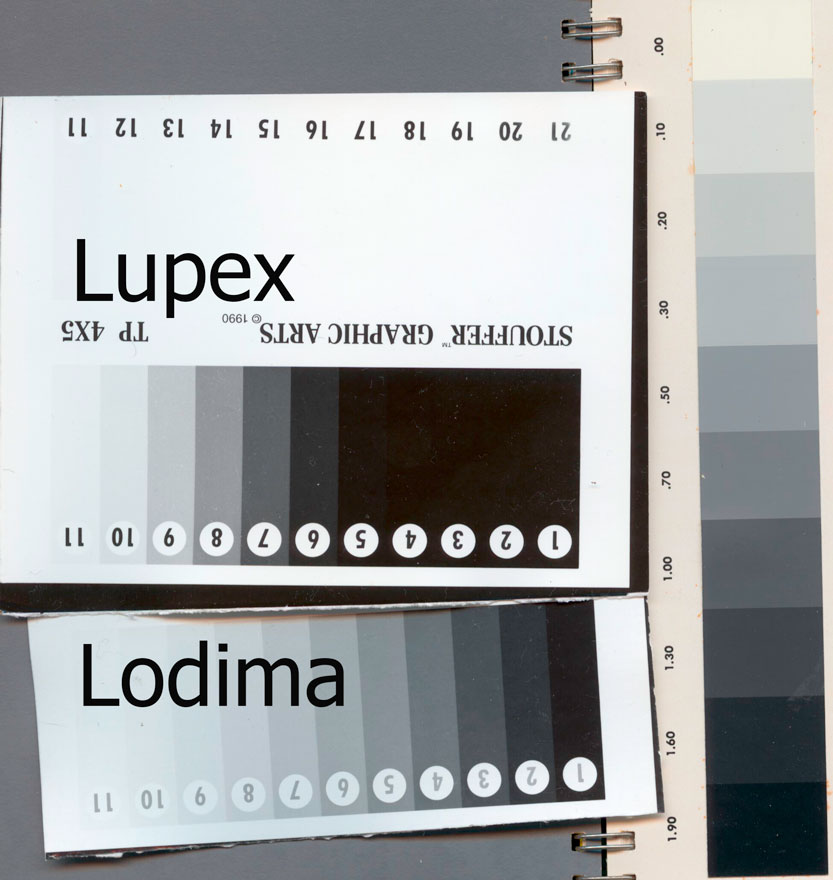
I have seen posts (apug) that Lupex is slower (not much) and warmer than Lodima. That isn’t what I see.

Lupex. Lodima Scan

Lupex v Lodima
Lupex & Lodima: 25 seconds exposure

both papers exposed to same light, for same time. Both papers were developed in the same developer at the same time. To compare color of emulsion, I’ve scanned the papers against a Kodak grey card.

Lupex Fomabrom Scan

Lupex compared to Fomabrom & Fomatone paper

Foma makes 2 papers which provide distinct differences between warm and neutral images. Lupex is closer to the Fomabrom 111.

Exposure Setup

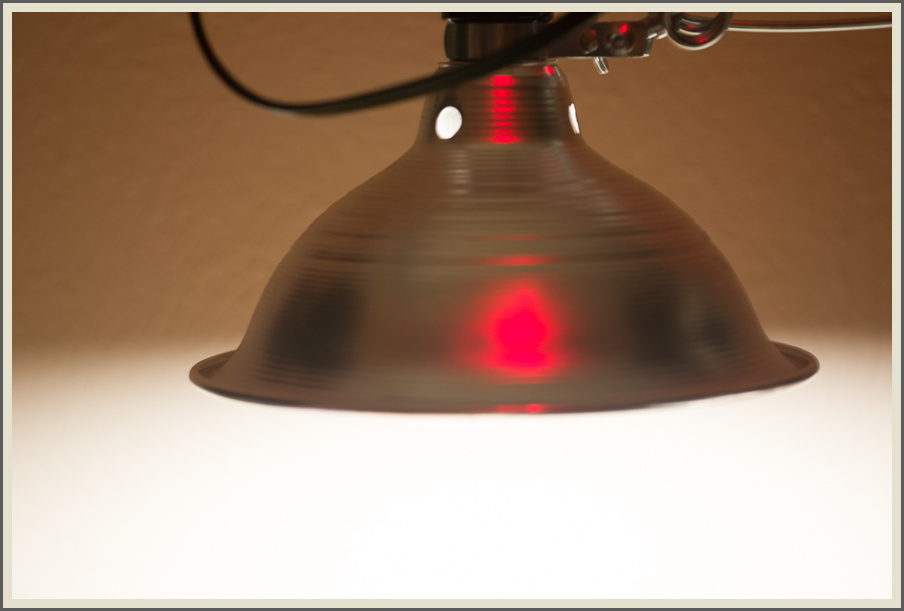
contact light
Soft LED white light in darkroom

Exposure is set using a Gossen lightmeter in diffusion mode. The ASA is set to 320. The lamp is raised to a point where the EV is 10. With the lamp at that height, exposure is 25 seconds for the Stouffer TP 4×5 wedge.

Developer

I use different developers, depending upon the image requirement. Many current users follow the Amidol road (spell lodima).. my preferred formula is in my ‘formulary’ section; also Lupex responds well to variable contrast developers, even more so using the 2 tray method.

More recently, I’ve souped both in Lith developers — they each offer brilliant color ranges in both Fotospeed and Moersch developers. I will probably use Lupex and Moersch later for more than just verification and idea generation.

Notes: See Easy Amidol for developer notes

Resources for making emulsions:

https://www.processreversal.org/public/workshops/handmade_baltimore/HandmadeEmulsionResources.pdf

Kodak Publication AJ-12, “Making a Photographic Emulsion.” https://unblinkingeye.com/Articles/Emulsion/emulsion.html

EJ WAll

The Light Farm: http://thelightfarm.com/Map/ContactPaperDev/ContactPaperPart3.htm

1996, Kodak: Process for making high chloride tabular grain emulsion using multiple stream addition of iodide. Patent