The Paper is Key

Ink, metal, chalk, or dye on paper, it is the paper that holds the “stuff of” and it also is the source of the light.

Albumin Printing: https://www.bostick-sullivan.com/product-category/alternative-process-kits/albumen-printing-process/

Or, albumin paper: https://analoginside.com/en/product/20-papeles-albuminados-85×11-216x277cm/

Unsensitized photo-paper: https://www.fotoimpex.com/brands/adox-art-baryta-241×305-cm-95×12-inch-50-sheets.html

Reflection requires smooth surface — smoother is more reflective. This provides higher “saturation” — the Dmax. The topmost covering produces the first and last light scatter. In photography of the Silver Gelatin type, this is Gelatin. Albumin has also been used. Many colloids have been tried in search of the perfect holder; that stuff with perfect properties — lasts, passes liquids, blocks gasses… No perfect single thing has been found — we live with a suited to purpose answer.

The ‘goo’ adds color– albumin is different color than gelatin. They age differently. As matter of cost,the albumen silver print uses more silver than the silver gelatin print

Make it smoother; get higher density. Gelatin seems our easy, cheap solution. That is what we have used at industrial scale since the 1930s. Keep the emulsion thin and smooth to achieve higher density.

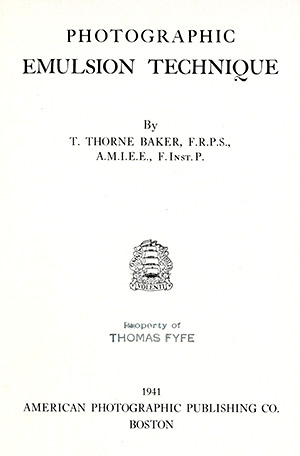
The secret to Dye Transfer’s intense color isn’t due to the matrix nor the dyes but to the paper, one of the most protected secret of the process. That was the item causing Kodak to stumble in the 80s. The process of the mill was little understood by much of the Kodak elite.

Additional to coating is HOW you coat; the tool, coater, as well — how many coatings. Making the emulsion means controlling crystal size, dispersion and “layer” —

Grokking Atget

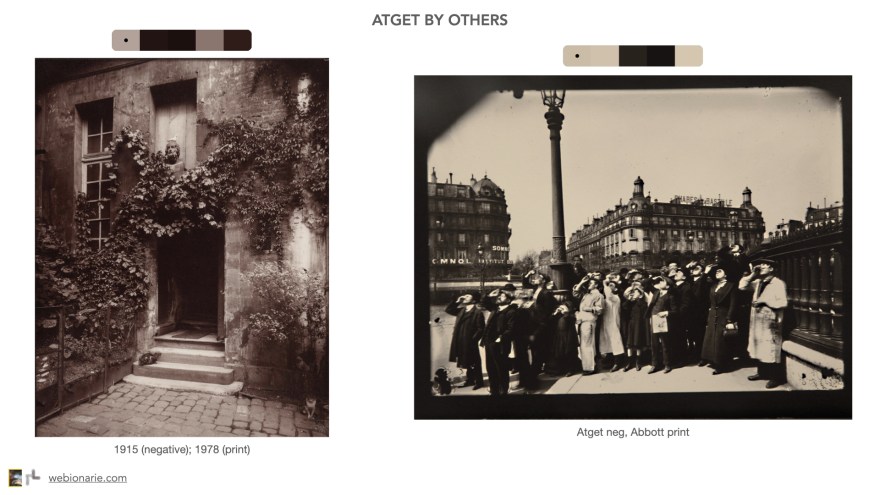
What does the print look like? Getting “that” look. Printing out albumin or gelatin paper was the look. Atget’s prints were also marked by lens falloff; usually the upper corners are dark because the lens didn’t cover for the camera movement used. This “technic” wasn’t important to satisfy the goals Atget set himself– sell images to other image makers for their purpose of study and reference.

The schematic of Atget’s image tones produced by his effort, and by the work of successors making reprints from his originals.

Prints made by Atget. Same negative at different times. The tone/colors show some of the variations of his “technic”
Two different printers’ efforts at reproduction. Their toning is closer than their contrast scale.

POP Refs:

PDF Book of Albumen
Albumin Works history
Kentmere Paper instructions

and for info about toning ‘salt prints’ this: https://core.ac.uk/download/pdf/15614798.pdf

Photography’s Prize

[price/prize] Photography arrived as entertainment, as substitute skill for the leisure class. By 1970 it had gained acceptance in many Art Schools. The 1980s was comfortable for specialized photography galleries; collectors had appetite.

Understanding the awards as assignment; what you should have known. These are Digests of the great works, those artists changing barriers, sometimes by crossing them; sometimes by crossing them off. Self-study assignment: use this to dig into yourself.

They began with an historian building meaning, making a market. The later recipients have re-evaluated the history of photographic uses.

The MacArthur foundation issued its first prize in the field to a historian, Beaumont Newhall in 1984. Photography had much sand to walk before attaining this acceptance. The most recent fellow is Wendy Red Star. Her stated area of focus: 2-D Visual Art, Photography, 3-D Visual Art That she doesn’t list herself as being a Photographer has caused the TOP, Part Time Salesman, concern about his beloved Photography. She may not even use a camera. What will happen to photography without cameras. What can we review. What will we sell.

Wendy Red Star, Peelatchiwaaxpáash / Medicine Crow (Raven), 2014, from the series 1880 Crow Peace Delegation. Original photograph by Charles Milton Bell, 1880, from the National Anthropological Archives, Smithsonian Institution

[https://aperture.org/interviews/people-of-the-earth-wendy-red-star/ ]

Some win more… the contest of merit loves to use another’s choice… path dependency isn’t just for mountain climbers. Get one award, another follows.

https://www.macfound.org/ [ based in Chicago, and in 2014 it was the 12th-largest private foundation in the United States] The Fellows Program: https://en.wikipedia.org/wiki/MacArthur_Fellows_Program

awards are signs

winning one prize, gaining grants or exhibition history becomes easier with prior recognizitions.

Offer something rewarding to the awarding agent, without being so novel to cause doubt. The more conservative the award, the more palatable must be the recipient.

to those who don’t have them who don’t make signs . Awards are more important to those who have not won an award … they guide the young and disappoint the old

Why Some Hate Art

art travels greater boundaries of space, time, legal, geographic as well. Art transcends; can remain dormant until some future needs it.

non-artists are pissed off, but they can’t change art. Although they can’t participate in art they can participate in church, business, in the commerce of church, in law. They cannot participate in Art, other than as consumers. and has blockades so if they don’t want to consumer set up a blockade 

within the US, public grant and award are used to diminish by those believing God as money 

In constant refrain: dig deeper than the advertisers understand. If the applause goes to the amount of the award, then the clapping is noise.

The prize provides access. Sometimes that is good.

“If I could make an income and have a couple of friends to enthuse with me over ideas and things, I should never enter the Art market, and never exhibit.” Man Ray 1922.