Steve Fitch: notecard

Steve Fitch earned a BA from UC Berkeley in 1971, an MFA from the University New Mexico in 1978, and has taught photography at UC Berkeley, the University of Colorado in Boulder, Princeton University, and since 1990, at the College of Santa Fe. He is the recipient of three NEA Fellowships, and his widely exhibited photographs are in permanent collections at institutions including the Smithsonian American Art Museum, Washington D.C.; Museum San Francisco Museum of Modern Art; The J. Paul Getty Museum, Los Angeles; the Whitney Museum of American Art, New York; the Museum of Modern Art, New York; the Art Institute of Chicago; the Rijksmuseum, Amsterdam; and the Multimedia Art Museum, Moscow, among others. Fitch’s monographs are Diesels and Dinosaurs (1976), Marks in Place: Contemporary Responses to Rock Art (1988), Gone: Photographs of Abandonment on the High Plains (2003), Llano Estacado: Island in the Sky (2011), Motel Signs (2011), and American Motel Signs 1980-2008 (2016).

American Motel Signs II.
Photographs by Steve Fitch.
The Velvet Cell, 2020.   Cat# ZJ561   
Vanishing Vernacular. Western Landmarks.
Photographs by Steve Fitch. Contribution by Toby Jurovics.
George F Thompson Publishing, 2018.   Cat# ZH501    ISBN-13: 978-1938086601
American Motel Signs. 1980-2008.
Photographs by Steve Fitch.
The Velvet Cell, London, 2016.   Cat# ZH054    ISBN-13: 978-1908889379
Steve Schapiro.
Photographs by Steve Schapiro.
Hatje Cantz, 2012.   Cat# DS047    ISBN-13: 978-3775734264
Llano Estacado. An Island in the Sky (Voice in the American West).
Edited by Stephen Bogener. Photographs by Peter Brown, Rick Dingus, Steve Fitch, Miguel Gandert, Tony Gleaton & Andrew John Liccardo.
Texas Tech University Press, 2011.   Cat# ZE965    ISBN-10: 0896726827
Motel Signs. One Picture Book #71.
Photographs by Steve Fitch.
Nazraeli Press, Portland, 2011.   Cat# TR370    ISBN-13: 978-1590053256
Gone. Photographs of Abandonment on the High Plains.
Photographs and text by Steve Fitch.
University Of New Mexico Press, Albuquerque, 2003.   Cat# NM168    ISBN-10: 0826329608
Steve Pyke. Philosophers.
Photographs by Steve Pyke.
Cornerhouse, Manchester, 1994.   Cat# PK146    ISBN-10: 0948797762
Marks in Place. Contemporary Responses to Rock Art.
Photographs by Linda Connor, Rick Dingus, Steve Fitch, John Pfahl, and Charles Roitz. Essays by Polly Schaafsma and Keith Davis.
The University of New Mexico Press, Albuquerque, 1987.   Cat# NM035    ISBN-10: 0826309755
Beyond Color.
Photographs by Harry Bowers, Barbra Esher, Stephen Collins, Steve Fitch, Jack Fulton, Richard Misrach, Arthur Ollman, Barbara Thompson, others
Museum of Modern Art, San Francisco, 1980.   Cat# SF013    ISBN-10: 0000000000
Diesels and Dinosaurs.
Photographs by Steve Fitch.
Long Run Press, Berkeley, 1976.   Cat# CS002    ISBN-10: 0000000000
a half hour well spent:

Mr. Fitch’s website is at: http://www.stevefitch.com/
[5.24.21]amalgamators.

put this with that. not makers, combiners.
most of the libertarian billionaires. 

RIT. the technical priority. craft first. could make tri-x before they could make something with it.
RIT grad make tri-x. but Frank, gibson could make something with it.

forums provide stimuluas of bad example. the side-show of failure.
invisible panda.

a bigger message than can
be found on the visual surface


tech talk is delaying
easier to talk about the stuff of instead of getting to the actual

writers don’t need sharp pencils

calculate EI
the same way you and your dog calculate the path of the ball…

EXPERIMENT
----

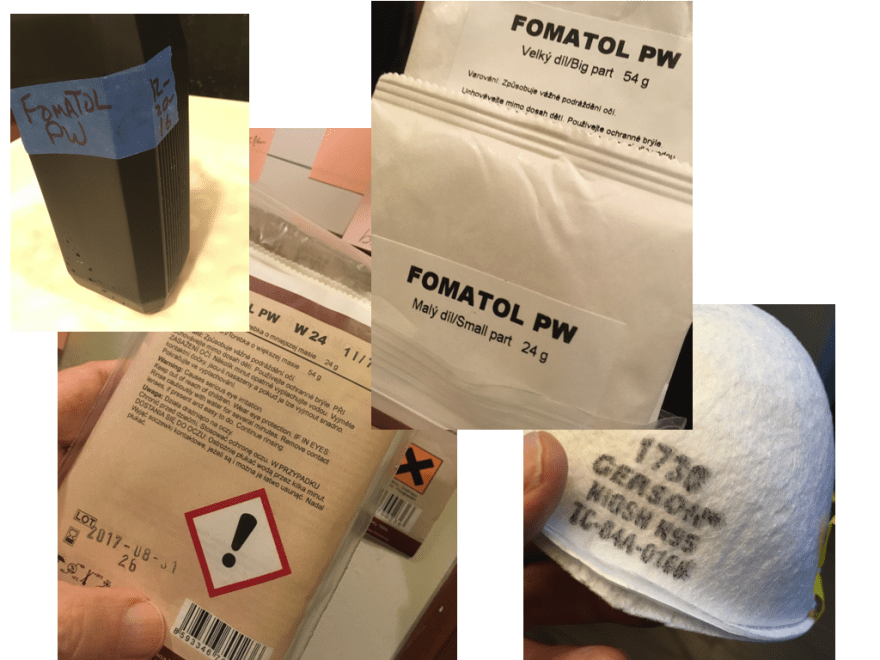
FOMATOL PW: warmtone developer

FOMATOL PW .. MIXING (2017 directions)

Fomatol PW is my standard warmtone developer. I’ve mixed from scratch, bought magic potions, changed proportions many times of the 50 years in the darkroom. This is the developer that satisfies my need. The disadvantages are availability and storage life; it does not have a long shelf life, even unmixed. As a working developer it is slow acting and exhausts quickly. The tray life is just hours. It outlasts an amidol developer, but it is not Dektol (D-72) my other common black-and-white print developer.

My typical developer is Dektol for proofs and edit prints. After selecting work for finals, I use a two tray method of image tuning. Fomatol PW and Moersch SE20C CATECHOL .

The english instruction sheets seem to be a source of wide ranging opinion about the developer agents, as well as the use of this developer. In going thru past notes, downloaded pdfs and, a few online posts of others, I think the product has changed. This change may be because of environmental regulations throughout the world.

At first, it was: “Specially formulated, glycine-hydroquinone” developer.” More recently, it is: “Specially formulated positive developer.” According to the US retailer Freestyle, it does not contain hydroquinone: no need for special shipping tags.

Mixing Fomatol PW

The only odd part of mixing is in understanding that “Big part” means the heavier bag. Both bags are the same size, but are different weights. Mixing directions are otherwise vary clear and simple to follow.

Using Formatol PW

Early directions gave development times based upon dilutions of 1+1, or 1+3; currently, directions are for undiluted stock. Sometimes I use it at 1+1, and have tested it at 1+3. Diluting this developer increases the times into the ‘lith’ timesphere (7 to 17 minutes) without ever getting a strong black. Using this as a stock developer is expensive, but it is worthwhile for my work.

Stock for 4 to 7 minutes using Fomatone, or Retrobrom Sp papers.

Links:

Foma

Freestyle

if it is glycin based? I don’t think it is anymore (since 2016).

see my post on glycin

//TBD. ansco 130 notes : see this

Labnotes: shaping negatives

If changes to development time (rates) controls density peak and range, then highlight density control is achieved readily; a direct relationship exists between development and highlight densities. While controlling shadow separations is not as simple. Shadows are dependent upon the characteristic of Film-Developer mating. Working the exercise of making parametric curves illustrate these points.

The general formulation of developer: Reducing agent, preservative, accelerator, restrainer, solvent.

Restrainers make controlled development (reduction) possible. They can also alter the (size) color of silver in the print. Potassium Bromide making that “Dektol Green” tint. DuPont BB was often used to produce Blue Black (cold tone) of Brovira, Kodabromide papers. Kodak Anti-Fog No. 1 can be used as replacement, or as addition to potassium bromide. Restrainers (aka, anti-foggants) alter contrast of the image. More AF increases contrast of the print.

Characterizing Paper: Labnotes

Packaged developers can be modified. In the 1970s the following chems were used as addenda to Kodak, Ansco, Ilford print developers:

  • Hydroquinone, 4oz
  • Potassium bromide, 1-4 ounces
  • DuPont BB solution, or Kodak Anti-Fog No.1, also AF No.2
  • Elon (Metol), 1 pound
  • Sodium Sulfite, 5 pounds
  • Sodium Carbonate, 1 pound
  • Borax, 1 pound

1970s papers:

CONTRASTKODAK & GAFAGFA
very low contrast11
2
NORMAL grade23
34
high contrast45
5
very high contrast (bang)6
paper grade Rosetta.. convert to LER, ISO(R)

Paper brands:

  • Kodak Medalist (F1 -4), Kodabromide (F-1-4)
  • Agfa Brovira (111 -1-6)
  • GAF Jet (GL 1-4)
  • Ilford Ilfobrome (IB 0-5)
  • GAF Cykora (GL 1-4 ). an old warmtone friend
  • Agfa Portriga Rapid (111 1-4) the most used warmtone paper during Peak Silver printing age.

Contrast Control by Developer Dilution:

Brovira was processed in Dektol 1:3, this produced softer acting developer as adjustment to the higher contrast of Agfa Normal. Dektol (most paper devs) can be used at range of dilutions, that is, straight (stock) up to 1:4. Paper/developers of the silver age changed print tone, going browner (warmer) with increasing dilution. This was due to change in concentration of Hydroquinone/ Elon (metol) ratio. Ilford papers (2024) are built to resist such alterations. These changes make the paper less affected by developer exhaustion or mishandling in the small volume darkroom..