Finding Film Data

We are in times of out dated film — film from unknown storage — film without datasheets. So, to the netfora with a question; like the camera counter of last century, except, these people are retired accountants, roofers, support staffers. Few of them worked as photographers; fewer still kept their old notebooks, those collections of datasheets. Firms like Kodak produced massive stacks of data in the form of how-to guides, along with instructional books — not even mentioning the many datasheets inserted into countless boxes of film/paper.

So, to the Loud Forums with a question:
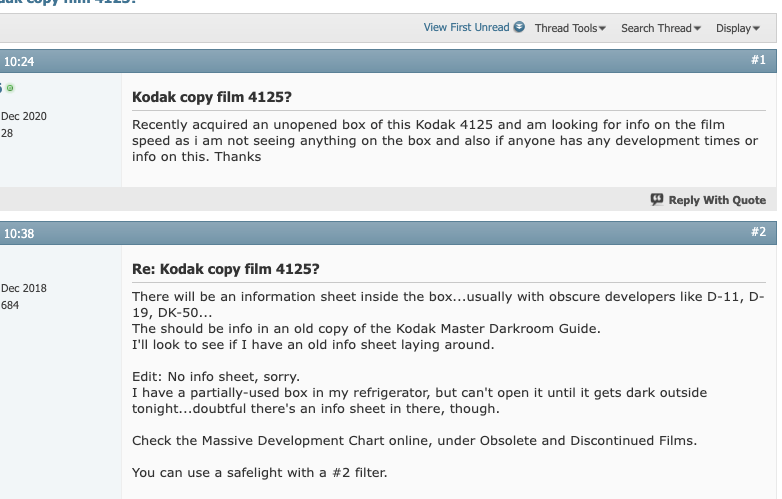
Kodak Copy Film

The answer is quick, intended to assist, but does it? How much help? Go somewhere else; look in a booklet you don’t have. Oh, and the obscure developers are wrong, but not really, they’re just flailing answers. The answer is online; in two archive books. And now here:
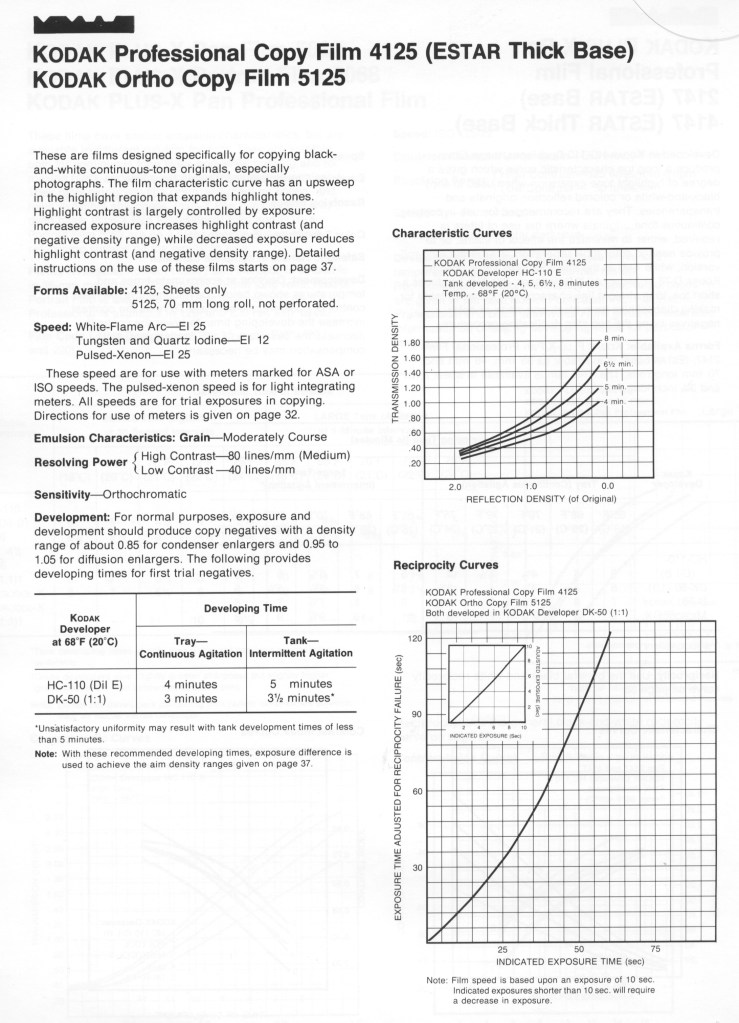
Kodak 4125 Copy Fillm

The exotic developer is HC-110 (Dil E). This film was used indoors, I used it at tungsten settings, EI:12. It was also used as a lab film, in darkroom using enlarger light. Read the guidance about exposure and control of highlights. That is why it could be used in a masking system, and in duplicate negative making, although, I used dupe negative film for that: made it a one-step process.

So, I could pass this info on to the Loud Forumists; why don’t I? I don’t have a login. They are boring people trapped and trapping others, like some vast herd stuck in bogs.

Dark Mirrors —

Dark Mirrors assembles sixteen essays by photographer and critic Stanley Wolukau-Wanambwa focusing on contemporary fine art photographic and video practices that are principally, though not exclusively, rooted in the United States, written between 2015 and 2021. Wolukau-Wanambwa analyses the image’s relationship to the urgent and complex questions that define our era, through the lens of artistic practices and works which insightfully engage with the ongoing contemporaneity of disparate histories and the ever-changing status of the visual in social life. — publisher

Deana Lawson, —241
Dana Lixenberg, — 139
Paul Pfeiffer, — 213
Arthur Jafa, —79
Katy Grannan, and — 117
Robert Bergman — 131
Ron Jude — 159
Rosalind Solomon — 147
Charlotte Cotton — 47
Joel W. Fisher — 63
Rabih Mroue —87
Daniel Shea — 107
Kristine Potter — 201
Mark Ruwedel — 187
Jason Koxvold — 171

Stanley Wolukau-Wanambwa (B. 1980–):

RISD: https://www.risd.edu/academics/photography/faculty/stanley-wolukau-wanambwa

Aperture: https://aperture.org/author/stanley-wolukau-wanambwa/

Light Work: https://www.lightwork.org/archive/stanley-wolukau-wanambwa/

Books by:

and

conversation: Dark Mirrors, reading.

readings … PPE

Achen, Christopher H., and Bartels, Larry M.. 2016. Democracy for Realists: Why Elections Do Not Produce Responsive Government. Princeton, NJ: Princeton University Press.CrossRefGoogle ScholarBankert, Alexa. 2020. “Negative and Positive Partisanship in the 2016 U.S. Presidential Elections.” Political Behavior. https://doi.org/10.1007/s11109-020-09599-1.CrossRefGoogle ScholarBartels, Larry M. 2000. “Partisanship and Voting Behavior, 1952–1996.” American Journal of Political Science 44 (1): 35–50.CrossRefGoogle ScholarBrewer, Marilynn B. 1999. The Psychology of Prejudice: Ingroup Love or Outgroup Hate? Journal of Social Issues 55 (3): 429–44.CrossRefGoogle ScholarCampbell, Angus, Converse, Philip E., Miller, Warren E., and Stokes, Donald E.. 1960. The American Voter. Chicago: University of Chicago Press.Google ScholarCikara, Mina, and Fiske, Susan T.. 2013. “Their Pain, Our Pleasure: Stereotype Content and Schadenfreude.” Annals of the New York Academy of Sciences 1299: 52–59.CrossRefGoogle ScholarPubMedDemocracy Fund Voter Study Group. 2018. Views of the Electorate Research Survey, May 2018. [computer file] Release 1: December 11, 2018. Washington, DC: Democracy Fund Voter Study Group [producer] https://www.voterstudygroup.org/.Google ScholarGreen, Donald, Palmquist, Bradley, and Schickler, Eric. 2004. Partisan Hearts and Minds. New Haven, CT: Yale University Press.Google ScholarKane, John V., Mason, Lilliana, and Wronski, Julie. 2021. “Who’s at the Party? Group Sentiments, Knowledge, and Partisan Identity.” The Journal of Politics. https://doi.org/10.1086/715072.CrossRefGoogle ScholarKlar, Samara, and Krupnikov, Yanna. 2016. Independent Politics. New York: Cambridge University Press.CrossRefGoogle ScholarMason, Lilliana. 2018. Uncivil Agreement: How Politics Became Our Identity. Chicago: University of Chicago Press.CrossRefGoogle ScholarMason, Lilliana, and Wronski, Julie. 2018. “One Tribe to Bind Them All: How Our Social Group Attachments Strengthen Partisanship.” Political Psychology 39 (S1): 257–77.CrossRefGoogle ScholarMason, Lilliana, Wronski, Julie, and Kane, John V.. 2021. “Replication Data for: Activating Animus: The Uniquely Social Roots of Trump Support.” Harvard Dataverse. Dataset. https://doi.org/10.7910/DVN/Q4VN7A.Google ScholarSchaffner, Brian F., Macwilliams, Matthew, and Nteta, Tatishe. 2018. “Understanding White Polarization in the 2016 Vote for President: The Sobering Role of Racism and Sexism.” Political Science Quarterly 133 (1): 9–34.CrossRefGoogle ScholarSides, John, Tesler, Michael, and Vavreck, Lynn. 2019. Identity Crisis: The 2016 Presidential Campaign and the Battle for the Meaning of America, 2nd edition. Princeton, NJ: Princeton University Press.CrossRefGoogle Scholar