Phonio

telling tales: to children about the evil rich chinese who fails because…

Have you heard the story about the rich Chinese who bought Technicolor, but couldn’t get it to work. If you haven’t heard it, good , it isn’t true. It’s based upon a prejudice told by a person Who is neither wealthy nor able.

A tale told often by the fool on the forum.

from an idler responding with waves and wishes; his comment, repeated many times has never been correct, and is never corrected. This lack of caring about accuracy is easy to pass off as knowledge among those asking questions about setting their camera ISO, or failing to know that pushing and pulling are terms from developing (movie lines introduced the terms). Even the long time keepers of those places seem to fail at understanding the exposure relationship differences between Negative and Slide processes. Furthering demonstrating the lack of experience based knowledge, consider that almost anyone with a drawer filled with negatives would realize that a sheet of 8×10 paper is covered by 4 (4x5s), or 1 roll of 120, or 135.

[The remaining Technicolor cameras, along with huge quantities of the remaining dyes, were allegedly sold to a Chinese entrepreneur, who thought there was a market for it in relation to the colorful big budget Bollywood films of India. But that would require rekindling an entire lost culture and industry of specialized craft at great expense, which proved unrealistic.]

Before providing a boast post, check– then, please proceed to boast of your skills.

[& if you don’t have a library, check online — avoid the forums]

Maybe this will help:

Technicolor:
The British line was shut down in 1978 and sold to Beijing Film and Video Lab which shipped the equipment to China. A great many films from China and Hong Kong were made in the Technicolor dye transfer process,[**] including Zhang Yimou’s Ju Dou (1990) and even one American film, Space Avenger (1989), directed by Richard W. Haines. The Beijing line was shut down in 1993.


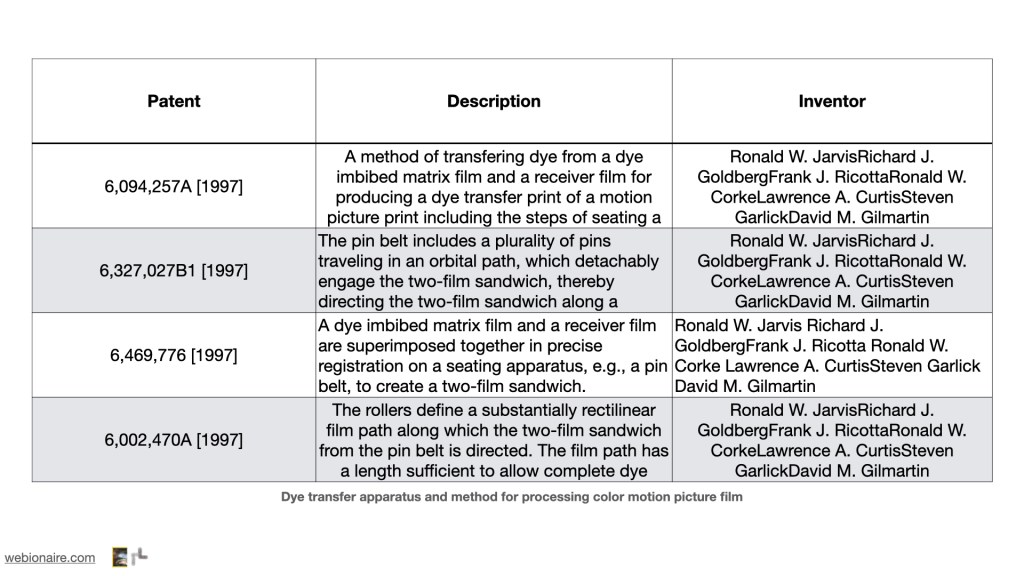
The “revived” Technicolor Dye Transfer process had several patents:
Kodak Feared Risk

becoming Silos of Silence. The paltry military mindset.

Management became intolerant. They couldn’t take a chance. Even now, those who were in positions of influence, having product control, cannot take a small risk. They rely on the hobby crowd to answer a question of low cost, low bar knowledge.

business is people making choices. they can be courageous, self learners, able and prepared to answer big questions, or — they stumble over the obvious.

“Can a cell phone be used without a phone service?”

A question the nineteen year old sales clerk at Verizon, or Apple could answer — even demonstrate.

“Yes”


who you ask is a source of confirmation error — 

  • ask the phone co
  • maybe the phone maker
  • anonymous strangers on the analog film forum (camera counter in last century)
  • try it…

A company may owe its investors, but it is a result of its employees efforts. Silos of silence; fearing crossing the hallways, those aren’t conducive to growing imagination — the fuel of researchers.


From the 60s up until the mid-70s, it was easy to obtain technical information from deep within Kodak. It would not be unusual that answers come from the desk of an engineer, not from a marketing representative. In 1963, I was able to meet two engineers without effort; even taken on a tour of the coating of Pan Matrix Film. At the end of that meeting I was given the name of those in charge of paper making [mordanting] … No NDA sought.

The fearful employee is a weak one, making decisions based upon avoiding any risk. If the employees at management levels lack imagination, or courage, or resilience, the company will fail; capital will not save it, anymore than oxygen cures cancer.

Taking pride in your military like precision came after the 80s. Those few retired Kodak technicians remained silent, secretive long after any enforceable NDA had expired. Allegiance to the dollar; perhaps they thought they could make money off their knowledge. That didn’t happen; old knowledge is worth  old money– not much

Kodak lost the chemical race to the DuPonts, to the companies like Fujifilm that began calling themselves material sciences companies in the 70s.

Even Kodak’s “other” coating businesses continue failing; the microfilm, as well as the NDT & dental films have closed. The analog bounce has left for the instant Asia.

Japanese corporate culture strives for continuous improvement.. their silence isn’t the silence of secrecy it’s a silence of respect of all the investors if they win till one. They tell all or none ,just like the SEC requires. US culture values insider trading — values it so much, it must be hidden