Masking: What Covers What

If at first steps you hesitate, will you ever make the journey? Making color prints is easy, but not trivial. It can be used simply or taken to extreme complexity. This is by design.

Masks are made to alter the color response. Usually they are made to correct for deficiency of colorants used in the practical printing. What was once a labor intensive procedure was made simpler, more automatic over several decades. By the 1950s theory and practice had become teachable in trade-schools to people never intending to go to college to learn linear algebra so they could make color prints.

Alexander Murray, of Eastman Kodak Research Laboratories, co-developer of the Murray-Davies equation was the early pioneer. His goal “eliminate retouching by the masking process” with as few masks as possible. “

Photo-trichromatic printing, in theory and practice by Zander, C. G., author

was an early text about ink on paper. It is a small booklet written by an ink maker and it should be read by everyone new to printing; the coverage of the first solutions to the common problems that remain today will highlight how far we have come.


Some references keyed to printing; the CMYK model.

Austin AC. Photo-Lithography: Suggestions for the Lithographers Which Should Prove Beneficial to the Trade. The National Lithographer. 1923;30(11):25-26.
Albert E. Photographisches Farbendruck-Verhahren. Published online 1899
Albert E. Photographisches Mehrfarbendruckverfahren. Published online 1900.
Bassist E. Retouching for Offset Lithography in Colors. Inland Printer. 1925;74:756.
Bultz SW. New Method of Copying Paintings: To the Editor of the Photographic Journal. Journal of the Photographic Society of London. 1856;3(40):15
Gamble W. The Future of Letterpress Printing. Inland Printer. 1925;74:757
Horgan SH. Process Engraving: A Three-Color Pessimist. Inland Printer. 1922;69:239.
Horgan SH. Offset Printing: Offset Printing’s Future. Inland Printer. 1922;69:368.
Horgan SH. Notes on Offset Printing: Color Correction on Offset Plates. Inland Printer. 1922;69:872
Mertle JS, Monsen GL. Photomechanics and Printing; Practical Information on Platemaking and Presswork by Recognized Procedures. Mertle Publishing Co. ; 1957.	
Murray A. The Masking Method of Color Correction Applied to Three- and Four-Color Reproduction. The Photo-Engravers Bulletin. Published online January 1934:13-21.
Yule JAC. The Theory of Subtractive Color Photography I. The Conditions for Perfect Color Rendering. Journal of the Optical Society of America. 1938;28:419-430
Yule JAC, Field GG. Principles of Color Reproduction. 2nd ed. GATFPress; 2001.
Field JAC. Color and Its Reproduction. 2nd ed. GATFPress; 1999.
An Improvement Process: Photo-Lithography in Color by an Ideal Method with Accurate Tonal Values. The National Lithographer. 1923;39:44. Accessed November 26, 2020. https://www.google.com/books/edition/_/ZTAyAQAAMAAJ?hl=en&gbpv=0	
Mixing Kodak Tanning Developer

adage: mix for 4, use for 3

NOTE- if you’re APUG, or Large Format Forum registered, you may not use this material. Please, leave this site now!

To make a set of mats, expose them and set aside the three mats in a safe-box. To develop, use the mixing directions, amounts as though you were souping 4 mats, but use that mixed developer in thirds. Take 1/3 and develop each mat in your developing tray. This assumes a very standardized procedure that has controlled balance and contrast. Clearly, if you are processing mats to different contrasts, then you cannot develop using the same mixed working solution.
Time is not a good adjustment to matrix contrast change. Tanning of the gelatin does not occur directly with development time. The oxidation of the tanning developer does not affect the matrix tanning as much as it would intuitively seem. The experienced darkroom tech coming to dye transfer cannot wholly bring their prior B&W experience to the matrix phase of dye transfer.

dye transfer

the matrix is the matrix — another world with other meanings

Sadly, none of this instruction will be useful to you these days, since none of the Kodak materials are useable. Any matrix film you could find is too old for proper dye transfers. They will have ‘age fog’ of the gelatin itself. Even if using the Efke film (sponsored by Jim Browning)it is so old that I wouldn’t use it as a reference to dye transfer from the age when fresh supplies were available in great quantity.

Even the most recent incarnation of Matrix films (Gecko, and Del Rio), which were being made when this post was originally made (2014), are out of production(2018 was the last date).


some links to formulas: Tanning Developers …& … PRIVATE page

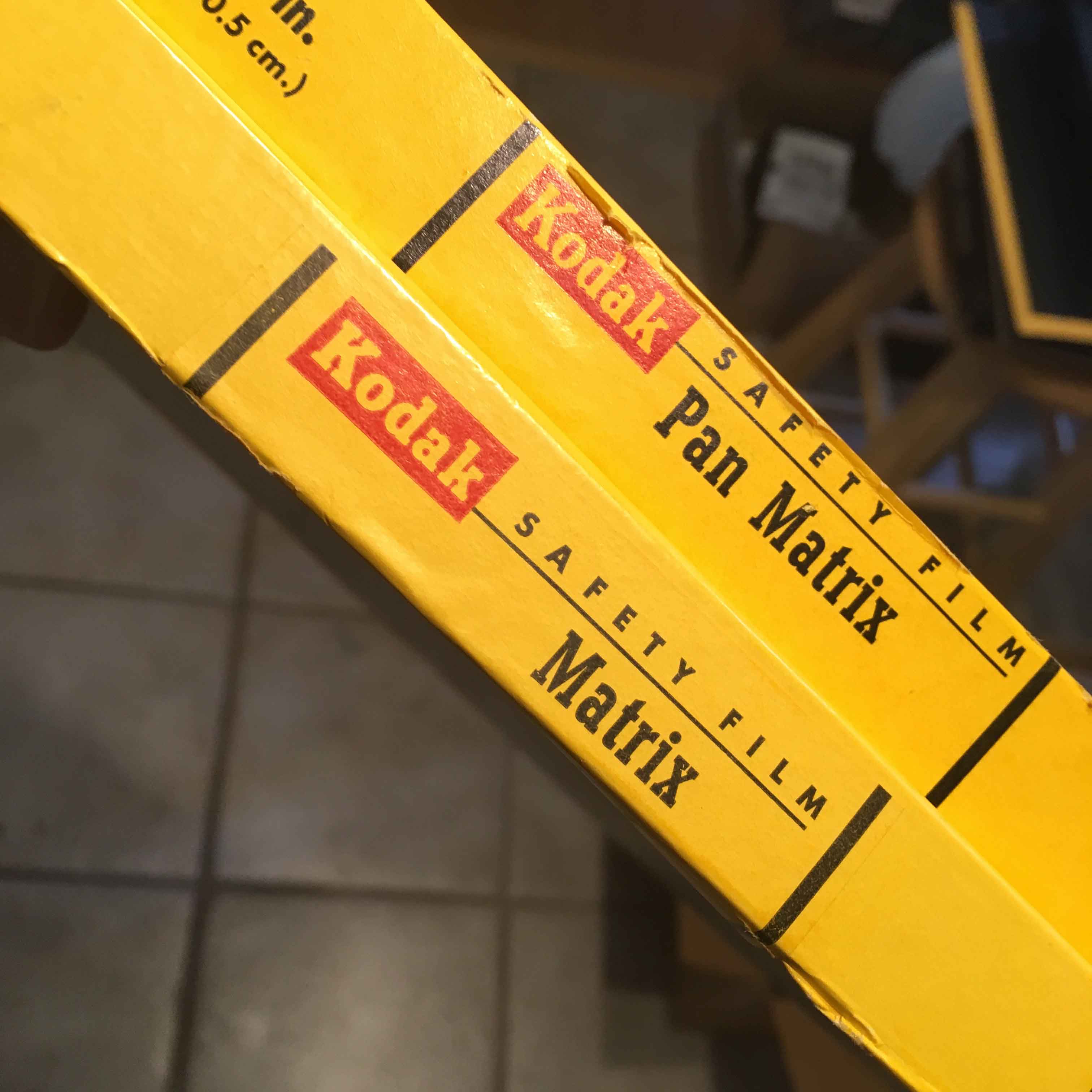
Old Matrix Film

gelatin hardens as it ages. And it does so in an uncharacterized manner. As the gelatin of a matrix film ages, it undergoes changes which I don’t know have ever been studied. No reason to do so since no film maker ever thought people would store soft gelatin film for decades.
Most of those still making Dye Transfers are doing so with old matrixfilm. They are hoping that cold storage is extending their working years, but how long is it useable? The following table presents some results of testing that I performed last year using matrixfilm I have gotten from many sources. I do not know the real storage condition of the materials, but everyone claimed their matrixfilm had been stored correctly since they bought it.
What is good enough?
Can it produce a mat that can hold Kodak dyes, and transfer completely, providing a full range of tones — simple, right.
As the matrix film ages, it hardens on its own. It does this based on size of the sheet, temperature of storage, and something else — I don’t know what, but I suspect that it is the sensitizer used during the coating of the emulsion. The more senisitive to broader spectrum, the quicker the matrix suffers from “hardening of the storage” — ortho last longer than panchromatic — smaller sheets last longer than bigger. Zoing.

Once you process the matrix it can be stored, seemingly indefinitely– just don’t “poison” the mat and it will last as long as any film (my guestimate). If the gelatin hardens it can readily be softened enough to pull prints. This has been confirmed by pulling mats that were first exposed circa 1974.