most people respond with an opinion before reading the question. Even those who consider themselves polymaths, successes in another field than this hobby.
How does the visual mind grow if it falters at words, the marks of words.
Those instructions/ request seem simple enough. Don’t know why the forum founder chose to post at this time since he is rare poster. Also, why that so specifically. Maybe he is getting a ratings list. How many of which. QTL’s request reads like instruction to business vendors. So, can this loyal group follow the request of their founder; the person they thank so often for his generosity.
Nope!
First, let’s make corrections to the question.
that seems easier than answering it.
then, we expand on the reason we can’t answer… of course we make certain to bring in another doubter.
…so it continues… They have clarification upon clarification, but no direct answer. I know they don’t see their own failure. Few of us ever do. QT didn’t ask for a ranking, just a reflective selection. He didn’t get to the harder questions, such as: is there a photography — are there artists making photographs —
Photography has moved beyond these doubters. It was pulled there by artists, just as in the beginning: photography was used as an artists tool, first. Like all art/craft systems it becomes a matter of commerce. And there, it lives, or dies.
QTL’s Large Forum is the hangout for those on a handout — the iceberg has long ago sailed.
QT’s playground is filled with shoppers and talkers. Goog searches bring the neophyte to the land of few people, with few ideas and unlimited opinions. Opinions about everything from shoe laces to national debts — all in the name of buying old cameras, lenses to make remakes of the fifties.
the arc of one story: join November. ask questions about camera, film, lens, developer. The basics.
get advice. going to the next step, with negative in hand, how to print this? Darkroom or Scan?
much opinion, until with response 277, his 200th post, he decides to skip large format altogether.
film is passed on to another seeker. hope they don’t visit the large format forum for insight.
what does the fresh stuff look like? does the color of the powder make a difference in the resulting developer?
Just another post fight on the bragboards, but it also reminds you, check the internet. Whatever the posters with more posts than pictures say— verify it. don’t get trumpd again.
glycin color [TCI] White to Gray to Brown powder to crystal. Notice that color correlates with size of — crystal is darker. Preparation see: Meldola, Foster, Brightman, J. Chem. Soc. 111, 552 (1917) It’s prepared from p-aminophenol and chloracetic acid. [ basis note: Chemical Storage InfoLIGHT SENSITIVE, AIR SENSITIVE: Keep tightly closed in light-resistant containers]
So, Amidol in the US comes from Artcraft or Formulary. December 2022
https://artcraftchemicals.com lists Amidol — chinese. Interestingly, this is the store that as of today is being boasted about as supplying the good English brand, not the evil chinese brand. Can’t say much about the company’s description. No SDS. They also say this: “Chinese Amidol, much better pricing than other Amidol sellers who are selling the Chinese stuff at a premium.”
Glycis / N-(4-Hydroxyphenyl)glycine / CAS 122-87-2 [over 97% purity] color is white – grayish yellow red
Using the CAS numbers will get you to different datasheets. color is seen in purity. the less pure the material the more color the chemical takes on. In purist assay Amidol and Glycin are mostly clear. This last only hours after the kettle.
Each of these absorb water; amidol darkens with exposure to light. Amidol works long past its darkest changes. Tray life is shortened, very little print stain occurs. Not the case with glycin which picks up moisture going darker and tending toward ‘dye’ form which will stain photographic paper.
These are items to keep in cold, dry, dark store. Freezers are the likely place. Date your purchase. Use the glycin within 2 years. Amidol keeps for decades. The Chinese stuff can, should be filtered. It was purchased as dye precursor so was intended to be purified further. It wasn’t contaminated by bad metal kettles nor storage drums.
Personally, having seen Formulary storage, I’m surprised anything works. Although Bryant Lab wasn’t much better back in “the day.”
notes from 2004 ” The stain is most evident when the amidol print is compared to the MQ print on the same paper. The Bryant amidol is the lightest I have among several samples. Based on my previous experience with amidols from various sources, I do not believe that a better result would be obtained with any other sample yielding a colored solution. On the contrary, I think most if not all solutions, acid or otherwise, whose color is owed to amidol are likely to stain the fiber print, and I would venture that the darker the working solution happens to be, the more pronounced the stain will be, regardless of what formula is used.
AND
“British Journal of Photography” on March 13, 1914 (p 198) in which the writer, one “T. Trevelyn,” claims that both potassium and chrome alum added to the developing solution will prevent amidol stain.
the staining seems more related to Ilford papers than to the Amidol. [2004]
from original meanings: photo lab chemistry from the middle of last century.
these terms have been modified in this century.
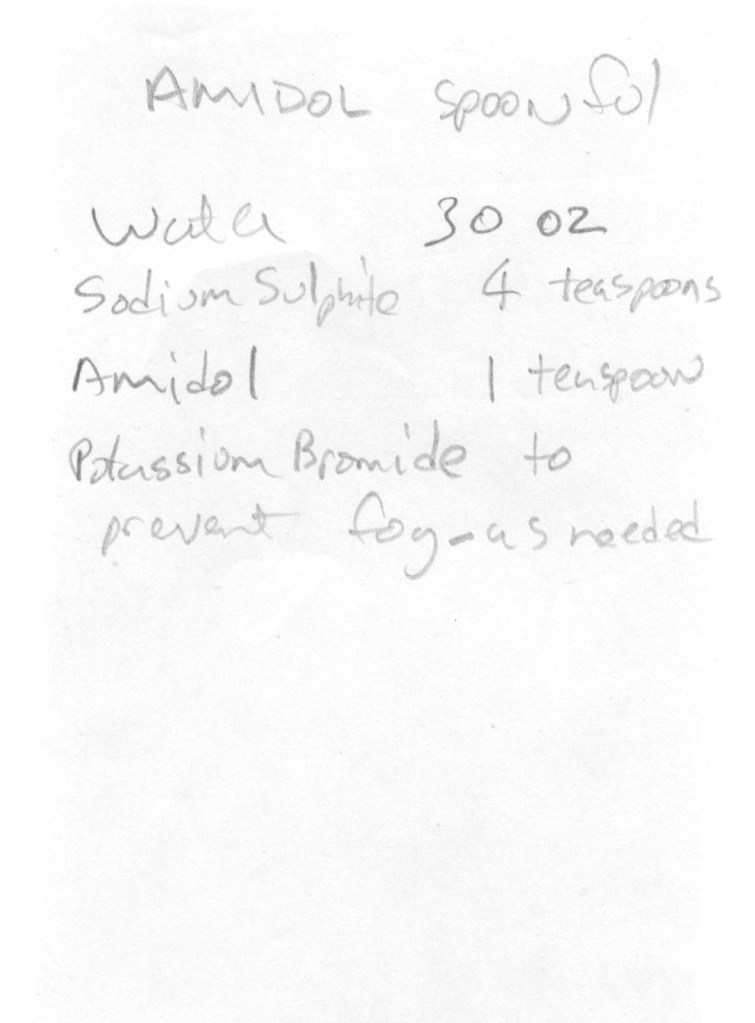
from my wall.amidol spoonful method. add KBr
or 2-3 ml of your 1% BZT solution per liter of developer — image tone.
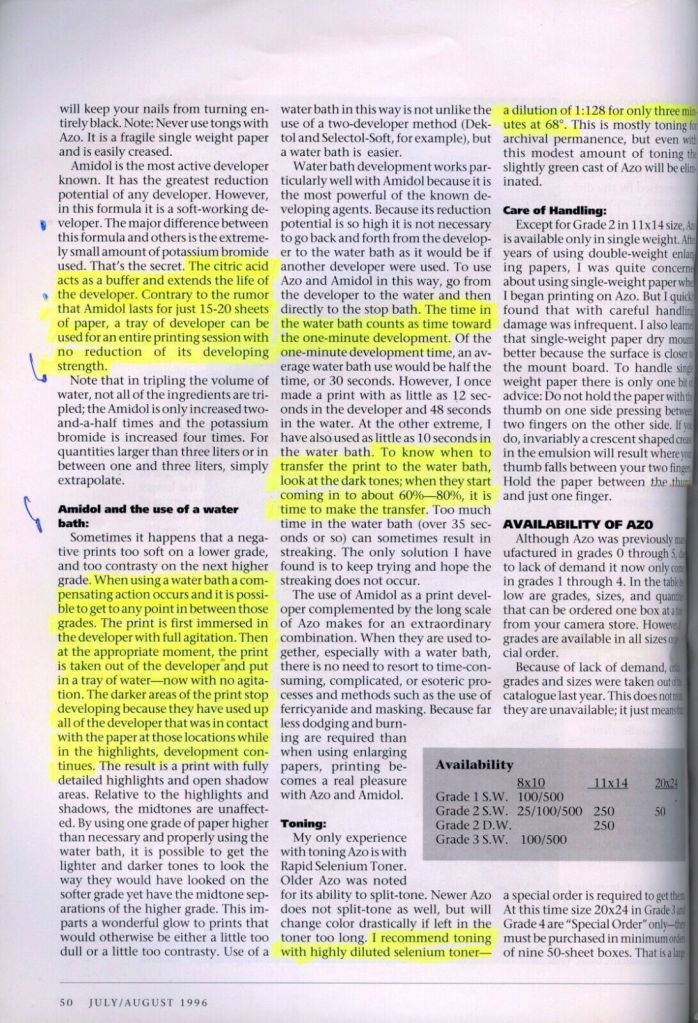
recall: amidol is called a “depth” developer.
for glycin alternate developer consider Foma’s PW warmtone
Reminder: most amidol formulations are effective, working the same, so pick any and apply. Amidol is the easy way to make developer. Water ,Sodium sulfite, and amidol…







You must be logged in to post a comment.