
have faith. it will return. you are saved. when all trends say it is the end. roll your eyes heaven word.


A collected heap of maybes. Some videos; some net remarks from the industry leads. None of that, not even all of that will change the hope, nor dash the spirit of those with conviction, with belief.
Film is gasping. It can barely support itself. The companies have outgrown it. Or, in the case of some companies, they are approaching life-style size while on life-support. Perhaps there will be small unions, dependent sharing of resources. Maybe Fujifilm will be able to keep Kodak EK Park running. For film, that’s fine, but paper, color paper, at least, is fully dependent upon digital print shops. Booklets and memory books. As a fad that may last this decade.
fujifilm tilburg 2021 new plant… replaced emulsion making
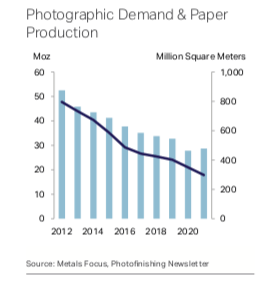
this down trend is interpreted by peta people as a sign of rebound. Too bad they don’t read the report itself. Such is the way of rumor tumor — death by a thousand posts.
“However, total demand for consumer and professional film and paper fell again last year, as travel still proved extremely difficult. The motion picture industry also posted another year of decline. Although this is now a niche part of the overall motion picture market, its adherents are staunchly committed and form a strong core of demand. Demand for non-destructive testing (NDT) x-rays saw relatively light losses last year, despite ongoing disruption from the global pandemic. The main end-users (namely those in oil and gas, automotive, aerospace and public infrastructure) are expected to maintain a core level of demand, as not only is x-ray’s technical performance still valued, but its analog nature also means that it cannot be manipulated, which is of value for some where hard proof is required.
We forecast only a 1% dip for 2022, in part as the x-ray backlog continues. Further out, demand for silver halide from medical x-rays looks set to continue to fall. However, a bedrock of demand should remain in the form of smaller medical service providers, such as dental laboratories, for whom switching to digital is viewed as too expensive.
Even radiography is waning. Carestream files for bankruptcy saying: ” [its] annual revenue has declined by $100 million from 2018 levels due to its customers’ preference for digital-only medical imaging systems, which are less profitable for the company than its print products.”
How about Kodak; certainly they’re doing better. Isn’t film flying off the shelf; doesn’t that mean everyone is using film again? In recent (past 90 days) a series of youtube videos show the inner working of emulsion making at the giant 1.3Billion building. Watching them, with attention to possible flaws, I noticed the pleasure of the middle age workers to “just be working at all.” As to the seniors: look-up their names in patent databases — for mechanics of pulling ESTAR through a cooling machine; and, recycling scrap. Not the big stuff of deep science.
at https://youtu.be/cAAJUHwh9F4
Kodak’s Film Quality Control Process
Where are we at: Fujifilm is switching away from film. They are using Kodak as a coater of film. “
With the welcome shift in market demand for color film driven by younger generations (i.e., GenZ/Millennials) discovering, and revitalizing film photography, Fujifilm is pleased to have introduced in December 2021 the updated release of “FUJIFILM 200” (ISO200 color film) in single roll and three packs.
To address the new target audience for consumer film, Fujifilm has updated the packaging of the film to appeal to the Gen Z/Millennial audience. The new product packaging includes friends celebrating and having fun – situations to use film to capture the everyday moments.
Fujifilm works with a pool of valued partners around the world as part of the production process to ensure we can continue to deliver high-quality imaging products to delight customers.
Fujifilm is pleased to continue the legacy of analog photography and film so all generations can experience the joy of photography.’
and:
Fujifilm decided to maintain and increase its manufacturing assembly of its QuickSnap one-time-use-cameras, due to the rising U.S. demand driven by Gen Z consumers.
“We are pleased to continue our manufacturing assembly operations of QuickSnap one-time-use-cameras and with the increased demand for color film, we’ve recently added a second shift with 15 additional positions,” said Bing Liem, division president, Imaging Division, FUJIFILM North American Corporation. “We will also continue our Personalized Photo Products operations here, where we provide fulfillment of photo prints, and photo gifts for customers across the country. We have built strong relationships with the community to fill nearly one thousand seasonal positions annually during our busy holiday season and are proud to be one of the largest employers in Greenwood.”
Snapshots are keeping the film cans rolling. Digital RA4 printers are keeping color paper in production. These are not upward trends. Not when compared to the struggle to manage a bottom line where it is MBA wisdom to sell your building and lease it back for a short term.
Twenty somethings become thirty somethings — they change; they outgrow the fling and sling. Something the sunk cost, limited income, retired don’t want to happen.
It is impossible not to grow up.




You must be logged in to post a comment.