Roger Minick. notes

Roger Laell Minick (born July 13, 1944) 

The “Sightseer” images were first exhibited at the Grapestake Gallery in San Francisco in 1981 . Minick’s photo project on the rural Ozark Mountains of Arkansas begun in 1969, he received a Guggenheim Fellowship in 1972. 

“In 1984, Minick entered the graduate art program at the University of California, Davis, where his MFA graduation show in 1986 consisted of both a series of paintings and a series of color photographs. For the next twenty-five years Minick taught photography throughout Northern California, including San Francisco State University, Sacramento State University, San Francisco City College, and the Academy of Art University of San Francisco.”

Dylan Swift is Roger Minick’s nom de plume.

REVIEWS

  • LOS ANGELES TIMES, “Legoland”, April 14, 2000
  • FRIEZE (magazine), “Sightseer Series”, June-July-August, 1997
  • LOS ANGELES TIMES, “Sightseer Series”, March 14, 1997
  •  Katzman, Louise (January 1984). Photography in California, 1945-1980. Hudson Hills.
  • SAN FRANCISCO CHRONICLE, Misc. Reviews, May 19, 1977; March 4, 1981; June 5, 1988; Sept. 16, 1989
  • Albright, Thomas (March 1981). “Photography, From Satire to Biography”. San Francisco Chronicle.
  • ARTFORUM, “Sightseer Series”, Summer 1981
  • ARTWEEK, Misc. Reviews, Nov. 13, 1976; Feb. 15, 1980; March 7, 1981; April 16, 1988; Sept. 17, 1988;
  • CHICAGO SUN TIMES, “Southland Series”, June 15, 1980
  • SMITHSONIAN, “Hills of Home”, December 1975
  • VILLAGE VOICE, “Delta West”, A.D. Coleman. June 25, 1970 [in Light-Readings, p.39]

Last saw his work at the Chandler; the place with the great blind dog.

from Delta West: “I speak about where you get on certain things in life and things confuse you. And when you get confused, you don’t know which way to go — and you take the wrong road in lif, the space is narrowed to the coffin. It’s definitely narrowed to the coffin. You just revert to this. You revert to the wandering shadows of shadows and the space is definitely narrowed to the coffin. And when the space gets narrowed to the coffin, well you know and I know, there’s no more space left for us. It’s all over. It’s all over right there. Now that’s definitely right!” https://www.rogerminick.com/delta-west

  • Born in Ramona, Oklahoma, in 1944, Roger Minick grew up in the Ozarks of Arkansas, moved to Southern California in 1956, and entered the University of California, Berkeley, in 1964, where he graduated in 1969 with a degree in history

  • 1966 he began a black and white photographic project on the land and people of the Sacramento-San Joaquin River Delta in California. Three years later, the project became Delta West (Scrimshaw Press, 1969),

  • 1965 and 1975, Minick was on staff at the ASUC Studio, serving as director from 1971 to 1975.

  • In 1970, he began a black and white photographic project on the rural Ozarks of Arkansas, receiving a Guggenheim Fellowship in 1972 to complete the series.

  • Minick not only co-designed his own books Delta West and Hills of Home but also books by other photographers, including Margo Davis’s Antigua Black (1973), Richard Misrach’s Telegraph 3 AM (1974), and Steve Fitch’s Diesels and Dinosaurs (1976).

  • 1974 through 1976, Minick worked on Southland, a project in which he photographed freeways, vernacular architecture, and made portraits of people at fast-food outlets and shopping plazas in Southern California.

  • 1977, he was one of five photographers selected to work on a two-year National Endowment for the Arts Photo Survey project on the Mexican American community

  • 1980, Minick began work on Sightseer, his first photographic series in color. Images from this series were included in the hardcover book and major traveling exhibition American Photographers and the National Parks, sponsored by the National Parks Foundation and published by Viking

  • 1981 through 1985, Minick took color photographs in enclosed shopping for a project he called The New Main Street.

  • Between 1987 and 1989, Minick began a color series photographing people on the streets of San Francisco which he called StreetWork

  • 1984, Minick entered the graduate art program at the University of California, Davis, where his MFA graduation show in 1986 consisted of both a series of paintings and a series of color photographs

  • 1998 to 2003, Minick photographed widely with the Holga camera 

  • 2006, Minick switched from analog to digital, and over the next few years experimented extensively making manipulated prints using Photoshop.

  • 2010, Minick founded Perambulation Press
FOCUS: Todd Walker

gallery notes from 70s. origin story of photography entering the world of walls for the people.

San Francisco early years of photography into art gallery. the wall and the bins were filled with unknowns, and early risers. Todd Walker was making a transition and name. His work was an early pathway into the alt-photo world. When alt meant “not Kodak” and a precedent to Post-Industrial photography.

Focus Gallery was founded by Helen Head Johnson (1916-1989) in 1966 on Union Street in San Francisco. She had worked for the de Young Museum as public relations director. She decided to open a “people’s gallery.” Over the nineteen year span of Focus Gallery, she presented over 300 exhibitions, showing work of more than 500 photographers. She closed the gallery in 1985.

Grapestake gallery was functioning in the period 1970-1986.

I remember the bins for photographs. Bins had prices. Prints were in plastic, much like a record store.

Helen Johnston left her private photography collection to the de Saisset Museum, the Oakland Museum of California, and the San Francisco Museum of Modern Art.

The show prior to Todd Walker’s was Eikoh Hosoe’s.

  • 1969, Aug :” enclosed is check for sale of portfolio at $9.00 less gallery commission of one third… Glad you are not dependent on our sales to keep the wolf from the door! I always say.. can promise no sales.. but certainly can promise exposure.

  • Sept 1969, from Todd: “Thank you for the check and most especially for the invitation to show in your gallery. Do you have a drawing or measurements of the gallery space so I can plan the number of prints and how they might fit?”

  • 1969, Nov 14: “dates for exhibition would be Feb 3-28. We instal over the weekend…. the other show will be by Tom Baird…we could use about 40 to 45 prints….. Am wondering what you plan to show? Would it be the same show as was “Camera Work?”

  • Dec 1969, from Todd: “I would also like to print the announcment and will get it to you two weeks ahead of time. I think the show should just be called Photographs by Todd Walker.

    FG: [announcement photos] if you have both abstract and representational probably representational would be better.. … printing enough copies of the announcement to send us copies for our mailing list of about 400 mostly poster sources and regular customers?

  • Jan 6, 1970: Received of Todd Walker. three portfolios and a sample to sell for $30 less gallery commission of one third and 450 announcements. [HJ]

    [HJ] We don’t have them (openings). However if there are photographers that you would want to see and might not have a chance to see them otherwise we could arrange one.

  • Feb, 1970: [HJ] … and I’m so glad we have the explanation for the techniques. There has already been much favorable commen on it. … Could you send us about two more press pictures? The one most representative of the show… The landscape is just too dark for newspaper reproduction and besides I’m afraid they would think it was not really representative of your show.

  • June 1970: [HJ] … I hear so many wonderful reports of what you are doing.. how exciting is your present work. We were fortunate to have had it at Focus. .. enlcosed is a check for the sale of the 16 print portfolio (30) less gallery commission and thank you!

    Aug, 1970: [HJ] Enclosed is check for sale of one of your portfolios … Your show at Focus was one of the best we ever had..

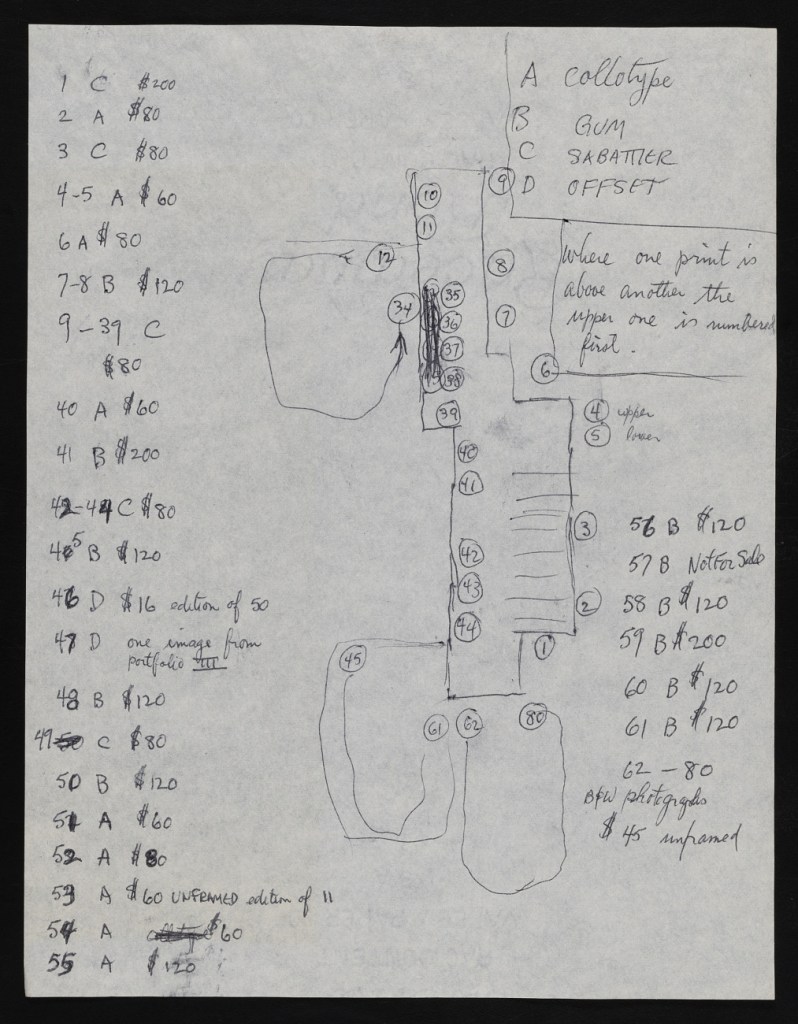
Todd Walker Focus Gallery layout with prices

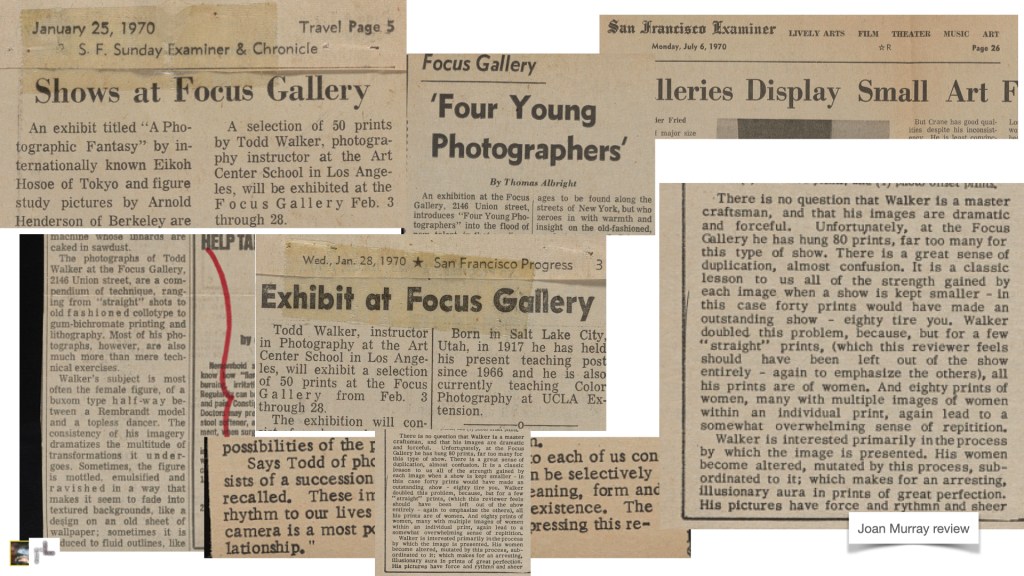
Arts coverage in the 70s was printed in Travel sections of papers. It fell into foundation journalism, being somewhat enlarged form of a Press Release. Some reviews were only that, a re-write for space.

1970 Press clippings; Focus Gallery shows.

Todd Walker: “Reality to each of us consists of a succession of images which can be selectively recalled. These images provide the meaning, form and rhythm to our lives as they relate us to existence The camera is a most powerful means of expressing this relationship.”

Joan Murray (reviewing): ” Unfortunately, at the Focus Gallery he has hung 80 prints, far too many for this type of show. There is a great sense of duplication, almost confusion. It is a classic lesson to us all of the strength gained by each image when a show is kept smaller. … Walker is interested primarily in the process by which the image is presented. His women become altered, mutated by this process, subordinated to it; which makes for an arresting, illusionary aura in prints of great perfection.”

Elemental Film

the difference between the frame and the frame strip — the tripod and a track — standing and walking. Everyone makes a movie as they drive. No single frame holds onto your mind. Driving, I see patterns against other patterns. The fence framing makes the scenic live.

Time is one of the strands of exposure. Short, long. Too much, too little. How we make an emulsion respond to light is a judgement made over time. The table of elements for camera craftsmen is exceedingly small — few basic means of achieving a life.

// Maya Deren. Titarenko. Slow cinema

Maya Deren (1917 – 1961). “was one of the most important avant-garde filmmakers of her time for her use of experimental editing techniques and her fascination with ecstatic religious dances. Deren earned an MA in English literature from Smith in 1939 before joining choreographer Katherine Dunham’s tour. “

“The still photograph is concerned with the isolation of the moment.  The moment is stayed, composed within a stable frame.  Films are concerned with the way in which a moment passes and becomes the next. This metamorphosis cannot be composed within the frame, but only through frames, from one frame to the next.” — Maya Deren

NOTES:

  • Brakhage, Stan. “Maya Deren.” In Film at Wit’s End: Eight Avant-Garde Filmmakers (1989): 91–112.
  • Clark, VeVe, Millicent Hudson, and Catrina Neiman. The Legend of Maya Deren (1984).
  • Deren, Maya. Papers. Department of Special Collections, Mugar Memorial Library, Boston University. NAW modern.
  • Obituary. NYTimes, October 14, 1961, 23:4.
  • Renan, Sheldon. An Introduction to the American Underground Film (1967).
  • Sadoul, Georges. Dictionary of Film Makers (1972).
  • Vogel, Amos. Film as a Subversive Art (1974).
Titarenko .. studio visit

“.. Proust taught me that the only way to communicate and to share what I was feeling with others is the use of the metaphor…” Titarenko

the City as Novel.. short

“slow cinema” concept.

  • Arnheim R. (1993) From Pleasure to Contemplation. The Journal of Aesthetics and Art Criticism 51: 195-197.
  • Bíro Y (2008) Turbulence and flow in film – The rhythmic design. Bloomington: Indiana University Press.
  • Boer J (2015) As slow as possible: An enquiry into the redeeming power of boredom for slow film viewers. Unpublished Paper, University of Groningen, Netherlands.
  • Doane MA (2002) The emergence of cinematic time – Modernity, contingency, the archive. Cambridge: Harvard University Press.
  • Flanagan M (2012) Slow Cinema: temporality and style in contemporary art and experimental Film. PhD thesis, University of Exeter, UK.
  • Margulies I (1996) Nothing happens – Chantal Akerman’s hyperrealist everyday. Durham, London: Duke University Press.
  • Wollen P (2000) Time in video and film art. In: Capellazzo A (ed) Making time: considering time as a material in contemporary video and film. Palm Beach, Fla.: Palm Beach Institute of Contemporary Art, pp.7-13.