
Beginning printers learn by coordinating their eye and hand, by looking at more things, until they can make assessments of greater abstraction, ie, things removed, even remote, from the origin object. With skill, you see the tree not the print — do this enough and you will see the print as you look at the mountain… The representation of an image may serve as mnemonic, even as illustration to other visualizers. A common grounding; a touchstone needn’t be stonehenge. The self aware growing their visual mindscape. Certainly making a point in the Web2 world can be made with an illustration.
While a “print” can’t be shown over the wire, it can be transmitted, even understood; understood well enough that Telemedicine works.
craft doesn’t have to limit, nor does conversation have to be limited to craft
“The real voyage of discovery consists, not in seeking new landscapes, but in having new eyes.” — Proust
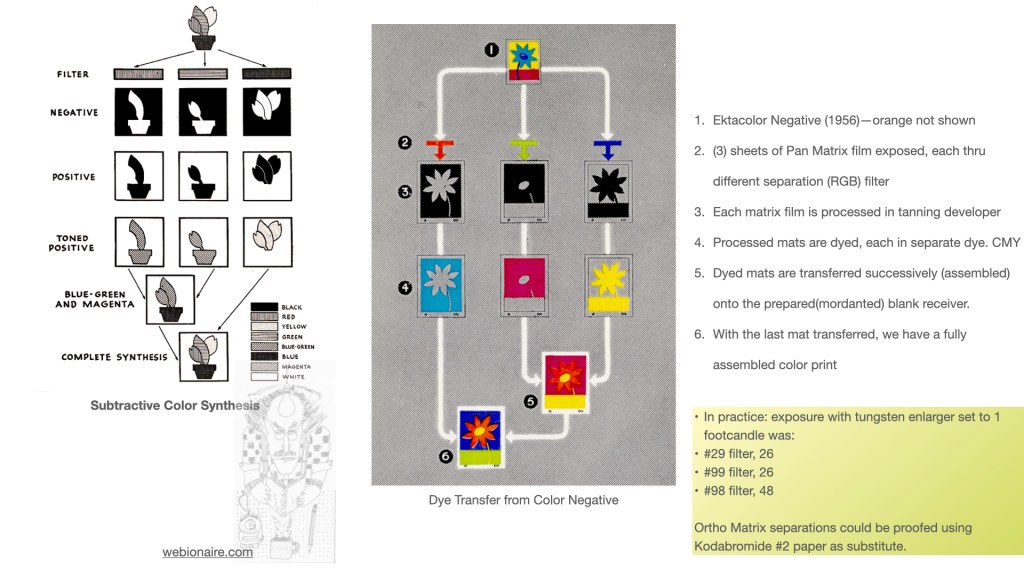
It was commonplace to teach by way of slides. I used it as supporting background teaching dye transfer. Additionally, I was able to demonstrate differences in filtration methods in making Type C prints. Side by side on the same slide. Humans capable of making art are quite apt at understanding comparisons. We see in relationships. For absolutes we need a machine. Our eye is the bundle of the revealed brain.
One use of the cellshot is a record, a timestamp of that “light”
You Don’t Show, not even as illustration because:
- don’t have
- embarrassed by what have
- don’t know how to show
- afraid [you/ someone] will steal
- don’t care about your opinion
- [why expend so much effort claiming a ‘one true’ way] Even the emoji using redundant engineer. I assume he didn’t study physics, or isn’t interested in current “frame” meanings.
Can I show more using the ‘net? Is electronic imagery more flexible? Can you, using chemical means, balance the curve differences of color (RA4) paper? Not without recourse to multiple colored masks. An almost triiavl task for intermediate skilled digital based retoucher/printer. A well managed system provides immediate soft=proof.
Assessing the Mentor:
said / meant

I’ve never taken a photograph with my cellphone. [i’m not good enough photographer to use the simple tool, to make memorable or useful picture]
Prepaid cell offering less coverage in remote locations. Still, makes a great retort of comfort to those steeped in creating a nearer to Thee legend.
An underdeveloped visual mind is terrible thing to brag about.
Their safety concern– how deep is their ocean?
- ” I have only a cell phone for emergency roadside need.”
- “I have never taken a picture with one [MEANING: so he can’t show you anything he has or has seen.]”
- ” Besides, even the cell phone selfie phonies couldn’t get reception at the beautiful points in my recent travel.”
If you carry the phone for emergency roadside use… and there is no reception…. your life lessons may be flawed. Not the best guide; not a skilled map-maker.
The logicians involved are retired very active forum posters. One, an aerospace engineer who was retired at 55; the other an order processor at a softwoods shop. He retired in his late 60s; clearly more critical in job function than the redundant engineer.
They would have you follow their advice, (why they give it so often) that a cell phone is only good for roadside emergency — even where there is not service[?]. Lacking cell service, the supposed phone provides recording features, alas, not of use for these cellular phonies. Perhaps they mean they have a satellite phone. Good for them.
SALSA: “Theocratic approach has no place..” Feb 15, 2016 Updated Aug 4, 2017 \\North Conway
NOTE: use the word as defined [relating to or denoting a system of government in which priests rule in the name of God or a god.] ex: Vatican.
Behind their legend: in one case, mystery permits changing his story to fit the need for boasting of skills. In showing nothing, he lets you imagine him more capable than he is; more productive than he ever was.
Reasons for maintaining their legend:
- they are embarrassed by what they have
- they don’t have what they claim
- maybe lack skill of translation
Skill types… the reason for craft is translation. Good to see your work is well regarded.

Exposure. Composition. Using the meter and following the measure of 18th century drawing rooms has a simple reward. Just not up to meeting on the majors stage
You must know where to show. Certainly the large, long-lived photo forums lack the shared background for worthwhile exchange. As well, they fail at being able to exchange craft information.
Perhaps they have stalled in all roads of their life — the roadside service has no on-ramp ramp
Tip toe through the tall tale
You can’t show on the Internet, you can’t evaluate a photograph, yet he didn’t like the prints, the photographs only seen on the Internet .
That web fight was between Drew, Kirk Gittings,& Bob Carnie over print quality.once this was pointed out to him, once it was pointed out to others that he had a website, within weeks his “own” website was taken down — chose to no longer show on the internet.



You must be logged in to post a comment.