Printing Dye Transfer: costs

from old notebook… circa 1986, the end of days for dye labs.

Making dyes wasn’t as expensive as you may have thought. By the 80s, it was on its last lap. The large labs knew; only the lollipops didn’t.

These pages are from a small lab, a lollipop. He was late to the game and hoping that he could save money by doing his own work. The prices are from his Kodak rep. The times are from him watching us make prints for him. He then figured whether it was worth it for us to continue making prints. He chose to do the work himself. He didn’t know that our costs were half of what he was being charged by Kodak.
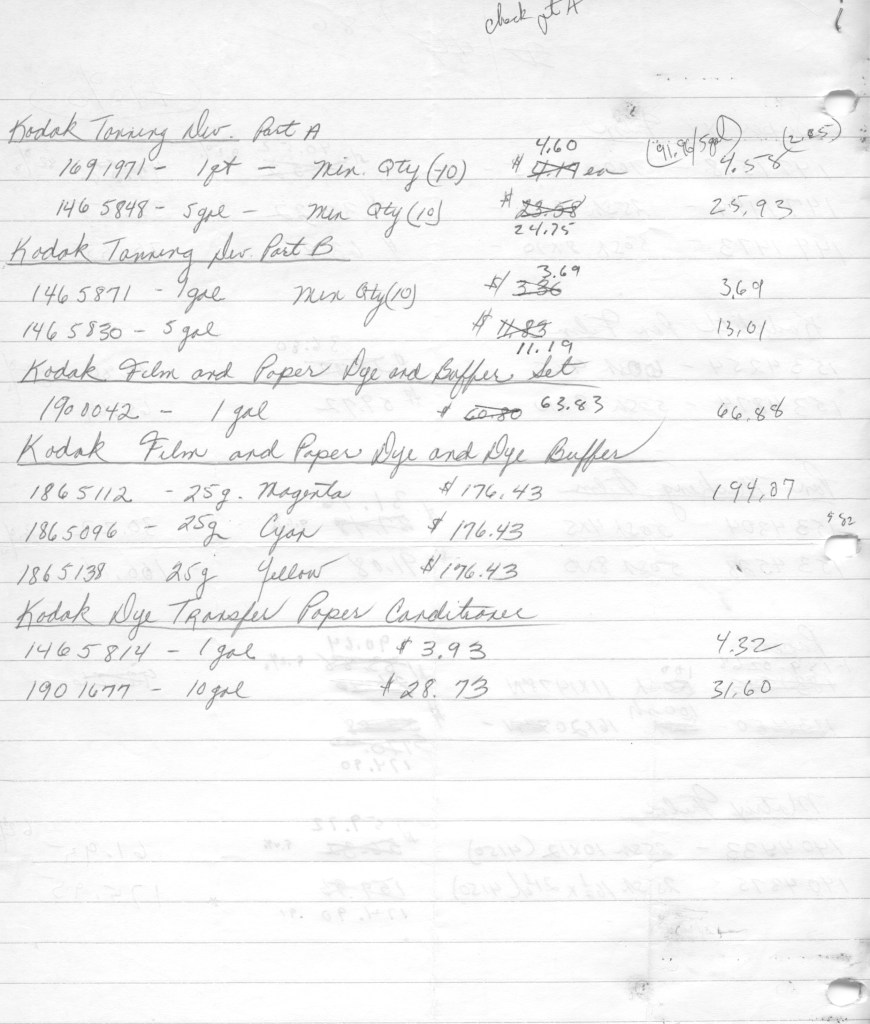
timing for 1st and 2nd dye transfer prints. The cost notations are the clients estimated costs from his Kodak rep.

The catalog pages from Kodak… two of the declining years. Most commercial labs knew the end was coming. Not everyone had the same estimator, nor did they have an exit. Kodak had fewer items at much higher prices. In the end, during that last official call, most of the sales were for chemistry. The film was eventually scrapped by Kodak as unsold waste.

This was a lesson Efke wasn’t taught. They learned on their own: specialty markets require specail handling. Of the three rolls of matrix-film produced, they sold less than half of one of them. The largest buyer, other than the originating university, was a British lab that never went into production.

Kodak was pulling the plug much earlier:

in 1981, Kodak issued a notice that products were being dropped. This notice drew several calls to Kodak’s C-suite.

It also caused the larger (Monarch) labs to consider buying Kodak’s process, as a license or outright. That didn’t happen — lucky for them. Don’t know. Could the process have been maintained by user labs?

Daisuke Yokota

Born: 1983- //  Yokota is part of a 
generation of young artists using photography in subversive 
new ways. His approach combines multiple rephotographing 
and printing, applying acid or flame to the end results, and 
making one-off prints and books from unexpected materials 
in staged public performances. Yokota is working out of, and 
pushing forward, a Japanese tradition of photobook-making 
that harks back to the visceral experimentation of the Provoke 
generation 

I don’t make work to express my feelings, it’s more like burning them

the Zine form: “A self published limited edition zine, the publication marks one of Yokota’s earliest printed works. Experimental and distinct to his book-making process, SITE is a series of images which displays the artist’s photographic approach in exploring both memory and time. With SITE, Yokota chose to experiment with both photoshop and digital forms of image distortion.” https://www.shashasha.co/en/book/site

“His practice consists in constantly revisiting his own archive of personal photographs by adding layers of accidents, in order to metaphorically signify the superimposition of states of consciousness and memories. Of- ten referring to the principles of echo and reverb, Yokota also establishes links between visual and musical fields. One could say that he captures ‘noise’ in the broadest sens of the word.

Daisuke Yokota is the author of numerous critically-acclaimed artist’s books, either handmade and self-published or realized with various publishers.” https://jeankentagauthier.com/en/artistes/presentation/5/daisuke-yokota

DAISUKE YOKOTA — For Color Photographs, I worked with layered sheets of unused, large-format color film, experimenting with the development before scanning them. Generally, photography exists to record reality. The present development of technology ignores the material. Originally, needless to say, film negatives generated the image, and there was paper to stabilize it. In short, photography is a combination of images without the mass and the matter [film and paper]. For
Color Photographs, I focused on this material side. https://purple.fr/magazine/ss-2016-issue-25/daisuke-yokota/

note the foils included… how they overlay.

finally, flashback, only because it makes those of the hobby board wonder…

very clear explanation that leaves those expecting their method to be the only method, mis-interpreting the steps

the first group of amateur, the most common type, understand only what they know how to do.