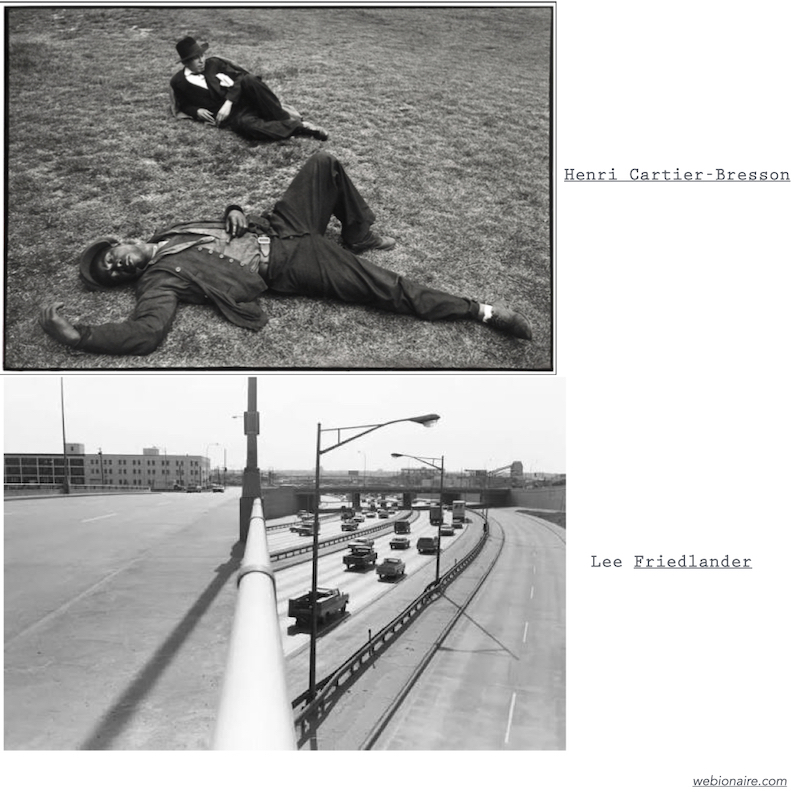
A very short post. A question in as many parts as you take it. Why did I gather these two pictures is a starting one.
Why: ask enough of yourself; always ask more. Two photographers offering distinct values.
What do they share?
[ not my pictures ]
All general knowledge, meaning that which can be used by some other, or be modified by someone to modify themself, is found in the taking X from the box and revealing it in the X from some other box.
Oops, rather page2.. I used to show, using dual projectors, comparisons of Atget and Friedlander — 4 carousels worth. Comparison, juxtapositions frequently expand awareness of why a strain of visual mind morphs.
Rem: anyone who understands Atget should realize how good Lee Friedlander is; how much more skill he has. That’s often the arc of a field.
Gatherings of the skilled increases the skill of those at the table. If, and only if… a person’s awareness increases beyond the elements of the work, the components. The gathering is the difference. Sometimes, it provides enough affirmation, supporting you as you gain the skills outside your studio.
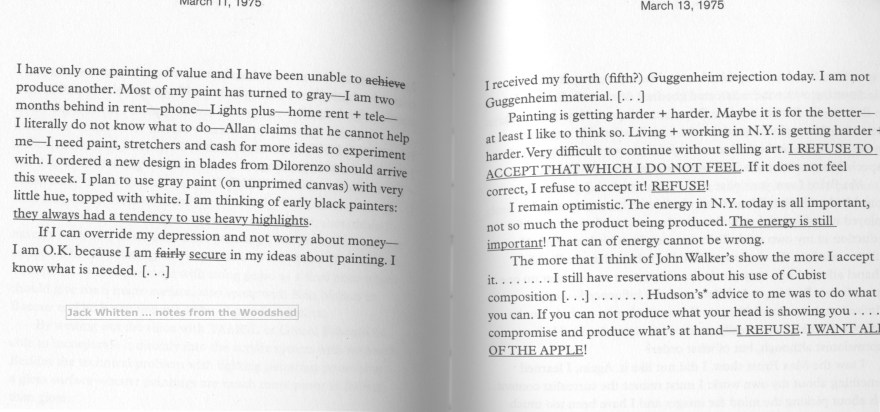
1975, “If I can override my depression and worry about money — I am OK because I am fairly secure in my ideas about painting.” AND ” I received by fourth(fifth) Guggenheim rejection today. “
doubts. uncertainty. resolution. “I REFUSE TO ACCEPT THAT WHICH I DO NOT FEE;. The energy in NY today is all important, not so much the product being produced.”
“We do not receive wisdom, we must discover it for ourselves, after a journey through the wilderness which no one else can make for us, which no one can spare us, for our wisdom is the point of view from which we come at last to regard the world.” — proust
[As a young man, Proust was a dilettante and a social climber whose aspirations as a writer were hampered by his lack of self-discipline. His reputation from this period, as a snob and an amateur, contributed to his later troubles with getting Swann’s Way, the first part of his large-scale novel, published in 1913]
“Photography suits the temper of this age – of active bodies and minds. It is a perfect medium for one whose mind is teeming with ideas, imagery, for a prolific worker who would be slowed down by painting or sculpting, for one who sees quickly and acts decisively, accurately. — Edward Weston
Book by age, or by contents. How do you choose the text for your table? Mine is filled and emptied by whim; by wandering among the stacks. Like a sleepwalker without slippers. Old books are kept not maintained. They become overlaid with marks upon readings. Reynolds is an old text without many current readers. I never spend more than a frew minutes with it, although it draws me in enough times over the years to remain on in the main stacks.
The ONLY ABSOLUTE TRUTH is that there are NO ABSOLUTE TRUTHS (Feyerabend)
I define postmodern as incredulity toward metanarratives … (Jean-François Lyotard)
Finally, if nothing can be truly asserted, even the following claim would be false, the claim that there is no true assertion. (Aristotle)
If anyone thinks nothing is to be known, he does not even know whether that can be known, as he says he knows nothing. (Lucretius)
And isn’t it a bad thing to be deceived about the truth, and a good thing to know what the truth is? For I assume that by knowing the truth you mean knowing things as they really are. (Plato)



You must be logged in to post a comment.