can you duplicate the coating
can you make a copy repeat copy of a bad AIM/LAD?
if it is silver, can you print a high, mid, low tone?
like a mystery, how does it turn out.

a good beginning and a bad ending
work both ends, bring them together as you learn


i used to teach by show the end stage -- they knew where they were headed. that is also where some people excelled while many failed.
rollup was where the better people wound in the big labs

key parts of a transmission densitometer
-- light and filter
equipment poor: buying long before need
buying too much too use
=====
prt 2
top to bottom
light, filters, film [exposure jigs] chems ---> est, eval
--- print /
light, tissue , chems, assembly jigs ---> transfer , print eval

once you have a cycle, button in the measurements , ie, densitometer permits future estimates ,, ifff your system remians stable as implemented.
greatest variables are locals -- the made to hand. by hand. did it dry, did it slip.
LEDs are easy — available, cheap, current knowledge. Why not use them for everything “light” — from enlargers to densitometers — the entire world of darkroom photography can be upgraded from the hot light era of last century to the energy efficient 21st century. We’ve come a long way from the 50s tube technology. Semiconductors advance rapidly, continuously. It is the way of industrial application.
So why not make it yourself using some breadboarding, a bit of code, and LEDs from a seemingly infinite range of suppliers.
are you building something to build it and prove something — learn something?
are you sharpening pencils rather than working
can it be bought cheaper
do you need it? now?
do you know why you would use it
does it replace existing
does it introduce additional complexity — do you know
LEDs are “additive” mode sources.
Enlarger Lamp Replacement
This seems to be the main source of information. Early efforts posted to the internet go back a decade. Many are for BW multigrade paper exposure and control. This replaces the color-heads that flourished during the 80s individual darkroom rush which was driven by people printing color. What is it that you are replacing, or upgrading?
The source of light? Color? A timer, an analyzer, a closed loop system?
There are, in November 2022, two companies making full function enlarger heads. That means they see a need and have engineered an answer. Maybe you should look at Heiland’s or Intrepid’s equipment before starting your own project. Intrepid 4×5 Enlarger Kit
Densitometer Replacement
More recent, but driven by the scarcity of densitometers most of which were discarded by professional labs as they closed down between 1990 and 2005. The first use of these was in color process analysis. That need reduced throughout the 60s and 70s as Type C printing took over from Dye Transfer. Dye transfer needs declined steadily after 1975.
The densitometer was used as a quality assurance and monitoring device. This was how labs maintained large chemical lines and automated printers. The explosion of small photography studios fed this. That has all been replaced by digital, which has dominated for more than a generation of photographers. — Digital uses more AIM points and spectrophotometers than film did/does.
How did those old densitometers do what they did? A light, filters, sensor(s) — sensor like a photocell, a lightmeter — early ones as well as very sensitive on-easel analyzers used photomultipliers.
the light wasn’t complex, it was just an ordinary off-the-shelf bulb. The filters where chosen from the status sets — one for transmission — the most needed in dye transfer. Or for reflection, the one for measuring standard quality strips for printing .. Much of the magic was in mechanical engineering, with much of that seemingly to obscure the otherwise simple mechanisms in the box.
There was a whole lot of discreet components on the boards. Over time integrated circuits replaced that, so much so that power supplies were the last holdout of the complex electronics. All of that could easily be upgraded by current electronics-software systems.
Do you need a densitometer — probably not. Do you know the difference between two and three point control?
The main need of a densitometer in an assembly process is control of separations, not in the analysis of the original film. In a lab operation where anything could come over the transom, examining the ‘chrome was important — it saved us time. Also, when we had many films to match print it saved us much expense, while assuring that the set of prints seemed as though they had been shot by the same camera/film and printed at the same time. This is what profiling achieves in the digital domain.
What I mean, what I did: my first three years making dye transfers I didn’t have a densitometer. These were my prints. I relied on other controls to get my results. With my second commercial printing, I bought my first densitometer. In effect, my client paid. That was a major realization — work on the clients money. If they can’t afford it, you can’t afford it either. Don’t become one of the many “equipment poor” photographers.
Status — the filters and light source specifications for a densitometer.
A == sets of filters for measuring color densities of positive materials (what you see)
M == the set used for measuring densities of negative color materials. These are densitometric values that you don’t directly see.
shorthand for terming readings is to call them A, or M reading. Additional distinction is whether a system is “colorimetric” or “densitometric” …THIS IS IMPORTANT IN SCANNING SYSTEMS.
Those abbreviations were short for something. Abbreviations, mnemonic notations meant something, more to some than to others. I don’t know that they have much carryover into this century, probably not for the future decades– the age of emitters.
Filters aren’t masks. Filters block light; colored filters block some light and pass other light from the beam — the light path. So, what color does a filter pass? What color do you see? That is the color it passes.
filter nomenclature such as CC 10Y means “color correction .10 units of yellow.” CP meant color printing filter. CPs went between light and lens, CCs could go in focus path, not only in light path.
10 is a low value, not the lowest, but a low common use amount. Filters came in simple (primary) and compound (secondary) colors. In the land of dichroic, meaning color heads, there are 3 dials — for the secondary (subtractive primaries) of yellow, magenta, and cyan. That number is a reference to the amount of light absorbed. The higher the value, the more light is absorbed. the 10s are third stop changes. A 30 filter absorbs half its complimentary color by one stop (halves the amount).
[ CC values are calculated log d x 100: 10cc is 0.1 log d or 1/3 stop. 15CC is a half stop. 30CC is a full stop]
Filter
Approx Peak Transmission
05 (CC05Y)
89%
0.05
10
79%
0.10
20
63%
0.20
30
50%
0.30
40
40%
0.40
50
32%
0.50
Printing color negatives (those orange pieces of film) use the (m)agenta and (y)ellow filters. The cyan filter entered the pack if printing “reversal” direct positives (type Rs, cibas, or dupe films)
filter density affects exposure (gels).
the amount of correction isn’t the same for each color. 10cc yellow only needs 2% more exposure. 10cc magenta needs almost 10%
color emulsions have multiple layers of ‘tuned’ sensitivities — they are subject to reciprocity failures — exposure times from 5 to 40 seconds are best.
the “digital C” papers are best exposed less than 15 seconds.
voltage stabilizers (regulators) were standard lab equipment — as enlargers became more sophisticated, their power supplies contained the regulated voltage.
voltage fluctuations caused color balance changes; also shortened bulb life.
I continue to use UV and IR filters in light path, and a regulators.
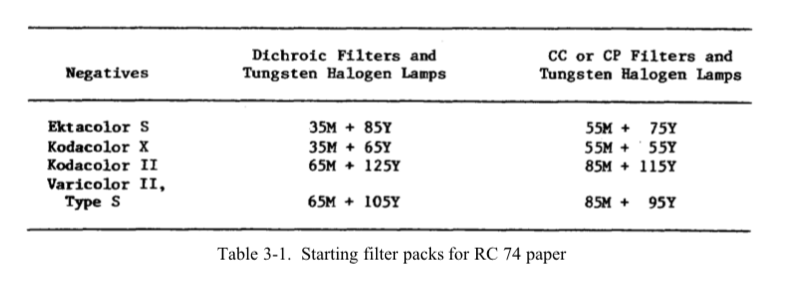
starting packs: RC ’74, and guidance to filter pack corrections
If the borders are not ‘white’ then you have stain or fog.
–Cyan probably is chemical stain; yellow is age fog. Tape is the diagnostic tool — waterproof surgical tape. Think about it.
More [Kodak]:
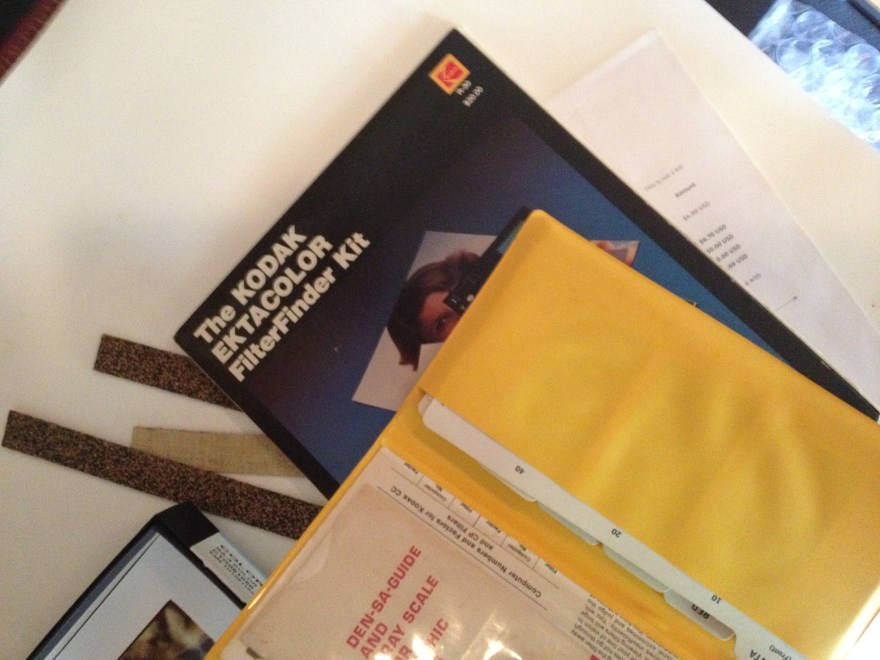
Kodak Ektacolor Filter finder Kit, R-30
Kodak Color Print Viewing Filter Kit, R-25
Retouching Color Negatives, E-71
Color Photographic Processing
How to process color prints in tubes
How to process color negatives using process C-41
Finishing Prints on Kodak Water-Resistant Papers, E-67
Printing Color Negatives, E-66
Type R = Reversal notes
patents about reversal processes. emulsions and chemistry. covering several foundation concepts including Solarization.






You must be logged in to post a comment.