information on many stages of the photolab are best found by asking the internet. You may not have a full library, nor have ready access to someone from last century. All the major manufacturers wrote guides, pamphlets, even books to provide you full reliable, useable information about their products. There were also the standard 3rd party references: British Journal of Photography, Photo-Lab Index.
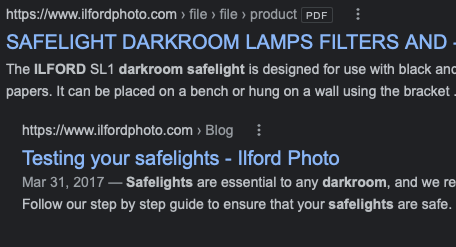
As an example of google search phrase: “kodak darkroom safelight” — along with simple modification to make: “ilford darkroom safelight.”
ilford safelight informationkodak safelight information
This took less than three minutes to find and download. Much less time than going to an internet chat-forum to ask what the safelight for MYPRDODUCT would be.
making a photo darkroom workable occupies many a camera crafter. An instructive case began with the notion of building a brighter safe-light using LEDs rather than 20th century filters and hot lamps.
Seems reasonable. Does it work? For BW; for Color?
He began with: “have ample and good-quality light to work with. But it’s also essential for judging print quality and properties such as hue/color balance, toning etc.” along with a picture of generic red light.
Well enough, but where do we end; what did we build? A little bit of research, datasheet reading, collecting housings, layout components, write a bit of code. Mr. Diy has a multiprogram remote control light system that sometimes fogs paper. And the inspection system: he seems pleased. So, maybe you would be too. He missed the goals, other than that it occupied time. Life creeps away in these small projects gone large.
Controlling the project is harder than controlling the lights.
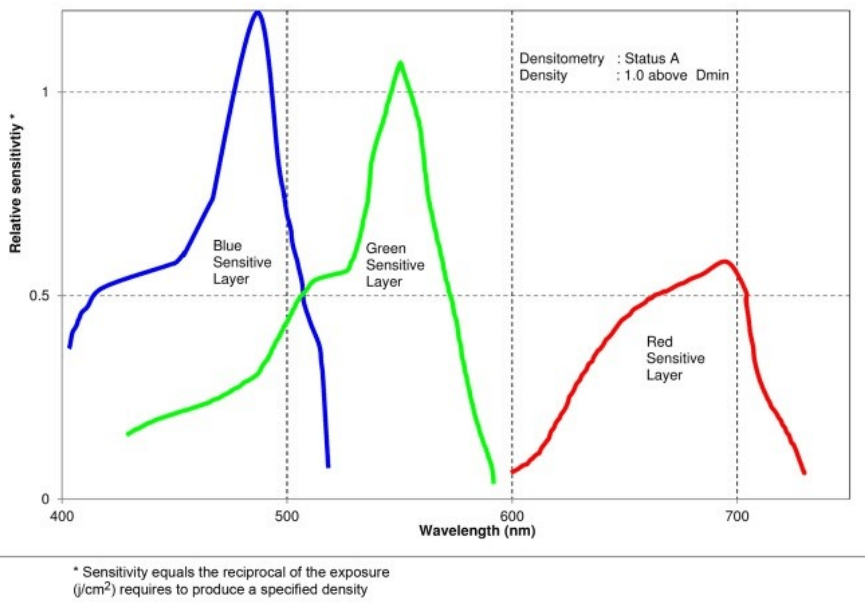
“You can use sodium-vapor lamps with a KODAK No. 8 Safelight Filter / dark yellow in safelights providing general darkroom illumination. The filtered sodium-vapor lamp provides the best visual efficiency with the least visual effect on the film. If you are using a low-wattage tungsten bulb for task-lighting, filter it with a KODAK 8 Safelight Filter / dark yellow. You can use amber Light Emitting Diodes (LEDs) (590 nm peak wavelength) for minimal task or path lighting; however, do not use them for prolonged or general darkroom illumination.
As for print inspection, I have two needs: the first is over the ‘wet’ tray. Mainly for judgement of density, and rough color. The other is in a dry work area where final judgements are made. In both place I use mixed lights. In no place do I use a clicker. They are switched, or foot peddle actuated. But that’s just my being lazy, too lazy to build a better time-trap.
The deeper dive into the way film develops. While learning, try to avoid the post holes..the forums, which may have had good larger intent, but now are often fights between amateurs over who has a claim on meaning.
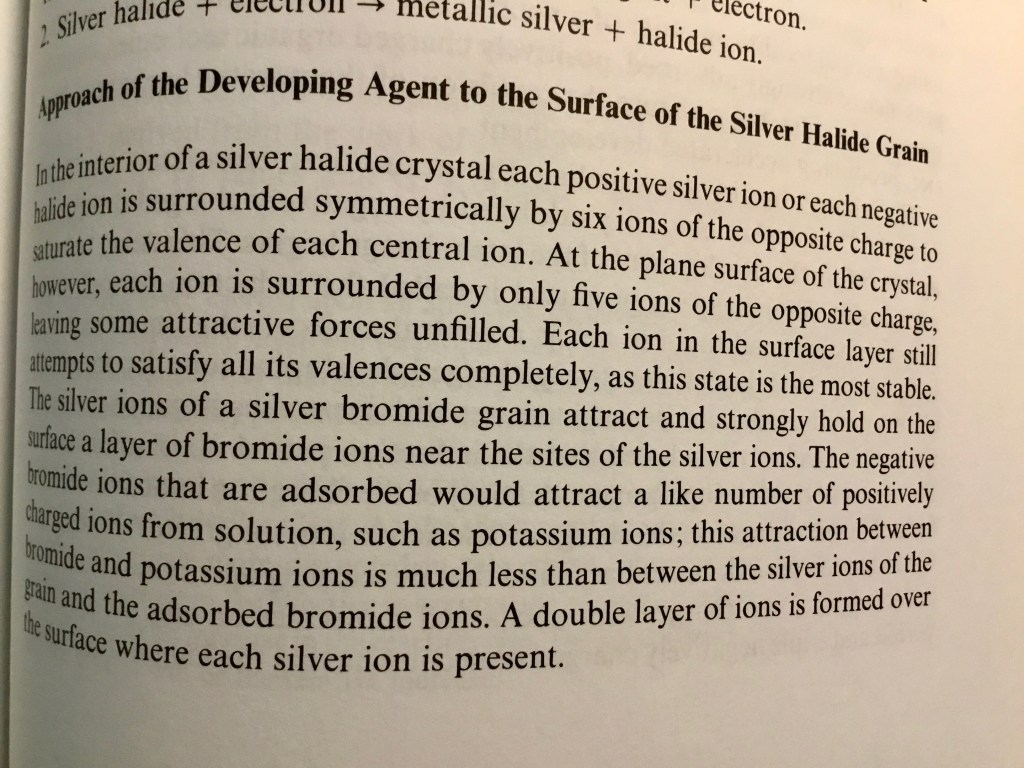
from Haist
L.F.A. Mason:
approach of the developing agent to the surface of the grain.
adsorption of the developing agent to the grain surface
transfer of an electron from the developing agent to the latent image sight
conduction of the electron through the latent image speck
combination of the electron with a silver ion from the grain
deposition of the silver atom to enlarge the latent image
movement of other silver ions through the train toward the latent image site, leaving pits on opposite side of grain surface, where bromide ions are liberated
That is the way to developed silver, no matter how the magic soup is concocted — the magic brew never makes a silver bullet — merely a speck of silver and residue. This process proceeds in three dimensions: from the top of the emulsion downward. Like a sponge absorbing water. The agitation cycle, particularly the initial portion is the key to smooth development. In with the good chemical, out with the exhausted chemical. The breath of life for a silver born image.




You must be logged in to post a comment.