Azo Zombie?

azo.jpg

Kodak Azo was discontinued in 2005. It was in production longer than Kodak Dye Transfer products. Monochrome outlived color. Just a tiny part of the tale.

Texture Sheen Tint Contrast

Azo came in most surfaces and weights; it was used widely because it was cheap and constant across so many types of surface. Deckle edged postcards, cheap studio proofs, or retouching prints for advertising agency work — all could be done on Azo.

Amidol was also easy to buy during that day. Drugstores sold it in glass tubes, ready for processing film or paper. Only Kodak’s Vitava Opal came in more configurations.

When a favorite paper drops dead what are members of the Silver Circle to do? Make it themself or sponsor someone else to make some.

Smith & Chamlee, of the workshop world, chose the latter. Other workers gladly coat small runs learned while workshopping their craft sense at places like George Eastman, and Photographers Formulary. Chloride papers are easy enough to coat, but clearly this is small scale demand, which isn’t a problem for people who hold to their belief that the longer something takes to do the better it is. Self coaters are the slow dry painters of photography.

Lodima Dreams

A new company and identity was introduced in response to the Kodak discontinuation of Azo. Photographers Michal Smith (MAS) and Paula Chamlee bought much of the Azo stock, going so far as being the last Kodak dealer for its sale. As demand dropped for all photo papers, Kodak, in trouble, dropped its black and white darkroom papers. Smith and Chamlee sought a producer of a replacement paper suited to contact printing – their preferred mode of print production.

Constructing the details of these progressions hasn’t been straightforward. I’ve collected posts from multiple web sources – some of which had to be retrieved from archived crawls. The posts on Photrio (nee Apug) and Large Format (LFPF) remain available (10/17).
elementsOfPrintingLodima.002
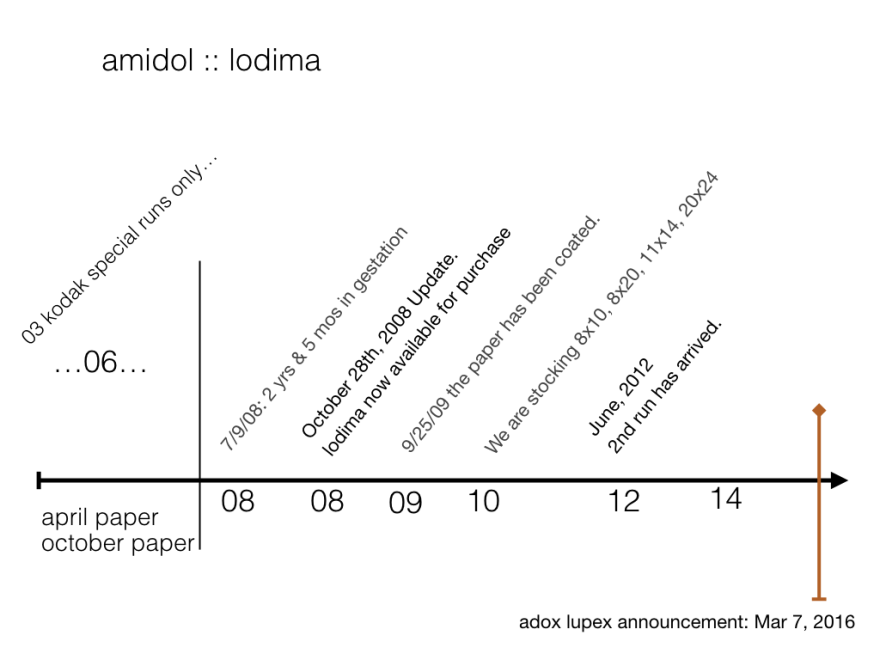
lodima timeline


Azo paper goes well in amidol developer; so much so that several onliners preach that you can only achieve nirvana when both are present. I’m a heathen. Amidol is nice, but not exclusively so, but then, azo (chloride) paper isn’t perfection in silver. They are just what they are: one way across the field.

Kodak, in their azo publication, indicated developing in Dektol 1:2 for 1 minute; that would have been the conventional processing for azo the last 20 years of its production and use. Graded paper can be “contrast” adjusted using divided, 2 tray, developing. Amidol is so active that a water bath suffices as the ‘other’ developer. I prefer using dektol 1:1 and an accelerator as the second tray.

current chloride papersI use amidol and have used lodima paper although my current contact paper is Adox Lupex – has been since April, 2016. Lodima, the paper and the company, don’t provide me any advantage over Lupex. In my procedures Lupex even liths. It also handles wet life better than lodima. Lodima comes in more grades, but Smith Chamlee cannot keep it stocked in grade and size offered on their price list which seems to be updated irregularly. In short, as business, Lodima paper is the sideline of Smith Chamlee workshopping business.

Michael Smith draws much fire from online fora – LFPF as example. That would usually earn him points on my card, however, what I see his success, his contribution to my community of photographers to be is: publishing. I’ve met him twice in 30 years, and only corresponded with him twice – once when I ordered paper he didn’t have; the other time was a request for confirmation about work he may have made. The business conversation went better.

Smith Chamlee have survived the years since Asilomar ’75 by selling simple solutions to the easily influenced junior photographers. He is a businessman who has succeeded by turning his life into a tax deduction. His contribution to artists is as a book publisher, and paper vendor to a few of the lesser imagists of the past 20 years.


webionaire links AMIDOL CHLORIDE PAPER

[2 of 3: Nov 7, 17]

Amidol Tales

The elixir, or the light… or just a developer that stains everything; these days it makes a great hair dye.

A REASON: amidol developer permits ‘water bath’ development better than any other common developer. A water bath is a second tray with only water; this is used during development as a control and evaluation step. Develop in amidol, then put print into the water tray. Examine the print [under safelight] for density & contrast. Return the print to the amidol tray is more density is needed.

Amidol was a developer used by the Cahoona Weston – that alone makes the tripod carrying acolytes tremble. If you don’t have his life, his world, his meaning, at least you can have his method. Big Bad Amidol and Big Bad Camera. I consider this chicken bones; there is no magic in the ash.

The workshop world is filled by takers being taken.

amidolstory.001.png
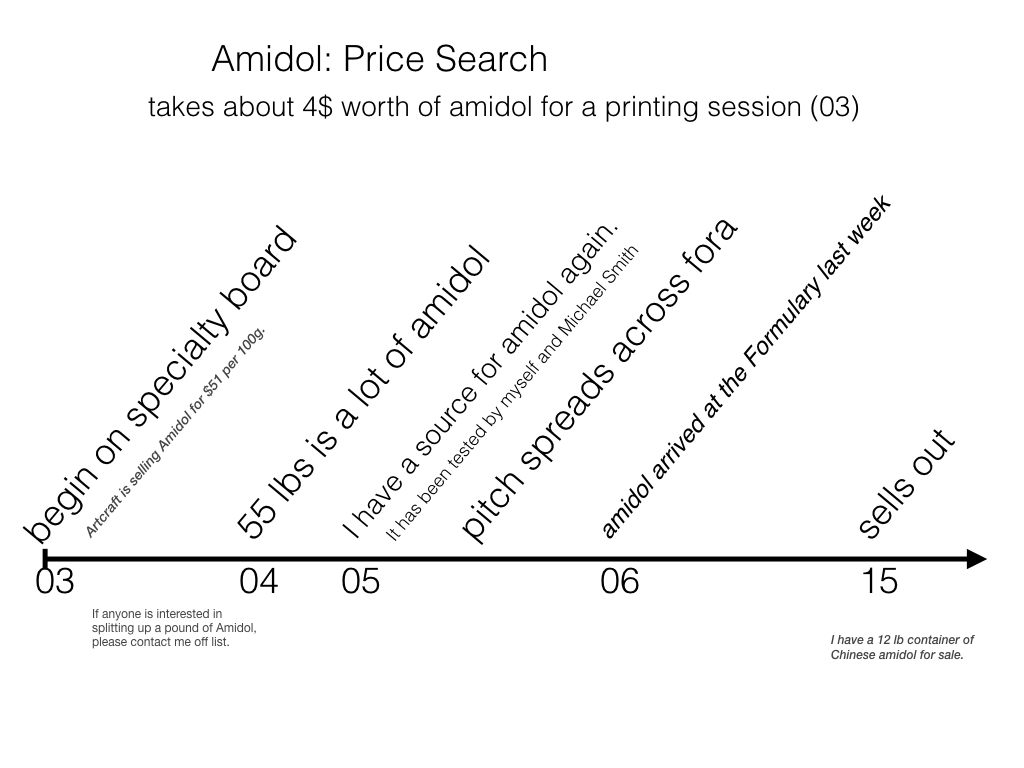
chinese amidol

It took 3 years to get the amidol. A lot of hours, effort away from that drive toward meaningful art. It was 9 years later that G. Davis sold off the big barrel. Hope it was worth it. Was he just converting excess to cash, or taking a wiser cash position of a failed dream. Why couldn’t Bud at formulary take it? Probably because they couldn’t sell it either. There is no magic in leftover history, not even the remains of chemical induced zealotry .

Why Oh Why

their motivation wasn’t to save money. that may have been a rational catalyst, but the effort was maintained by some other commitment. Even the commitment to save money was prompted by their need to use the product. What was that need+drive is a much more interesting topic to me

The time and social energy expended had to have some reward, otherwise they are just drained, wasted flow away from an esthetic drive. The simple fact is that the work of Smith and Chamlee is easy bake – the questions they are solving are elementary. Davis has provided a small set of results that edge into beginning terrain, but they quit, having no updates or expansion in years. Perhaps his energy failed him – his techno quest faltered, faith failing him. His sig lines call us toward biblical lands of Matthew and salvation – hard to hold onto a barrel of hair dye if Jesus is calling the faithful and you’re left behind.

take aways:

  • No silver bullet. No magic christian.
  • In search of price. Searching for the silver bullet.
  • Silver users in search of the perfected cheap bullet.
  • After the magic bullet instead of the magic.
  • buying their magic instead of making it.

References & Notes:

amidol supply:

people:

webionaire links AMIDOL CHLORIDE PAPER

[1 of 3: Nov 6, 17]

Paper: Flash or Burn

flash and bump exposures in the darkroom

Photography is a compression algorithm; a form of making smaller, of reducing without losing meaning.

The Hard Scenes

snow, big blank grey sky, interiors with bright window – these are challenging for the tone, the detail as meaning art practiced by most photographers. Photographers pride themselves early in their efforts in bringing ‘detail’ to art- details are the truth, but a devil to manage.

Photography is always a demonstration and an example.

Pre flash’increases’ sensitivity – gets the exposure started

Post flash ‘decreases’ contrast – adds (visible) tone to the highlights. Shadows are also affected, but those at maximum black can’t get darker. The deep grey shades are darkened, but this may not be noticed, or important to the image effect.

In general viewers respond in stages to the picture. First, they see overall object, with inspection they move to detail – most people approach pictures with notions based upon their ability to produce, therefore they are naive, taking cues from their “what is it” approach from pre-school life. With maturity they can move beyond what can be done by them; beyond hand waving or finger pointing.

vcPapersBumpNeg.001
overview motivation

pre-exposure and post-exposure. We mean non-image producing exposures; those made without a negative in the light path. I was taught that they were called:

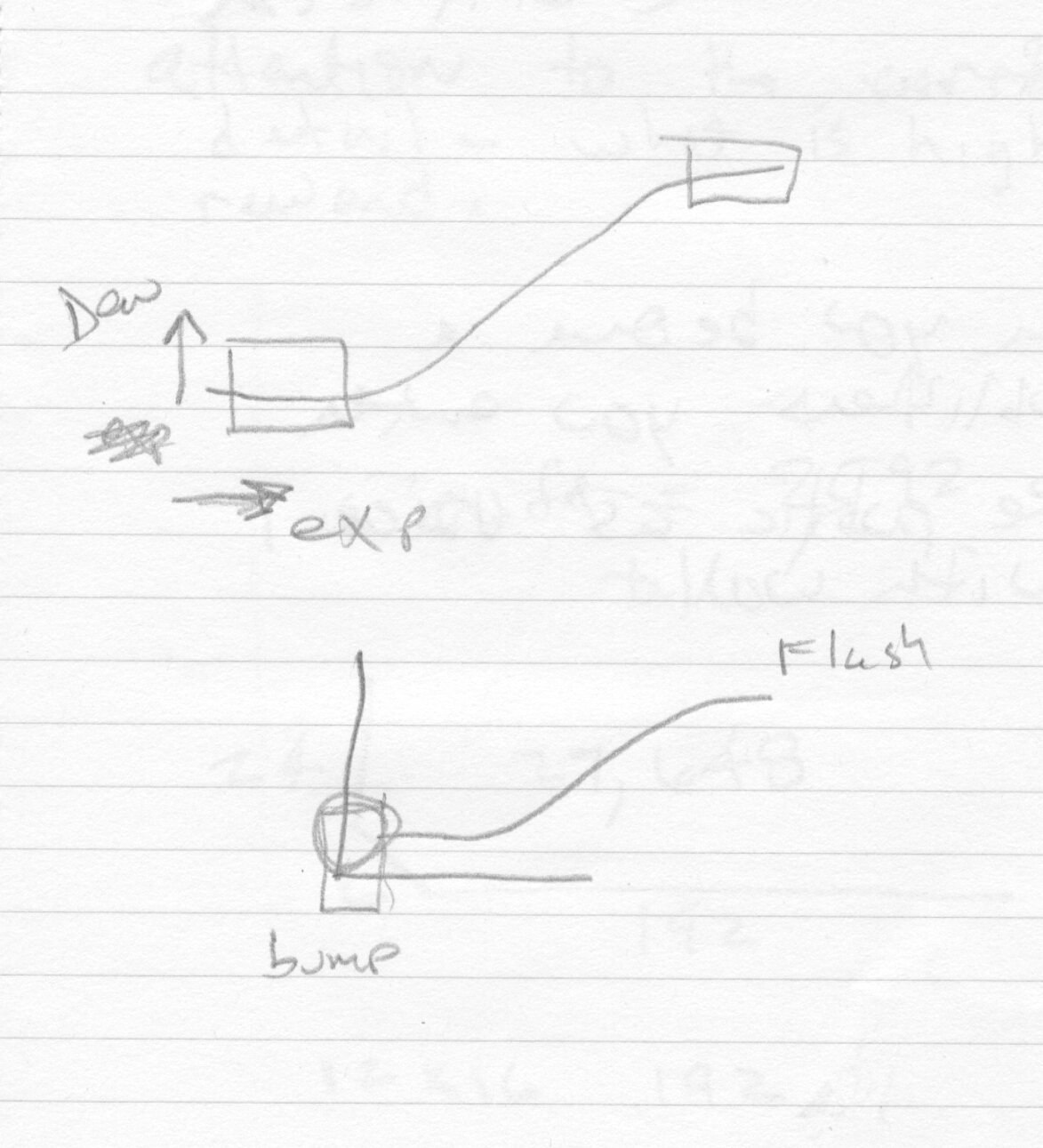
  • bump: those pre-exposures which raise the sensitivity of the emulsion. overcoming the ‘inertia’ – lazy halides are awaked just before ‘dawn’
  • flash: those post image exposures. lower the contrast of the emulsion. this drops the highlight down the the curve

With bump raising the shadows up the curve, and flash lowering the highlights down the curve, we get a longer straight line image; more linear. This linear image is what a digital sensor provides. Straight line, not S-curved response.

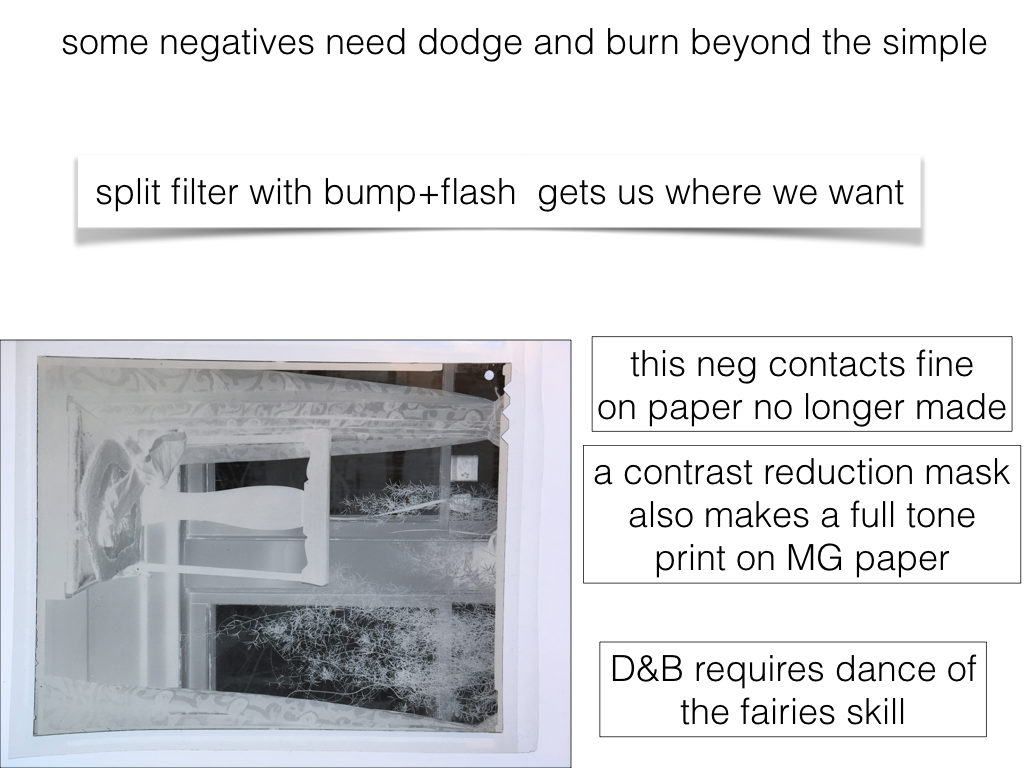
Burning in the highlights, those dark negative areas, may take many hits of the timer. They also may seem to never bring out image detail. This is the opportunity to bring out more filters with multigrade paper. It also may signal the need for “bump” and/or “flash,” exposures.scn_BumpFlasht

The exposure light is most often the enlarger light; just remove the negative – fiddle and go. You can also use a small penlight, or digital controlled led like those made by RH. The color of the light has some effect, but the key use of a color flash is to hit a Red safe emulsion with an OC filter safelight. This is a very effective highlight pickup. Slavich paper, and litho film, exposed for 30 seconds to an OC filter at 3 foot drops almost another grade of contrast, most visibly in the highlights – perfect way to bring in detail that is difficult to burn in without that tattle tale grey featureless tone.

I’ve tested the color of light used for multigrade and have been unable to measure significant difference to 0 or 5 filters. Some, but not enough to warrant the change. Instead I usually bump with the filter I’m going to first expose with, and flash with the filter I just exposed with.

How Much: using Ilford MG fiber paper base exposure of 8 seconds, a 3X burn-in was replaced with a 3second ‘bump’ and a 5second ‘flash’ – giving details in the highlights that the burn hadn’t given. In other words 3 burns was just a waste of non-image forming exposure. The bump and flash equal to one burn provided image definition in the highlights. This process also made the edition of prints easy, and repeatable.

A Digital Way

With a digital process, the flash/burn doesn’t happen – isn’t used, since changing numbers is done in other ways. Ways such as luminosity masks; tonal overlays; local mask with additional manipulation. Even pulling into one image elements from different exposures. This can be done using dedicated HDR tools, or blunt force select, adjust, copy, paste actions.